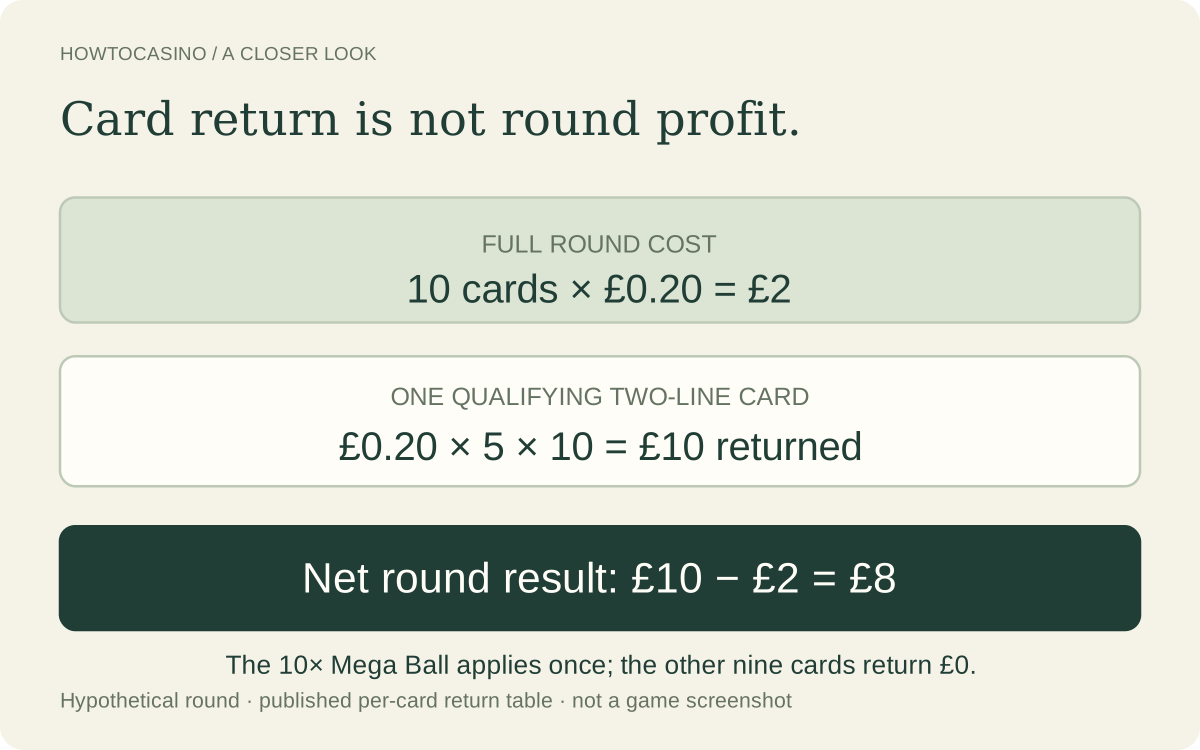
What happens to the cards during a round?
This guide describes Evolution’s original live Mega Ball, not a national lottery or a different ball-draw game. The inspected public live rules use a 5×5 card with 24 different numbers and an already marked free centre. Five marked squares in a row, column or diagonal complete a line; the centre counts wherever that line crosses it.
- During betting, choose a card value and the number of cards. Check the total cost before confirming.
- After betting closes, 20 balls are drawn from the 51-number pool and matching card numbers are marked.
- One or two Mega Ball stages follow, each with a multiplier and an additional ball.
- The final completed lines and any eligible Mega Ball multiplier determine the award on each card.
- Add the returns from all cards, then compare with the cost of the whole round.
The 51 is the number pool, not a promise that every ball will be drawn. A second Mega Ball is an additional draw in the same round; it does not start a new 20-ball game. Numbers are marked automatically in the documented online version.
A 5×5 card has 12 possible straight line paths: five rows, five columns and two diagonals. That does not mean all 12 will be completed in this shorter draw. Sky’s public rules describe up to nine completed lines. A paytable’s “6+” tier is also not an instruction to add a separate award for every line.
How much does a Mega Ball round cost?
The selected price is per card. Ten cards at 20p cost £2; twenty cards at 10p also cost £2. Neither is a 20p or 10p round. A screen full of cards can obscure that simple multiplication, so use the displayed total bet.
| Hypothetical selection | Per-card price | Full round stake |
|---|---|---|
| 1 card | 20p | £0.20 |
| 10 cards | 20p | £2.00 |
| 20 cards | 10p | £2.00 |
More cards add more paid entries, not certainty of a winning line or a profitable round. Repeated rounds add further cost: five £2 rounds stake £10 in total, even if some cards return money along the way.
Do not assume a universal card maximum or pound range. Evolution’s public overview itself gives both 200 and 400 cards in different passages, while operator descriptions differ. Use the limit in the exact game’s current Help and Bet Limits. The examples here are arithmetic, not confirmation that a named operator accepts a particular card value.
When does a Mega Ball multiplier count?
Evolution describes a randomly generated multiplier from 5× to 100× before the corresponding Mega Ball draw. The number must participate in a completed line on the card for the bonus multiplication to apply. Merely seeing a 100× announcement does not multiply every card.
The qualifying multiplier applies to that card’s payout. If its number completes both a row and a column, use the resulting line-count award and one multiplier. Do not multiply by 10× twice because the same number sits at an intersection.
Where more than one Mega Ball is in winning lines on the same card, only the highest eligible multiplier applies. Two eligible multipliers of 10× and 25× mean 25×, not 35× and not 250×. Another card has to qualify on its own; the multiplier does not automatically spread to the rest of the purchase.
A Mega Ball number that does not make part of a completed line is just a marked number for that purpose. Its announced multiplier is not a separate cash prize. The examples below assume the stated lines are completed; they do not estimate the chance of doing so.
How do line awards translate into a return?
BetVictor’s GB public Mega Ball page publishes the following base return multiples of the stake per card. This is an attributed public table, not a logged-in inspection of every GB configuration. Check the table in your exact game before using it for a real settlement.
| Completed lines on a card | Published base return multiple, before any Mega Ball multiplier |
|---|---|
| 1 | 1× |
| 2 | 5× |
| 3 | 50× |
| 4 | 250× |
| 5 | 1,000× |
| 6 or more | 10,000× |
These are returns including the stake component, not net profit odds. Sky’s fuller rules describe one line as a push: at 20p per card, an unmultiplied one-line result returns 20p and makes no profit on that card. A 5× return on 20p is £1 total, equivalent to 80p profit on that card before considering other cards.
Use the final line-count tier once. A two-line card takes the 5× base tier, not 1× plus 5×. If an eligible 10× multiplier applies, the return becomes 5× × 10 = 50× the card price. At 20p, that is £10 returned; do not add the 20p stake a second time.
The same information may be displayed as profit odds instead: a 5× gross return corresponds to 4:1 profit odds. Mixing these conventions produces the wrong answer, especially when a bonus multiplier is applied.
Three complete pound examples
These invented rounds use the published return table above, assume no other cards pay, and omit promotional credit, deductions and payout caps. Their purpose is to distinguish a card award from the result of the whole round.
| Round | Calculation | Return and net round result |
|---|---|---|
| 20 cards at 10p; one card has one line, no qualifying multiplier | £2 staked; £0.10 × 1 = £0.10 returned | £0.10 − £2 = £1.90 loss |
| 10 cards at 20p; one card has two lines and a qualifying 10× Mega Ball | £2 staked; £0.20 × 5 × 10 = £10 returned | £10 − £2 = £8 profit |
| 10 cards at 20p; one card has two lines containing eligible 10× and 25× Mega Balls | £2 staked; £0.20 × 5 × 25 = £25 returned | £25 − £2 = £23 profit |
In the first example, a 100× Mega Ball elsewhere would not change the result if it is absent from that card’s winning line. The card has pushed but the round has lost £1.90 because the other nineteen cards cost money and returned nothing.
For the second example, imagine a row and column both missing their shared square numbered 4. If Mega Ball 4 fills it at 10×, two lines complete, but that multiplier applies once to the card’s 5× base award. The £10 return is 50× one 20p card, but only five times the £2 round stake.
For the third, suppose the first Mega Ball completes one row at 10×, and the second completes another at 25× on the same card. The final two-line award uses the higher 25× once. It does not add both line tiers or multiply the two Mega Ball multipliers together.
Is First Person Mega Ball the same as live Mega Ball?
Evolution describes First Person Mega Ball as an RNG version with a virtual draw. Live Mega Ball is presented with a host and physical ball machine. First Person was announced alongside the live game in April 2020; it is not evidence of a later sequel with identical operator settings.
Similar names also need care. Lightning Ball and Crazy Balls are separate Evolution titles with different draw structures and features. Do not borrow their number pools or bonus rules for original Mega Ball.
For an overview of the format, read our live casino game shows guide. A live video stream identifies presentation, not the stake you bought, the result of your card or the applicable paytable.
If the game you saw included MONOPOLY cards and a board-game bonus, use our MONOPOLY Big Baller guide instead. That is a different named game, with its own entry conditions and card rules.
What should you check before play or when a result looks wrong?
- Exact game title and live or First Person version.
- Price per card, number of cards and total bet.
- Current line-return table and whether figures mean total return or profit odds.
- Mega Ball qualification, any maximum payout and the rules for connection loss.
- For GB play, the operator’s active Gambling Commission permission for its exact domain.
We do not give one universal GB RTP or cash cap here. The inspected public pages disagree on card limits, and Sky’s header and rules show different RTP ranges. A public marketing description is not proof of the paytable installed in an account.
If a payment looks wrong, retain the round ID, card reference, full bet, completed-line result, Mega Ball numbers and multipliers, and the rule table used. A clip of the multiplier alone cannot establish a missing award. Ask support for the recorded card settlement; no real game, account or withdrawal was tested for this guide.
Related questions
Does a 100× Mega Ball multiply my whole bet?
It applies to the eligible card payout under the rules, not automatically to every card or the total amount spent. A card must qualify through its completed line; other cards settle separately.
Can a winning card still leave me losing overall?
Yes. Twenty 10p cards cost £2. If only one returns its 10p stake as a one-line push, the full round returns 10p and loses £1.90. Count the cost of every card, not just the one that paid.
Are two Mega Ball multipliers multiplied together?
No. Where more than one Mega Ball is in winning lines of the same card, only the highest eligible multiplier applies. The final card award is not multiplied by both.