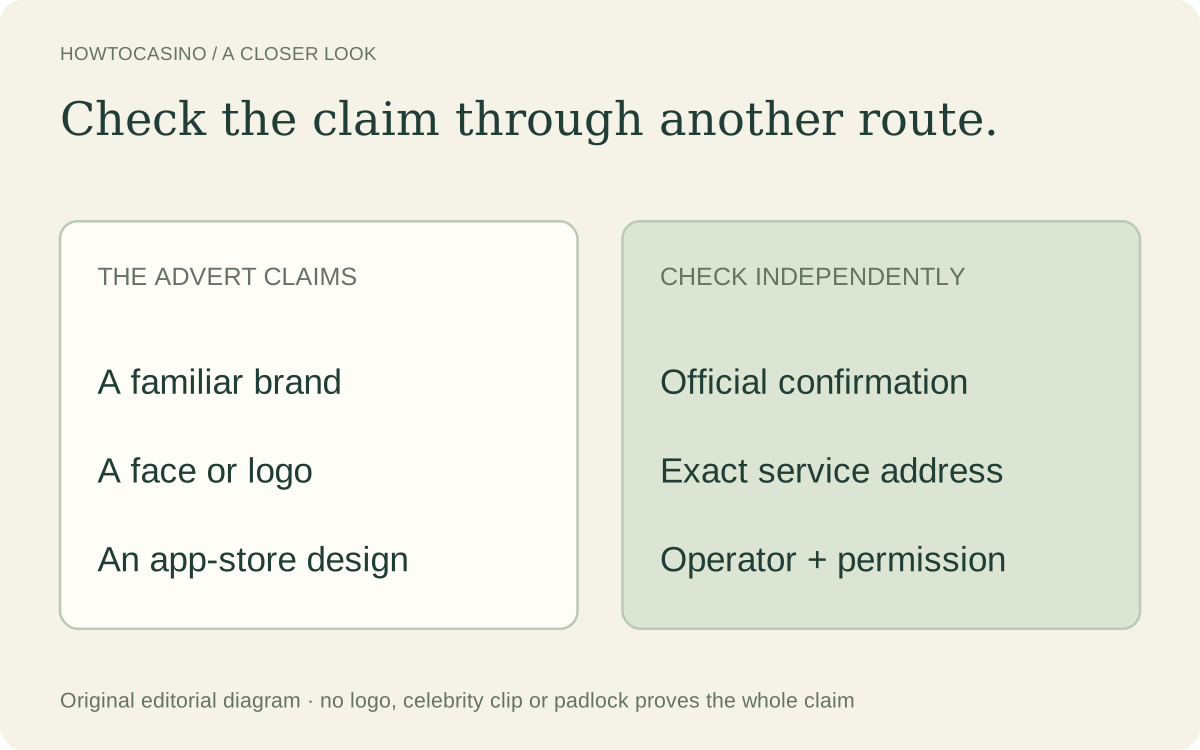
What exactly might a fake casino advert misrepresent?
Several claims can be bundled together: that a celebrity recommends a game, that a familiar business launched it, that an app page belongs to an official store, that a displayed prize can be withdrawn, and that the linked casino is authorised to serve Great Britain. Evidence for one does not establish the others.
A polished video can be synthetic or misleading without obvious spelling errors or visual glitches. Conversely, an unfamiliar design or awkward phrase is not proof of fraud. The useful question is whether the claimed identity and connection can be confirmed independently, rather than whether the advert looks convincing.
This guide is a protective investigation framework. It does not label every similarly named product or every advert featuring a public figure as fraudulent. A specific allegation needs evidence tied to the exact advert, address, date and claim.
Which checks are stronger than a logo or an endorsement clip?
| Claim in the advert | Independent check | Weak substitute |
|---|---|---|
| A known organisation launched the product | Open the organisation’s official app or independently located website and verify the announcement | Another advert repeating the same claim |
| A celebrity endorses it | Look for confirmation through that person’s verified official channels or representatives | A convincing face, voice or cropped news clip |
| This is an official app listing | Check the actual store, developer identity and service address through an independent route | An app-store-looking page reached from the advert |
| This casino may serve GB consumers | Match the legal operator, current status, exact domain and authorised activity in the UKGC register | A copied licence badge or a similar trading name |
| The website is safe because it uses HTTPS | Treat encryption as a connection property and still verify identity | A padlock presented as a casino approval mark |
Use a route you establish independently. An advert’s own support button, displayed address or apparent news page may be part of the same story. If a bank brand is used, contact the bank through its known official app or previously verified details; do not enter banking credentials into a casino-branded verification form.
The operator holds the relevant gambling licence. A domain record, trading name and white-label relationship need careful interpretation; a domain is not a product endorsement by the Commission. Our licence-check guide explains the record fields and the limits of what they establish.
What does the documented “Monzo Slots” example establish?
Netcraft’s investigation published on 2 July 2026 documented gambling adverts impersonating trusted brands, including Monzo. It observed fabricated launch announcements and imitation app-store pages leading to unrelated casino services. This is dated threat research, not our device or account test.
That evidence concerns the campaigns Netcraft observed. It is not a universal verdict on every later page or app with similar wording.
For a current Monzo-related claim, verify it through Monzo’s independently accessed official app or channels. The name in an advert cannot establish its own connection to the bank.
Does an app icon, store design or PWA prove the service is genuine?
No. The displayed name, icon, landing page and actual service destination can refer to different parties. An imitation store layout may be an ordinary website. A home-screen icon can open a web app rather than an app installed through the store whose appearance was copied.
That does not make Progressive Web Apps or every website installation prompt inherently fraudulent. The important questions are who controls the service, what was represented, what permissions or information are requested and whether the claimed connection is independently supported.
Do not install another file or pay a supposed release charge merely to test an unknown promise. Preserve the information already visible when practical, close the untrusted route and verify through official channels. You do not need to revisit a suspicious destination to make a report.
A service outside the national self-exclusion scheme also does not acquire GB permission from an app icon or an overseas licence. The separate GAMSTOP explanation distinguishes the marketing label, operator permission and an individual’s exclusion status.
What should you do if you already clicked, signed in or paid?
| What happened | Relevant next step | Do not assume |
|---|---|---|
| Only saw the advert | Avoid interacting; use the platform’s reporting control and retain a screenshot if already available | That a polished advert is independently verified |
| Opened a page without supplying anything | Close the untrusted route and avoid further interaction. On a computer, follow NCSC advice including a full security scan if available | That one click necessarily proves an account compromise |
| Shared a password | Use the genuine provider’s recovery or password-change route; change reused passwords and enable two-step verification where available | That changing only the suspicious site’s password protects other accounts |
| Shared bank/card information or paid | Contact the bank promptly using independently verified details; follow its account-protection and dispute process | That an advert report guarantees a refund |
| Installed software or suspect account access | Follow the appropriate official device and account-recovery guidance; on a computer, use a full security scan if available | That every device has the same cleanup procedure |
| Lost money or experienced hacking | Contact the bank where relevant and use the applicable crime-reporting route below | That a regulator or technical URL report replaces a police report |
NCSC’s advice separates these situations because the response depends on what was exposed. If the real account is inaccessible, use its provider’s recovery process through an independently verified route. Do not rely on an unknown “recovery agent” supplied by the original advert or give that person account access.
If identity documents were shared, record what was sent and use the appropriate official advice for the affected accounts and documents. A genuine casino’s need for verification does not mean an unidentified advert recipient is entitled to your documents. The identity guide explains the legitimate requirement after the service itself has been verified.
A possible recovery route depends on the payment method, circumstances and applicable rules. This page does not promise reimbursement or make a legal decision about a particular transaction. Contact the relevant provider promptly instead of paying further sums to an unverified claimant.
Where should a suspicious casino advert or website be reported?
| Concern | Official route | Purpose and limit |
|---|---|---|
| Paid online scam advert | The platform’s report control and ASA’s online scam-ad form | Advertising intelligence; not a guaranteed removal, personal reply or refund |
| Suspicious website address | NCSC scam-website reporting | Technical assessment and possible action; not a personal compensation claim |
| Fraud or cybercrime affecting someone in England, Wales or Northern Ireland | Report Fraud | The current police reporting service; an advert report is not a substitute |
| Fraud or online crime in Scotland | Police Scotland; official Scottish guidance gives 101 for non-emergencies | Use the appropriate police route; an ordinary suspicious advert is not an emergency |
| Suspected unlicensed gambling serving GB consumers | Gambling Commission’s official reporting route | Regulatory information; the Commission does not recover individual players’ money |
These routes were checked on 29 October 2026. Current official pages direct affected people in England, Wales and Northern Ireland to Report Fraud, rather than treating the older Action Fraud name as the current universal route. Scotland has a separate police reporting route.
Keep the advert’s date, platform, advertiser name, visible claim, exact address if safely available, payment reference and correspondence. Supply evidence through the relevant trusted channel. Avoid exposing full card numbers, passwords, identity documents or unrelated personal details in a public post or a general advert report.
The next step is to establish the exact claim and use the route that addresses it. A licence check, a bank dispute, a police report and an advertising alert answer different questions. None should be presented as an automatic recovery guarantee.
Related questions
Is a casino advert genuine because the platform accepted payment for it?
Paid placement alone is not independent confirmation of the advertiser’s identity, endorsement claim or GB gambling permission. Check those separately.
Does a celebrity video prove they endorsed a casino?
No. A face or voice can be imitated or shown out of context. Seek independent confirmation through the claimed person’s official channels; visual quality alone does not resolve it.
Is Monzo Slots an official Monzo product?
The name alone does not establish that. Netcraft documented Monzo-impersonation gambling adverts in its July 2026 research. For a current specific claim, confirm through Monzo’s official app or channels; this page is not a universal verdict on every similarly named service.
Are all web apps scams?
No. The technology alone does not establish fraud or authenticity. Verify the developer, actual destination, permissions and claimed connection through an independent route.
Will reporting an advert get my money back?
An advertising or technical URL report is not a refund claim. If money or banking information was involved, contact the bank and use the appropriate crime-reporting route as relevant.
Should I click the advert again to gather proof?
You do not need to revisit a suspicious destination. Keep information already available safely and use the official reporting channel without entering further personal data or downloading files.