Which Bigger Bass Bonanza rules does this explain?
This is the original Bigger Bass Bonanza, developed with Reel Kingdom and supplied by Pragmatic Play. The supplier overview identifies it as vs12bbb: five reels, four visible rows and twelve paylines. Big Bass Bonanza, Big Bass Splash, Bigger Bass Splash and Big Bass Bonanza Megaways are separate games. The word “Bigger” matters when matching a result to its rules.
The five-fish cash-line rule is stated in the supplier’s overview hosted by distributor BetConstruct. Fortune Games’ public GB guide independently describes the same distinction. Virgin Games confirms twelve fixed paylines, while O’Reels and MrQ provide public GB descriptions of Fisherman collections and retriggers. These are published descriptions; we did not open an account or inspect an installed game.
The overview is a worldwide supplier document, not proof of a British account’s RTP, stake menu, controls or maximum award. The explanation below concerns the identified fish-payment rules. For the settings that apply to a real result, keep the information panel supplied with that game.
Does a fish payment need a line or a collector?
| Situation | What can pay the printed fish values? | What to avoid assuming |
|---|---|---|
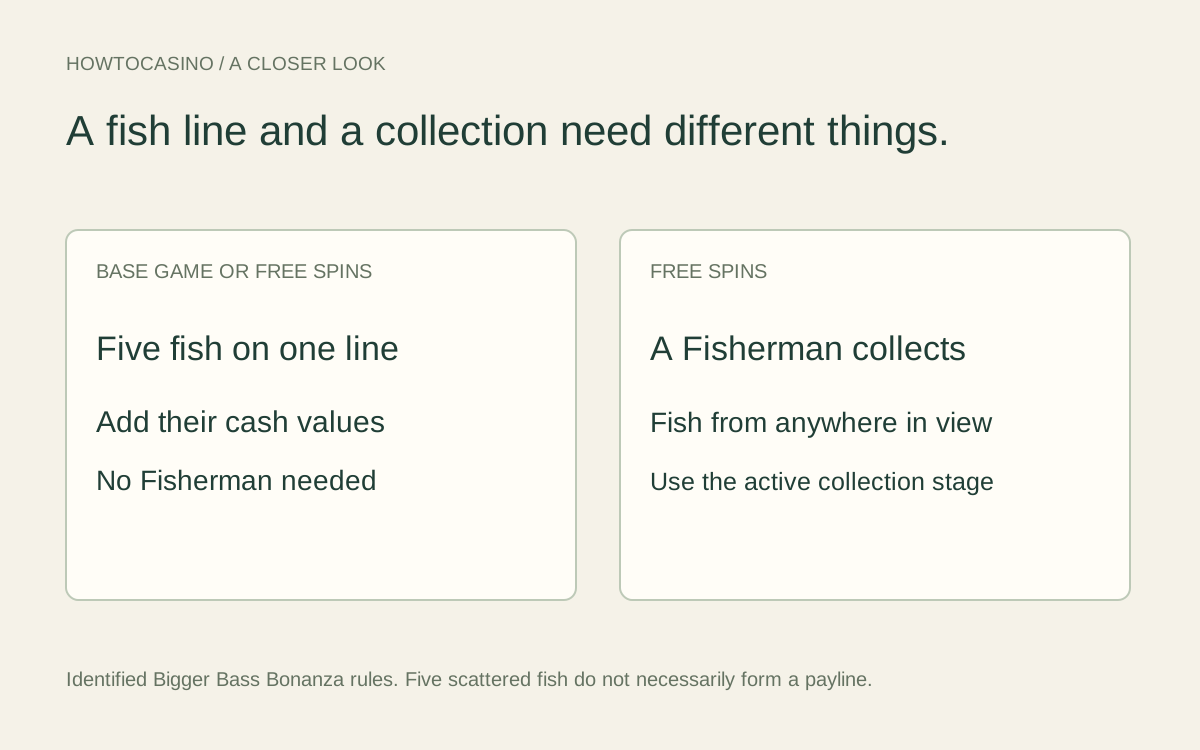
| Base game: five Money Fish on one qualifying payline | Their combined cash values pay without a Fisherman. | Five fish anywhere on the twenty-position grid are not enough. |
| Base game: three or four fish on a qualifying line | Their ordinary line award follows the paytable. | The printed cash tags are not automatically added as a separate money collection. |
| Free spins: a Fisherman appears with Money Fish in view | Each Fisherman collects the visible fish values under the feature rules. | The fish do not have to share one payline for this collection. |
| Free spins: five Money Fish on one payline, without a Fisherman | The special five-fish line still pays their cash sum. | The absence of a Fisherman does not cancel this separate line condition. |
A payline is a defined route across the reels. Five fish occupying different rows may form that route, or may not: inspect the actual marked line rather than count fish on the whole screen. A visibly straight row is not the only possible payline.
Likewise, failing the special five-fish rule does not mean the entire spin pays nothing. Three or four fish may qualify for their ordinary line payment, other symbols may form winning lines, and free-spin collections have their own condition. Read the award breakdown before calling the result a zero.
Five fish on one line: a cash-value example
Suppose the total stake is 60p over twelve lines, making the line stake 5p. For this invented result, assume all five positions on one qualifying payline show Money Fish with £1.20 cash tags. Assume no other winning line, cap or rounding adjustment. The special payment is the sum of those five already-cash values.
| Input | Calculation | Illustrated return |
|---|---|---|
| Five qualifying fish, each showing £1.20 | £1.20 + £1.20 + £1.20 + £1.20 + £1.20 | £6.00 for that fish line |
| The same five tags, but not on one qualifying line | The special five-fish cash-line condition is unmet. | No payment under that particular rule; assess any other awards separately. |
The £6 is already a cash amount. Do not multiply it again by the 60p total stake or the 5p line stake. Ordinary symbols may be explained using a paytable multiplier and a line stake; that is a different unit calculation. A heading saying “line wins” is not a reason to apply a stake twice to a displayed cash sum.
If your information screen expresses a fish value as a stake multiple rather than a cash tag, first identify what that multiple uses. For illustration, 2× a 60p total stake is £1.20. That conversion is needed once; if the display already says £1.20, it has already supplied the cash input. Our credits-and-coins guide explains why the same number can mean different amounts when the unit changes.
This example isolates one award. Its £6 return equals ten times the assumed 60p stake, but it is not a forecast of a bonus, average return or session profit. If other lines share some of these symbols, use the game’s settled breakdown to establish which additional lines paid rather than add the same recorded total twice.
What changes when a Fisherman lands during free spins?
During free spins, Fisherman Wilds collect Money Fish from anywhere in view. The collector rule is therefore broader than the special five-fish payline condition: three scattered fish can be collected even though they do not complete a five-fish line. O’Reels describes each Wild collecting the values, and the supplier describes collections using the feature’s current multiplier.
For separate hypothetical comparisons, assume three visible fish have raw cash values of £1.20 each: £3.60 in total before the collection-stage factor. Assume the stated stage is already active, each stated Fisherman collects those fish, and there are no other awards, limit or rounding adjustment. These are alternative calculations, not consecutive spins.
| Assumed collectors and active stage | Calculation of this collection only | Illustrated collection |
|---|---|---|
| One Fisherman at 1× | £3.60 × 1 collector × 1 | £3.60 |
| One Fisherman at 2× | £3.60 × 1 collector × 2 | £7.20 |
| Two Fishermen at 2× | £3.60 × 2 collectors × 2 | £14.40 |
These inputs are expressly before the stage multiplier. A screen or history entry may instead show an amount after the factor has been applied. Check its label before multiplying again. The same caution applies to a settled round total that already includes line awards and collections.
A Fisherman also acts as a Wild under the published substitution rules, excluding Scatters. A line involving that Wild and a money collection are separate award mechanisms. When checking a real result, use the game’s itemised explanation to establish which payments have already been included; do not reconstruct the whole return from a single large number.
Do the meter, dynamite or hook guarantee a larger catch?
No. Three, four or five Scatters trigger 10, 15 or 20 initial free spins in the published model. Fishermen collected during the feature advance the meter; every fourth earns ten more spins, progressing through 2×, 3× and a final 10× collection stage. The supplier overview says the additional batch follows the remaining spins in the current batch. The new factor does not retrospectively reprice an earlier fish line or collection.
The third retrigger is the final one in O’Reels and MrQ’s public descriptions. Reaching the top stage does not mean every later result has fish and a collector. A multiplier increases an eligible collection; it does not create a payment where its condition is absent.
The supplier overview describes two random events when a Fisherman lands without fish to collect: dynamite can bring fish into view, and a hook can attempt to recover fish below the screen. Neither is promised on every empty catch. MrQ also describes conditional extra fish when one Wild is present, rather than an automatic award for every lone Fisherman.
A passing fish, an animation below the grid or a nearly full meter does not establish a payable amount or show that a later paid spin is due to recover a loss. The consulted documents do not supply the event probabilities needed to calculate an average catch or a reliable trigger interval.
What to record if a fish payment looks wrong
- Match the complete title and, where available, the model or version. Do not use a Big Bass Splash or Megaways screenshot as Bigger Bass Bonanza’s paytable.
- Record whether the result was base play or free spins, the total stake and the units used for fish tags.
- For a five-fish cash-line question, identify the actual payline and the five positions on it. A whole-grid fish count is insufficient.
- For a collection, record the Fishermen, visible fish and active stage. Distinguish a remaining current batch from newly awarded spins.
- Check whether each displayed figure is a raw tag, an individual collection, a spin total or the settled feature total. Do not add a component to a total that includes it.
- Keep the round ID, time, relevant information-panel text and settled history before asking the casino to explain the specific award.
A game page or foreign demo cannot establish the configuration served to your account. Check the information panel supplied with the game for its RTP and payout limits. The original Big Bass Bonanza free-spins guide explains that game’s meter timing; its values should not replace this sequel’s rules.
If you want to check an operator rather than a fish calculation, use our Pragmatic Play availability guide and the individual casino review to inspect the relevant GB service and licence. A supplier relationship or public listing does not guarantee that this exact title is available to every account today.
Related questions
Do three or four Money Fish pay their printed cash values?
Not merely because they carry cash tags. In the consulted model, three or four fish can receive their ordinary qualifying line award; the special sum of printed fish values needs five on one payline. Free-spin Fisherman collections use a separate condition.
Can five fish pay during free spins without a Fisherman?
Yes, if they form one qualifying payline. The supplier overview explicitly applies the five-fish cash-sum rule in base play and free spins. Five fish scattered around the grid do not automatically form that line.
Does the collection multiplier apply to every line win?
The documented stages increase Fisherman money collections. Do not apply that factor to every ordinary line or retrospectively to earlier payments. Use the loaded game’s award breakdown to check what is already included.
Is Bigger Bass Bonanza the same as Big Bass Bonanza Megaways?
No. This guide identifies the original Bigger Bass Bonanza model vs12bbb, with five reels, four visible rows and twelve paylines. Megaways, Splash and the other similarly named sequels need their own game rules.