How do denomination, credits, coins and bet level differ?
A credit is a unit. Denomination supplies its stated money value. A coin can be another name for that unit, but the label is not universal: a coin symbol appearing on the reels can be a feature symbol rather than a unit of account. Read the definition attached to the number.
| Term | Question it answers |
|---|---|
| Denomination or credit value | How much is one cash-valued credit worth? |
| Credits wagered | How many units does this figure count: one line or the entire round? |
| Bet level | Does the game use another multiplier when calculating the stake? |
| Total bet or total stake | How much money is committed for the complete stated round? |
| Balance in credits | How many units represent the balance under that display’s rules? |
| Credit or coin award | Is this an already calculated return, a paytable unit or a feature counter? |
OLG’s PlaySmart physical-slot guide uses denomination for a credit’s cash value. That Canadian educational source helps explain the terminology; it does not supply GB law or prove that a named online game offers those settings. PokerStars’ public coin-value help uses a particular line-stake and bet-level model. Its published example is not evidence of a current playable GB catalogue or a universal slot interface.
The meaning must therefore come from the exact title and help, rather than from a label borrowed from another machine. Our general rules guide explains where to find payout conditions and version information.
How do you calculate the complete stake in pounds?
Once you know the total number of cash-valued credits committed to the round, multiply it by the value of one credit. In a game that separately specifies equal credits per active line, first calculate the total credits across those lines. These are two ways of describing the same stake, not multipliers to apply one after another.
| Separate description of an invented configuration | Calculation | Round stake |
|---|---|---|
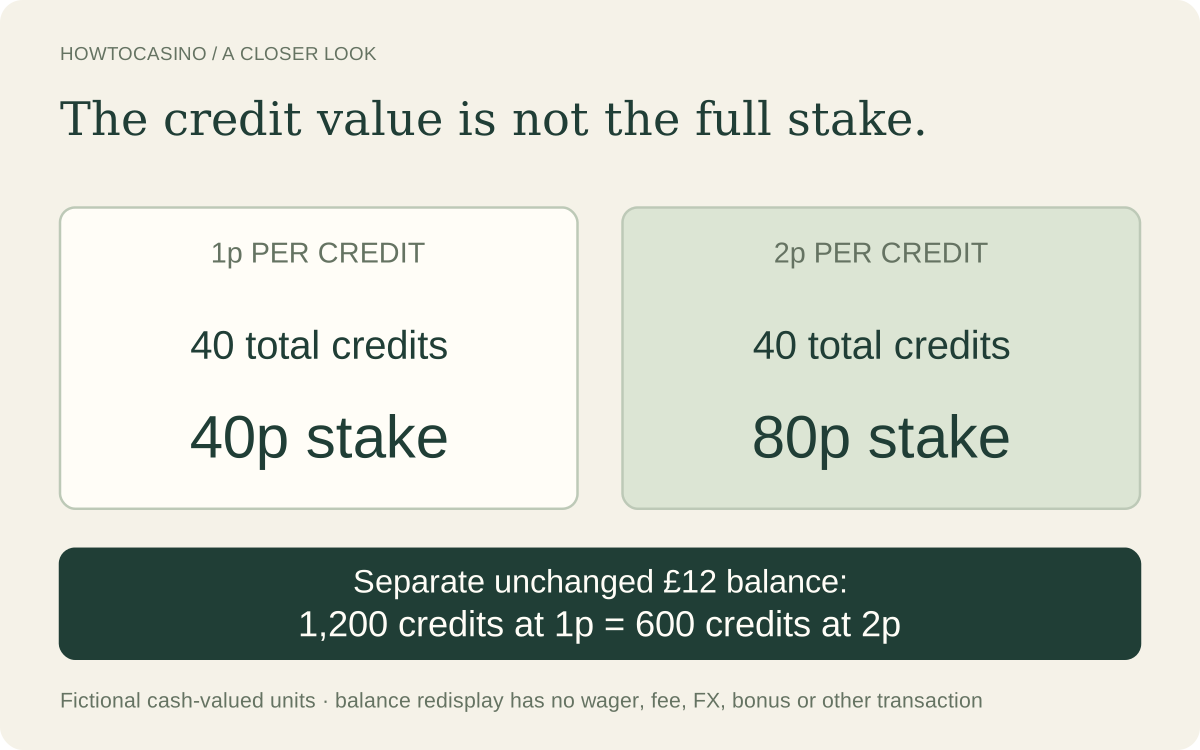
| 40 total credits at 1p each | 40 × £0.01 | £0.40 |
| 20 active lines, 2 credits per line, 1p per credit | 20 × 2 × £0.01 | £0.40 |
| 40 total credits at 2p each | 40 × £0.02 | £0.80 |
The first two rows describe the same 40p configuration. Multiplying the already-total 40 credits by 20 lines again would incorrectly produce £8. A ways count, reel count or number of symbols is not automatically another stake multiplier either. Some games show only a total money stake and need no credit conversion.
In the line model, bet level may be included in the credits-per-line figure or shown separately. Apply it only as the help defines it. If the displayed total and your calculation disagree, keep the units and settings, then ask the operator to explain the difference before staking.
The payline guide covers active paths and line awards in depth. This calculation assumes an equal-line model, no extra wager and no fee; it is not a claim that every slot uses selectable lines.
Why can a credit balance halve without money being lost?
A change in the display unit can change the number of credits representing the same cash amount. For example, assume a £12 cash-valued balance is only being redisplayed, with no wager, award, fee, currency conversion, promotional restriction or other transaction.
| Display value of one credit | Credits representing the same £12 | Next wager if it uses 40 total credits |
|---|---|---|
| 1p | £12 ÷ £0.01 = 1,200 credits | 40 × £0.01 = 40p |
| 2p | £12 ÷ £0.02 = 600 credits | 40 × £0.02 = 80p |
The balance is still £12 in this example. The next 40-credit wager would cost twice as much under the second setting, so an unchanged credit count does not imply an unchanged price. This is an explanation of units, not evidence that every game supports denomination changes or automatically preserves every other setting.
Check the cash figure and transaction record if the balance changes unexpectedly. A game-state change, a credit display and an actual debit are different observations. Do not assume an unexplained decrease is merely a harmless redisplay; reconcile it against the actual ledger.
How do credits, line multipliers and total-bet multipliers pay?
First establish whether the prize is a stated number of credits or a multiple of a particular stake. The following are three different fictional paytable rules, not three awards to add together. Each assumes the same 40p total round stake: 20 equal lines at 2p each, with a 1p cash-credit value and no other award.
| Different fictional rule | Total cash return | Net result after the 40p stake |
|---|---|---|
| 80 cash-valued credits already awarded | 80 × £0.01 = £0.80 | +£0.40 |
| 80× the 2p line stake | 80 × £0.02 = £1.60 | +£1.20 |
| 80× the 40p total stake | 80 × £0.40 = £32.00 | +£31.60 |
The numeral 80 does not identify the calculation base. Do not multiply an already-calculated 80-credit award by the line count or bet level again unless the exact rules say that figure still needs that adjustment. A return includes whatever stake element the rules define; net result is total money returned minus the complete stake.
For the same invented 40p round, no award gives a 40p loss. A 10-credit total award at 1p returns 10p and leaves a 30p loss. A 40-credit total award returns 40p and breaks even. An 80-credit total award returns 80p and gains 40p. These examples describe accounting, not the probability of those results.
Starting from the separate £12 cash balance, a 40p stake and 80p total return would leave £12.40. Do not add another 40p stake refund unless the rules and actual entries show it separately rather than already included in the return.
Does a penny denomination mean a 1p spin or better odds?
A penny label can refer to one unit, rather than a complete spin. Forty 1p credits cost 40p. In North American examples, penny commonly means a one-cent unit in that product’s currency, not a British penny or a currency conversion. A label in a review does not establish a current GB minimum stake.
Do not import a physical machine’s coin, ticket, jackpot or maximum-bet rules into a GB online title. Online games can use fixed total stakes, line units or other defined models. Their actual help and configuration determine the price and award rules.
Denomination alone does not establish RTP, hit frequency or a future result. If only the cash unit is scaled under otherwise identical rules, the money values scale; that assumption must not be extended to another title, paytable or feature configuration. A larger possible pound prize also does not by itself demonstrate better chances.
Our RTP guide explains the long-run percentage, while the volatility guide covers the spread of results. Neither figure becomes a prediction because a game uses a particular credit value.
For GB online slots, the current per-cycle maximum concerns the total amount staked: £2 for adults aged 18–24 and £5 for those aged 25 or over. A 1p credit label does not replace that total. These maximums are not suggested stakes, personal budgets, deposit limits or rules for every physical machine and table game.
Does a credit balance mean withdrawable cash?
Only interpret a credit as cash-valued where that mode and account actually define it that way. No-prize demo units are virtual; promotional credits can have separate conditions. An account’s available cash, restricted reward and unfinished feature counter are not interchangeable just because the interface shows a number.
The demo guide explains why a no-prize balance cannot be converted into a withdrawal. The bonus-terms guide deals with promotional credit and eligible winnings. Even a correctly converted cash amount does not independently prove that a particular withdrawal has been requested, approved or received.
GB transaction standards require clear information about money committed and conversions to credits or tokens, with relevant currency amounts and stake information. Applicable rules and payout information must be accessible before commitment. Those are requirements, not our certification of an individual game’s display.
- Identify the exact game, mode and account/product currency.
- Read what one credit or coin represents and whether the credit count is per line or total.
- Check the complete stake, any separately defined level and the precise prize unit.
- Compare actual balance changes with the accepted stake and total return.
- If something does not reconcile, preserve the time, round ID, settings and ledger, then ask verified support for the calculation without buying another spin.
If the result is missing after a disconnection, use the interrupted-round guide. A blank screen or feature counter needs round-state evidence as well as unit arithmetic.
Related questions
What is a denomination in slots?
It is the stated cash value of one credit in a game using cash-valued credits. Full round cost also depends on how many credits are committed. Virtual or promotional units need their own mode and balance definitions.
How much is 100 slot credits in pounds?
It depends on the defined value and credit type. At 1p per cash-valued credit, 100 credits represent £1; at 2p they represent £2. No-prize demo credits do not become pounds through this calculation.
Do penny slots cost exactly 1p per spin?
The label alone does not establish that. If a round commits 40 credits worth 1p each, it costs 40p. Check the actual total stake and currency rather than inferring a live minimum from a nickname.
Should I multiply total credits by the line count?
Not if the credits already represent the whole round. In the fictional example, 40 total credits at 1p cost 40p. Twenty lines with two credits per line describe the same 40 credits, not another multiplier.
Does changing denomination improve the slot’s RTP?
That does not follow from denomination alone. Check the exact configuration and chance information. A higher cash value or larger prize display is not evidence of better probability or a due win.
Why did my balance fall from 1200 credits to 600?
If an unchanged £12 balance is merely redisplayed from 1p to 2p per credit, those counts represent the same cash. That is one hypothetical explanation, not a diagnosis: check actual currency, mode and transactions if the change is unexplained.