What does a slot max win actually mean?
Start by identifying the ceiling’s unit and scope. It may be a multiple of a base bet, a maximum total round award, a cash limit or a feature-specific amount. A symbol prize or single displayed tumble is not necessarily the maximum for the complete game cycle.
| Number or phrase | Question it answers | What it does not tell you alone |
|---|---|---|
| 5,000× base bet | How a stated award ceiling scales with its specified base | How often that award occurs |
| RTP percentage | The model’s average return relative to stakes | The probability of its single largest award |
| Feature-trigger chance | How often a specified feature starts in that model | How often it reaches the maximum |
| Observed max-win video | What the particular recorded event appears to show | A complete probability denominator or current GB configuration |
The exact help matters because even the word bet can need clarification. Before relying on a maximum, identify the rule’s base, whether the award is cumulative across the round, and any relevant fee or mode. The credits guide separates cash stake from credits, line units and denominations.
UKGC’s rules standard requires accessible, accurate explanatory content and payout information. Its likelihood requirements can be expressed through relevant RTP, house edge or event information; this is not a promise that every slot publishes a dedicated max-win-frequency table.
How do you convert a maximum multiplier to pounds?
Multiply by the base defined in that exact rule, not whichever larger number appears elsewhere in the interface. These are fictional cash examples for a stated 5,000× base-bet ceiling, with no jackpot or extra cost unless shown. They do not establish current stake options or personal eligibility.
| Stated base and assumptions | Ceiling calculation | What remains separate |
|---|---|---|
| £0.20 base; no extra cost | 5,000 × £0.20 = £1,000 | Probability and actual result |
| £1 base; no extra cost | 5,000 × £1 = £5,000 | Probability and any lower applicable cash ceiling |
| £1 base; separate mode charge makes total cost £1.50 | 5,000 × £1 = £5,000, if the rule still uses base bet | Do not multiply by £1.50 and assert £7,500 |
Nolimit City’s international Outsourced page supplies a concrete terminology example: its maximum uses base bet, while its xBet description charges 1.5 times that base. Current GB deployment and mode availability were not established. Fictional pounds above are arithmetic units, not a quoted operator offer or currency conversion.
If a fictional £5,000 game award is credited after a total £1.50 cash charge, the net change for that isolated round is £5,000 − £1.50 = £4,998.50. The award and net profit are different. Earlier spending, other rounds, promotional restrictions and payment records would need separate accounting.
A bigger cash stake scales an award stated as a constant multiple, but that multiplication does not demonstrate a greater probability of the top event. A paid mode’s feature-trigger claim also does not establish its max-win frequency.
Can two games have the same RTP and maximum but different odds?
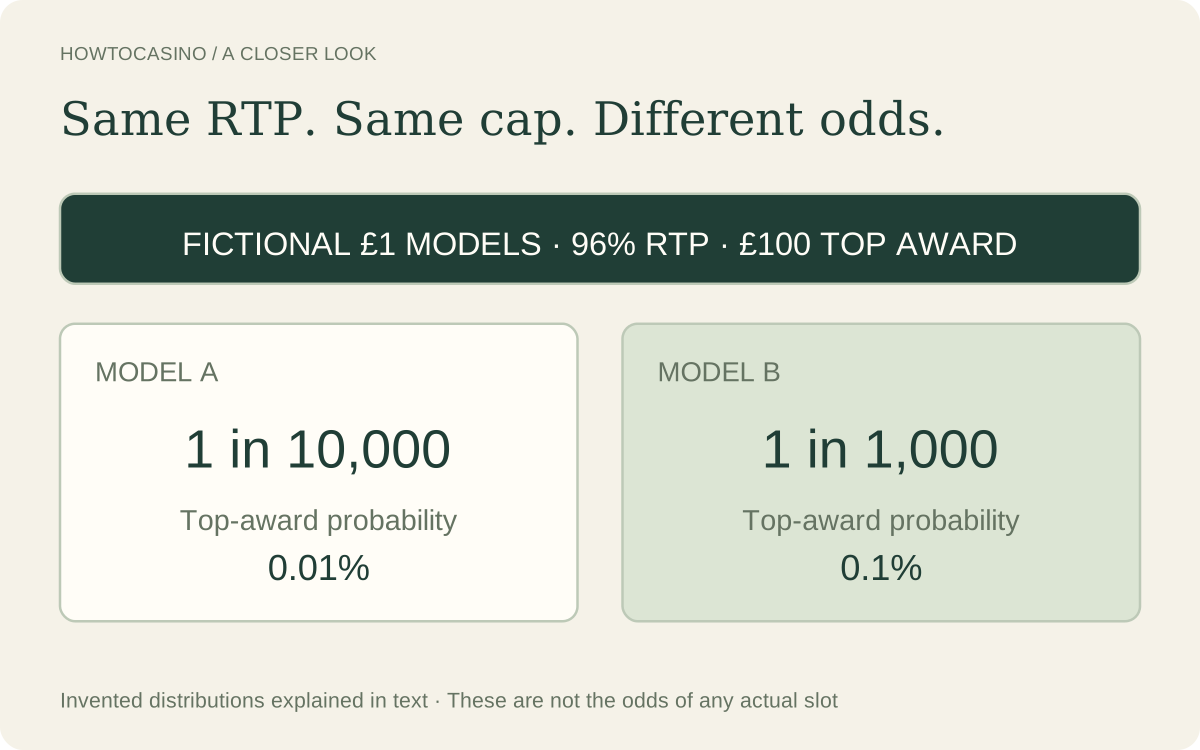
Yes. Consider two deliberately invented distributions. Each stakes £1 and returns either £100, £1 or £0. There are no bonus states, fees or other outcomes. These are mathematical teaching models, not real slots or forecasts.
| Total cash returned from a £1 stake | Model A probability | Model B probability |
|---|---|---|
| £100 top award | 0.01%: 1 in 10,000 | 0.1%: 1 in 1,000 |
| £1 stake-sized return | 95% | 86% |
| £0 | 4.99% | 13.9% |
| All probabilities | 100% | 100% |
Model A’s expected return is £100 × 0.0001 + £1 × 0.95 + £0 × 0.0499 = £0.96. Model B’s is £100 × 0.001 + £1 × 0.86 + £0 × 0.139 = £0.96. Each therefore has 96% theoretical RTP and a 100× maximum, while the top-award probabilities differ tenfold.
The example proves an information limit: the average and upper endpoint do not determine the whole distribution. It does not estimate the odds of Gates of Olympus, Outsourced or any game with a similar headline RTP.
A long-run probability also would not make an event due after that many attempts. Do not treat an average frequency as a spending target or a counter that guarantees an award. The RTP guide explains averages; volatility describes another property, without supplying a missing max-win probability.
Can a max-win cap end a bonus before its remaining spins?
It can under a particular game’s rules. Sky Bet’s public original Gates of Olympus page, consulted on 30 October 2026, says its 5,000× bet total-round limit ends the round and forfeits remaining features. It also states a separate £250,000 single-game ceiling. This is that public game description, not Gates of Olympus 1000, an account test or a promise that every listed ceiling is reachable.
The page describes an Ante mode and base-bet win calculation, but the cap clause’s shorthand bet does not settle every enhanced-charge interpretation. The plain-base examples above avoid assigning that unresolved wording a new current GB value.
Outsourced’s international page uses different wording: when the cumulative round win exceeds 5,000 times base bet, the game ends and awards the ceiling. Do not silently rewrite exceeds as reaches, or infer that this supplier rule describes every slot or GB build.
| Fictional cap accounting | Result under the explicit assumption |
|---|---|
| Round ceiling £1,000; £920 already counted; next calculation adds £150 | Uncapped sum £1,070; if the rule caps total round award at £1,000, only £80 further fits |
| The same £1,000 cumulative ceiling is reached | £1,000 is the total, not £1,000 added on top of the earlier £920 |
| Remaining feature after a stated stop-at-cap rule | Follow that exact stopping rule; unused animations are not extra cash automatically owed |
Those sums illustrate a specified ceiling. They do not decide an actual disputed result, apply a supplier’s rounding rule or establish what a different title owes. Keep the full round, accumulated awards and actual credits together when asking for an explanation.
How do game caps differ from operator limits and stake limits?
| Limit | Relevant scope |
|---|---|
| Game multiplier | A defined base and game/round award |
| Single-game cash ceiling | A cash maximum that may constrain the multiplier result |
| Operator aggregate limit | The specified account, products, period and profit/return definition |
| GB online-slot stake ceiling | Money staked in a game cycle, not the maximum prize |
| Progressive jackpot rule | Separate funding, eligibility, ceiling and award provisions |
| Withdrawal-processing limit | Payment handling; do not assume it changes the game’s winning result |
As an attributed operator example, Betfair’s Casino Games conditions, section 11.2, describe a £1 million cumulative-profit limit across those games in a 24-hour period, excluding progressive jackpot wins. That is not a £1 million gross-return limit, a calendar-day rule or a withdrawal cap. The same clause has specific treatment for the crossing bet and later bets, including a pro-rata original-stake provision; this guide does not invent its formula or determine enforceability.
GB online-slot guidance limits the total game-cycle stake to £2 for adults aged 18–24 and £5 for those aged 25 or over. It does not set one universal online-slot cash prize. Nor should land-based machine prize categories be imported into online slot rules.
Progressive jackpots need their own terms, and can themselves have ceilings. Whether a particular jackpot sits outside another cap depends on the applicable clauses. The jackpot guide covers that mechanism; an exception in one operator’s contract is not an industry-wide rule.
How should you check a claimed max-win probability?
- Identify the exact title and version/configuration.
- Establish what max win means: ceiling, event and accumulation period.
- Check the mode, base bet and total cash cost.
- Look for a primary probability with a defined event denominator.
- Separate a supplier headline, a simulation estimate and an observed sample.
- If the necessary detail is absent, record the probability as unknown.
A supplier can publish a top-event headline without enough detail to apply it to a particular mode or GB build. Outsourced’s public page does publish a max-win-probability headline, but the inspected page does not identify a complete mode/configuration denominator for transferring it to today’s GB game. No numeric frequency from that headline is used as a personal forecast here.
A highlights video or selected winner list lacks all the other rounds needed to estimate frequency. A short sample with no maximum is also not proof the maximum cannot occur. Do not buy extra features, raise a stake or continue playing to test a probability claim.
If an actual cap or award is unclear, save the round identifier, accepted total stake, applicable rules, accumulated award and credited amount. The game-comparison guide explains how to compare exact configurations; the results guide addresses attempts to predict a later spin.
Related questions
What are the odds of getting a max win on slots?
There is no single probability across slots. You need the exact event, game configuration and mode, plus a reliable probability for that model. A multiplier or RTP alone does not supply it.
Does 96% RTP tell me how often the maximum pays?
No. The two fictional distributions in this guide both have 96% RTP and a 100× top award, yet their top-event probabilities are 1 in 10,000 and 1 in 1,000. Those are teaching models, not actual slot odds.
Is 5,000× always multiplied by the full amount charged?
No universal base is established. A rule may use base bet while an optional mode costs more. Read the specified base and total charge separately rather than silently multiplying by the larger number.
Can reaching a cap end remaining free spins?
Under the cited original Gates of Olympus description, the total-round cap ends the round and remaining features are forfeited. Other titles and versions need their own stopping clause.
Does the £2 or £5 GB online-slot limit cap the prize?
Those figures are age-dependent total game-cycle stake ceilings, not a universal cash-prize maximum. Game and operator award limits are separate.
Are progressive jackpots always outside max-win limits?
No universal exception follows. Read the jackpot rules and applicable operator clauses. The cited Betfair cumulative-profit condition excludes progressive wins, but that does not establish every operator’s treatment.