How does a progressive jackpot grow?
A progressive system has a starting amount, often called a seed, and a method of adding to its pool. The contribution can be linked to eligible wagers. The exact contribution rate, any operator funding and any ceiling belong to the particular system; there is no universal percentage that applies to every jackpot.
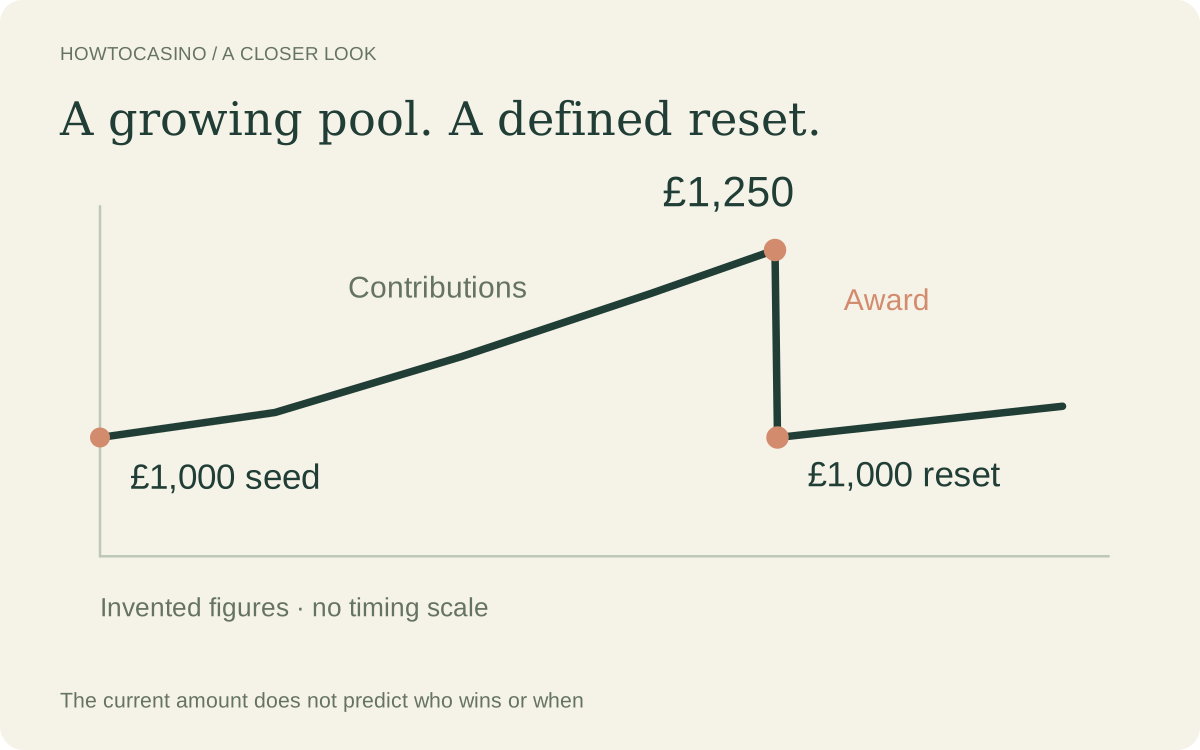
Consider an invented pool starting at £1,000. If eligible play adds £250 before an award, the displayed pool becomes £1,250. If the rules then reset it to a £1,000 seed, the next cycle begins from that amount. This arithmetic explains the movement of the display; it does not model the chance or timing of an award.
A rising number can reflect contributions from many other people. It is not a personal balance, and contributing to the pool does not build an individual entitlement to a share of it. An unawarded amount remains governed by the published jackpot rules.
Progressive, fixed and network jackpots: what is the difference?
| Term | What it describes | What it does not establish |
|---|---|---|
| Progressive | A prize pool that can increase under stated rules | The probability of your next entry winning |
| Fixed | A prize amount or stake multiple set by the rules | That the prize is easy to trigger |
| Local or standalone | The pool is associated with a more limited game or installation | A particular contribution rate or payout schedule |
| Network or linked | Eligible play from multiple connected games or locations feeds a shared system | That every game or stake shown in a lobby qualifies |
These labels can overlap. A linked pool can be progressive, and a game can offer several prize tiers. A title with a fixed jackpot is not automatically a progressive game. The useful comparison is between the exact prizes and eligibility conditions, rather than between attractive lobby labels.
How is the jackpot awarded, and is it ever due?
Some games describe a symbol-based trigger; others use a separately defined random mechanism. A must-drop system has an additional rule, such as an award before a stated limit. Those are distinct designs. The trigger, ceiling and treatment of contributions after a cap must be read together.
An ordinary growing total alone does not establish a deadline. It is not enough to see a large pool or a long interval since the previous winner and decide an award must be close. Even where a deadline exists, the display does not identify who will receive the prize or make a particular entry profitable.
What should you check about eligibility and RTP?
- Find which game, stake and mode qualify, including any extra charge or required contribution.
- Check how the current prize is shown, its seed, any ceiling and what causes an award.
- Read whether the stated return combines base-game and jackpot RTP or lists them separately.
- Check how simultaneous triggers, interrupted play and settlement are handled.
- Read any payment or identity requirements without assuming a prize bypasses normal account checks.
A combined return already includes the components it names. For example, an invented 94% base-game figure plus a 2% jackpot component produces 96% in total; adding 2% again would count it twice. See our explanation of RTP for the difference between a modelled return and a session result.
Does a larger jackpot make a game better?
A prize amount is only one input. Entry cost, eligibility, the probability of an award and the rest of the game's payouts affect the comparison. This page does not have the verified live pool values and probabilities needed to rank particular games by expected value.
Keep the prize mechanism separate from how the reels work: Megaways describes changing symbol positions, while a jackpot describes an award. Reading the game rules and paytable is the way to establish whether both are present in a specific version.
Related questions
Does a progressive jackpot always reset to zero?
No. The published rules can specify a non-zero starting seed. A reset should be interpreted against those rules rather than assumed to mean that all funding has vanished.
Does a bigger stake always qualify for a bigger jackpot?
Do not assume so. Eligibility and how contributions affect chances must be explained for the specific system. Read the rules instead of increasing a stake on the basis of a lobby label.
Is a progressive jackpot the same as a casino bonus?
No. A jackpot is an in-game prize mechanism. A promotional bonus is an offer with its own eligibility and conditions; the word jackpot does not establish bonus wagering requirements.