How do Megaways reels work?
A conventional payline game identifies particular routes through its reel window. A ways game assesses qualifying symbols on consecutive reels under its own matching rules. With Megaways, changing reel heights mean that the set of available paths can also change on the next paid spin.
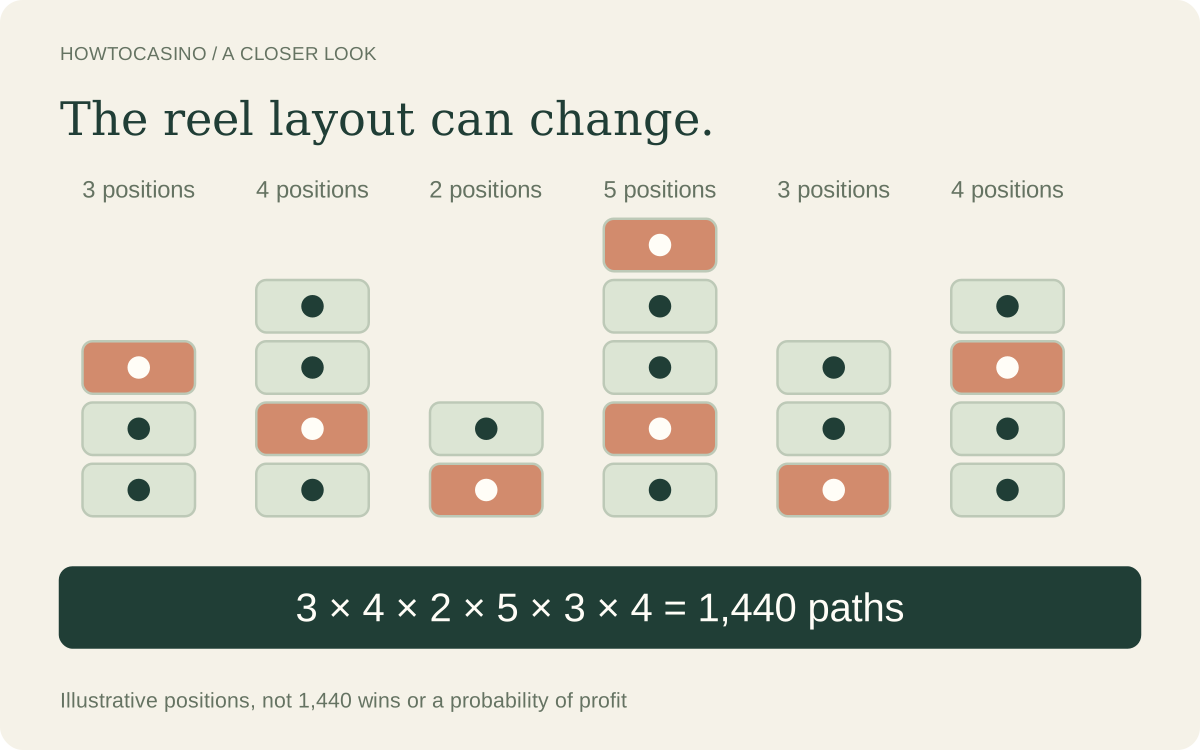
For a simplified example, imagine six reels containing 3, 4, 2, 5, 3 and 4 symbol positions. Choosing one position from each reel produces 3 × 4 × 2 × 5 × 3 × 4 = 1,440 full-width paths. That is a count of positions; it does not say that 1,440 winning combinations have landed.
A particular symbol might be absent from an early reel, preventing a qualifying combination altogether. Another prize might require fewer than six consecutive reels. The rules specify the starting reel, minimum matching length, treatment of wilds and how each paid combination is valued.
What does 117,649 ways to win mean?
The familiar maximum is 7 × 7 × 7 × 7 × 7 × 7 = 117,649. It describes a six-reel arrangement with seven eligible positions on each reel. A maximum advertised for a game is not necessarily the layout on the next spin, and Megaways titles do not all share one universal reel configuration.
| Illustrative six-reel layout | Calculation | Possible full-width paths |
|---|---|---|
| Two positions on every reel | 2 × 2 × 2 × 2 × 2 × 2 | 64 |
| Three positions on every reel | 3 × 3 × 3 × 3 × 3 × 3 | 729 |
| A mixed layout | 3 × 4 × 2 × 5 × 3 × 4 | 1,440 |
| Seven positions on every reel | 7 × 7 × 7 × 7 × 7 × 7 | 117,649 |
Are cascading reels part of every Megaways game?
Bonanza combines Megaways with a cascading reel feature. After a qualifying win, symbols are removed and replacements can create another evaluated arrangement. A cascade is a sequence within the feature's rules; it should not automatically be counted as a new paid spin.
The reel modifier, cascades, free spins and multipliers describe different parts of a game. Seeing the Megaways name does not tell you which extras exist or whether a multiplier carries forward. Read the exact game's feature description rather than borrowing the rules of another title.
Do more ways mean a higher RTP or more frequent wins?
No conclusion follows from the ways count alone. RTP describes the game's theoretical long-run return, while slot volatility concerns the spread of results. Neither can be read from the number of displayed paths. A game can have many possible combinations and still produce a losing spin or session.
For the same reason, a large multiplier in a feature is not a return percentage. A multiplier needs an eligible underlying prize to multiply, and its rules may differ between the base game and bonus round. Comparing only the headline maximum leaves out much of the game.
What should you check in a UK game's information panel?
- Find the matching rule: the starting reel, adjacent reels and minimum number of symbols required.
- Check the total stake and whether paytable values are cash amounts or multiples of that stake.
- Read the actual RTP and feature rules for this version, including any separate mode.
- Check how cascades, wilds and multipliers are evaluated and whether a stated maximum has conditions.
- Use the help panel of the game offered to adults in Great Britain; a general developer page may describe features of versions supplied elsewhere.
Our guide to reading slot rules and paytables explains how to interpret these details. If a separate jackpot is advertised, check its own eligibility and funding rules too; a progressive jackpot is a prize mechanism rather than another name for Megaways.
Related questions
Is Megaways a casino or a game developer?
Here it refers to Big Time Gaming's mechanic. Other developers can use it under licence. A similarly named operator or a game lobby category should not be confused with the mechanic itself.
Does every Megaways slot have 117,649 ways?
No. That well-known figure corresponds to a particular maximum layout. The actual game can use a different configuration, and its ways count can change between spins.
Can Megaways guarantee a win because it has more paths?
No. Paths describe possible arrangements. A qualifying set of symbols must still land, and a prize can be smaller than the total stake. You can lose all the money put at risk.