What is the difference between understanding a slot and predicting it?
Rules can tell you which symbols qualify, what a feature does, the active RTP version and which stake a multiplier uses. These facts describe the game. A prediction would identify an unknown future outcome or a reliable change in its conditional probability. Knowing a maximum prize or seeing a past bonus is not that information.
For GB remote games, RTS 7 sets requirements for random outcomes and prohibits adaptive compensated behaviour. Its guidance addresses unpredictability and the mapping from random inputs to game results. Those are requirements for compliant operation, not a certificate that an unnamed website has implemented them correctly.
This article answers the common “how to win online slots” question by examining prediction claims. It does not provide a winning system. For a suspected fault or incorrect settlement, use the fairness and evidence guide rather than treating every loss as proof of either fraud or correct operation.
Does a long losing streak make the next spin more likely to pay?
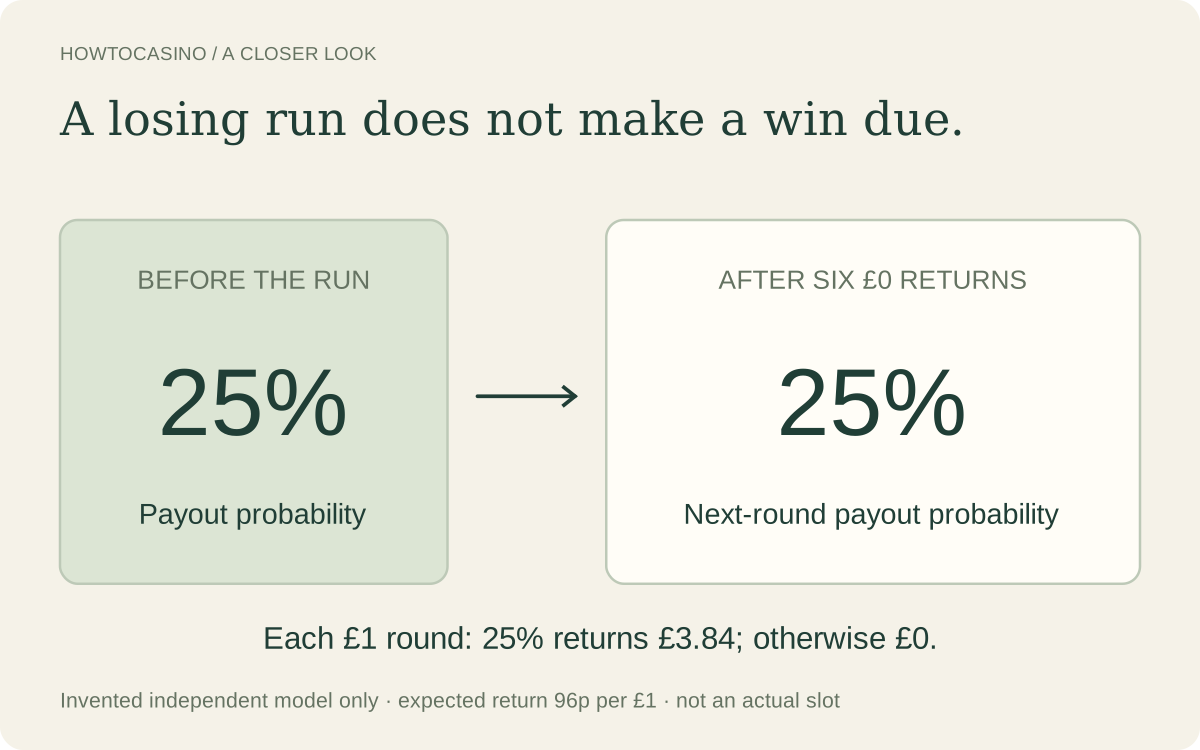
Not in a fixed independent-round model. To show what independence means, invent a £1 game that returns £3.84 with probability 25%, and £0 with probability 75%. These are complete returns, not profit added on top. Its expected return is 0.25 × £3.84 = £0.96 per £1 staked.
| Question about this invented model | Calculation | Result |
|---|---|---|
| Chance of six consecutive £0 returns | 0.75⁶ | About 17.80% |
| Chance of a payout on the next round, before any history | 0.25 | 25% |
| Chance of a payout next, after those six £0 returns | Still 0.25 by the independence assumption | 25% |
| Chance of at least one payout in a specified next four rounds | 1 − 0.75⁴ | About 68.36% |
The last row concerns four future opportunities, not a rising chance on a particular spin. It is not a reason to buy those opportunities: each costs another £1, and the probability is not 100%. A run can be surprising to the person experiencing it without changing the stated next-round distribution.
Actual slots can have multiple awards, feature states and payout distributions. The 25% figure does not estimate their hit frequency. Our RTP and volatility explanations show why a return percentage alone cannot supply the probability of your specific losing streak.
Do timing, near misses or hot/cold labels reveal the next outcome?
| Claim | What the observation establishes | Missing evidence |
|---|---|---|
| “It has not paid for ages” | A selected past run had few returns | A rule connecting that history to a changed future probability |
| “Two scatters mean a bonus is close” | The displayed result was near a visual trigger | Evidence that the next independent round becomes more favourable |
| “The streamer just won here” | Another recorded round returned an award | Your future random input and applicable game state |
| “Press at this time or stop the reels” | A control was used at a selected time | A published rule giving that action an outcome-changing function |
| “This slot is hot” | A retrospective label or a site’s own statistic | A defined measure that validly predicts future outcomes |
A near miss is a losing result under the stated paytable, not a partly completed future win. An animation or sound can make a result feel close without identifying the next random input. Do not assume all games use the same technical architecture or that every on-screen control changes outcome selection.
The compliant-game standard also addresses misleading near-miss substitutions and unannounced rule changes. If an actual display contradicts the rules, retain the round record and investigate that specific issue. It should not be converted into a prediction rule.
Can feature meters, held symbols or jackpots make past play relevant?
A game may retain a disclosed state: for example, collected tokens or a feature level. RTS 3 addresses information about the current state of multi-state games. That is different from silently making a game more generous because a particular player has lost money.
Suppose an expressly invented feature requires ten collected tokens and the display shows nine. One qualifying token remains. That does not tell you the chance of collecting it next, whether a time limit applies, whether progress is retained between sessions, or what the final award will be. Each needs the actual rules.
Similarly, a larger progressive pool can affect the available prize. A stated ceiling or deadline adds a rule about the award process, but it does not identify your next spin as the winner. Trigger probabilities, eligibility and contributions depend on the specific system; no universal “wait until nearly full” formula follows.
Read the progressive jackpot explanation for the distinction between prize growth and a guaranteed personal win. State information can be useful without turning an unknown random result into a known one.
Can bigger stakes or a higher RTP make the next spin a guaranteed win?
No. If an unchanged model has expected return of 96% at a £1 stake, its expected loss is 4p for that round. If the game scales the same distribution proportionately at £2, expected loss becomes 8p, not a better percentage. A higher stake changes the amount at risk; a feature or eligibility change needs a separately stated model.
RTP describes an average under the active configuration. A 96% figure is not a promise that a £20 deposit will return £19.20, or that continued play must repair a session running below 96%. Historical returns are not a debt the game owes to the next player.
A different game or RTP version can change theoretical return. That still does not reveal its next outcome or guarantee a more profitable session. Check the exact Help or Game Rules rather than borrowing a percentage from another operator’s version.
Budget limits can restrict exposure if followed; they do not alter the random result. A previous loss is not a mathematical reason to increase a stake or continue. If play feels difficult to stop, the site’s safer gambling page links to independent support.
Can an AI tool or paid slot predictor find the winning spin?
A chart, image model or app reading publicly visible history does not acquire the hidden random state merely by calling itself AI. To support a forecast it would need a valid relationship between its inputs and future outcomes, a clearly stated success measure and independent evidence. A few selected winning screenshots are not that evidence.
Do not treat a request for casino credentials, a fee or a deposit as proof of predictive access. We have not tested every app and do not claim every seller has identical motives. The narrower conclusion is that labels and retrospective examples do not establish the advertised ability.
For understanding a real result, keep the accepted total stake, game version, round ID, final return and any feature state. These can help check settlement against rules. They do not provide an instruction for the next spin. The paytable guide explains the useful part of that record.
Related questions
Can you ever win money on a slot?
An individual round or session can return more than its stakes. That possibility is different from a reliable method for predicting wins or earning continuing income.
Is a slot due after ten losing spins?
A fixed independent model does not make the next result more favourable because of those losses. A disclosed feature state is a separate rule question, not a general compensation mechanism.
Does a hot-slots list prove a slot will keep paying?
No. Without a valid prospective model, the list describes its selected past data or label. That does not establish the distribution of your next outcome.
Does every slot have no memory?
That wording is too broad. Disclosed tokens, held symbols or feature states can persist. Check what the state changes under the rules; it does not mean losses make a win owed.
Does a low-volatility slot guarantee my money lasts longer?
No. Volatility concerns the distribution of returns, not a guaranteed session length. Total stakes and the actual outcomes still determine the balance.
Can stopping a reel early change a selected result?
Do not infer that from the animation. The exact game rules must describe any outcome-relevant control; a visually faster reveal is not evidence of a better future random outcome.