What do the controls on a slot screen mean?
A slot presents symbols and a set of rules for which outcomes pay. The visible grid might use reels, changing reel heights or a cluster arrangement. A theme, animation or familiar title does not establish the exact pay rules or configuration.
| Control or display | What to establish |
|---|---|
| Rules / help / paytable | Winning combinations, payout units, features and relevant return information |
| Stake / total bet | The full amount committed, including any selected add-on |
| Line bet / coin value | A component that may be multiplied to form the total stake |
| Spin / start | The action that commits to the next paid round |
| Balance / last win / history | Available funds and records; a last-win amount is not necessarily net profit |
The Gambling Commission requires accessible rules and relevant likelihood information before customers commit to gamble. Open the actual help, not only an external game review. Our paytable guide explains the details to look for.
How do you follow a slot round step by step?
- Identify whether you are in real-money, promotional-spin or demo play. The balances are not interchangeable.
- Read the rules for combinations, payout units, special symbols, features and any changing game state.
- Choose the total stake. Check the final amount rather than assuming a coin-value button is the full cost.
- Start the round, then let the game resolve its base result and any included feature sequence.
- Read the total credited for the completed round and subtract the complete amount staked to find its net result.
- Check the updated balance and stop or take a break when you choose. A previous loss is not an instruction to stake again.
There is no universal number of reels, active lines or required matching symbols. Likewise, some games fix the number of lines while others expose different controls. These steps explain what to verify; they do not promise the same buttons in every client.
How do paylines, ways and clusters differ?
| Mechanic | What the rules specify |
|---|---|
| Paylines | The permitted symbol paths, direction and starting position |
| Ways | Which adjacent reels and matching symbol positions form eligible combinations |
| Clusters | The required connected group, size and connection rule |
| Scatter or feature symbol | Its own payment or trigger condition, which can differ from ordinary combinations |
Three identical symbols anywhere on the screen are not a universal winning condition. A line game might need a combination beginning on an edge; another game might pay in both directions. A scatter may pay, trigger a feature, do both or have another function under its own rules.
Our paylines and scatter guides answer those mechanics in detail. A larger count of lines or ways is a count under a specified structure, not by itself a probability of profit or a reason that one game will pay more.
What does a spin actually cost, and what is a win?
Suppose an explicitly hypothetical slot shows 20 active lines at 2p per line, with no other cost. The total paid stake is 20 × 2p = 40p, not 2p. Other games quote total-stake multipliers instead; read which amount the paytable uses before calculating an award.
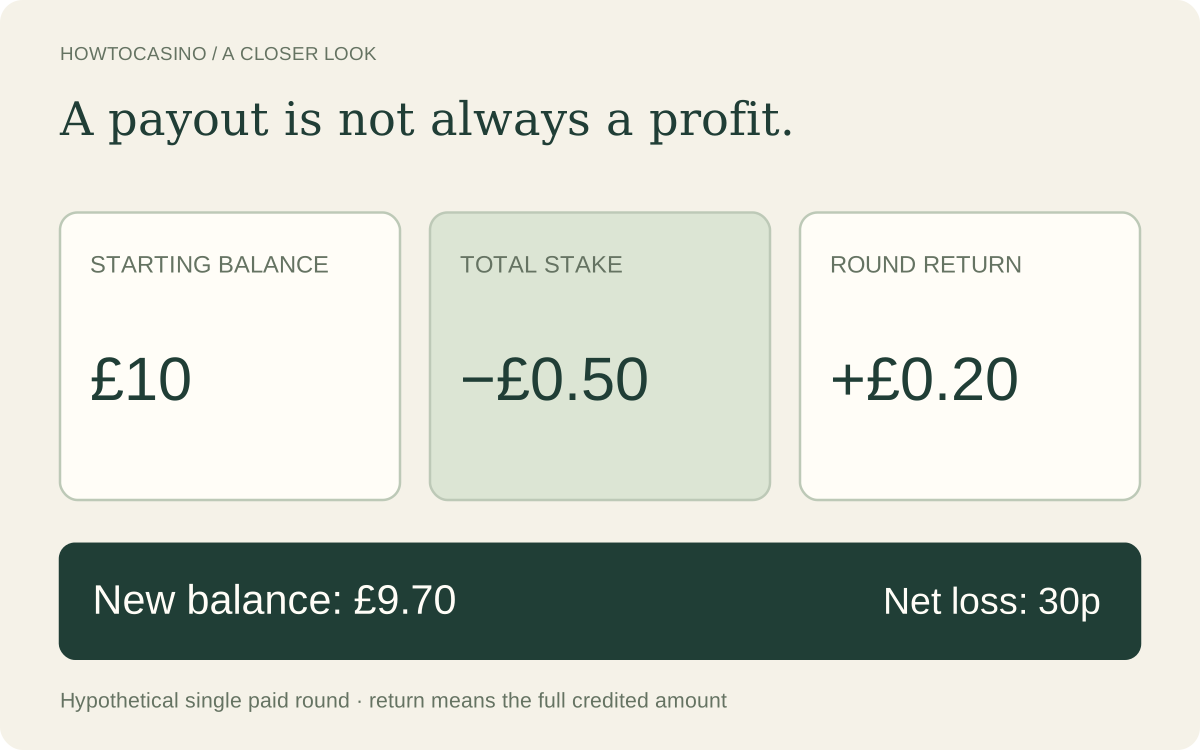
For a separate hypothetical example, start with £10, stake 50p and receive 20p in total from the completed round. The balance becomes £10 − £0.50 + £0.20 = £9.70. A 20p payout occurred, but the round lost 30p.
| Total return from a 50p round | Net result | Balance from a £10 start |
|---|---|---|
| £0 | 50p loss | £9.50 |
| 20p | 30p loss | £9.70 |
| 50p | £0 | £10 |
| £2 | £1.50 profit | £11.50 |
Here, total return means the full amount credited for the round. Do not add the stake back a second time. If a feature shows several intermediate awards, first establish whether the final amount already includes them before summing the figures.
Returning more than the stake in one round does not establish that the whole session is profitable. Keep total stakes, total returns, deposits and the current balance distinct.
Are slot outcomes random, and can a game be due a win?
For relevant GB remote games, the Gambling Commission’s RTS 7 requires acceptably random outcomes and prohibits adaptive compensated behaviour. A game must not change probabilities to repay an individual’s earlier losses. A losing run therefore does not establish that a reward is due.
Random does not mean every displayed symbol or prize is equally likely. A game’s mapping, rules and prize structure determine its outcome distribution. The display is not proof of the size of the chance attached to each symbol.
Avoid taking “the game has no memory” too literally. A feature may retain a meter, collected item or a changed state under disclosed rules. That is different from a machine owing you money after losses. Check the current state and applicable feature rules instead of applying a blanket claim that nothing can carry over.
What do RTP and volatility tell a beginner?
RTP is a theoretical return measure for the specified game and configuration across its outcome distribution. It is not a promise to return a percentage of your deposit or a forecast for the next few rounds. Volatility concerns the distribution and size of outcomes; it does not remove the possibility of losing the money staked.
Read the RTP and volatility explainers for the underlying distinctions and examples. A short demo or a handful of paid spins cannot establish the true return or reliably measure a game’s risk profile.
The same title can have a particular selected configuration. Use the information in the game you are actually considering rather than treating a provider’s headline or another casino’s review as a guarantee about this instance.
Are feature free spins the same as promotional free spins?
A triggered game feature is part of the game’s rules: for example, an awarded sequence can use different symbols or retain particular positions. It can be resolved within the original paid round without a new paid stake for every visible reel movement. Read the trigger, award and ending rules.
Promotional free spins are an account reward supplied under separate terms. They can have fixed denominations, eligible games, expiry and conditions on the resulting winnings. The promotional free-spins guide explains that separate process; a game feature is not automatically a welcome offer.
A demo uses virtual credits rather than a withdrawable cash balance. It can help you inspect controls and disclosed mechanics where available, but does not establish that a real-money configuration, offer or future result will match your short demonstration.
What are the online slot stake limits in Great Britain?
| Adult age | Maximum total stake per online slot game cycle |
|---|---|
| 18–24 | £2 |
| 25 and over | £5 |
These limits apply to the total staked in a game cycle, not merely a line bet or each separate visual spin. The Gambling Commission’s guidance explains that further staking opportunities within the same cycle must stay within the applicable combined limit. Operators can impose lower limits.
A game cycle begins when the game is initiated and ends when the amounts staked or won have been lost or made available for collection. A feature sequence can therefore make “one cycle” different from “one reel animation”. The online-slot limits do not set a £2 or £5 maximum for blackjack or roulette.
For slots, RTS 14D requires at least 2.5 seconds before the next game cycle can be commenced and an individual action for each cycle. This is not a statement that every reel animation lasts exactly 2.5 seconds. Turbo and similar result-speed controls are prohibited under RTS 14E, with its stated exception for bonus or feature games without an additional stake.
The stake and timing limits are regulatory ceilings and controls, not a recommended stake or assurance that a session is affordable. Lower stakes can still accumulate through repeated play.
What if a slot freezes or the return seems wrong?
Record the title, variant, time, round ID, stake, balance movement and any result shown in the game history. Check whether a feature is still being resolved and whether an amount is an intermediate award or the final credited total.
Do not assume a closed window or lost connection cancels an accepted stake. Interrupted-game handling depends on the stage and the published rules. Ask the operator for the recorded settlement before repeating a paid action because the animation disappeared.
Use a properly licensed GB service and its verified support route. Our operator-licence guide explains the identity checks; it does not certify every game outcome or guarantee a payment.
Related questions
Do three matching symbols always win on a slot?
No. Their positions, direction and symbol type must satisfy that game’s actual rules. A line, ways or cluster game can assess the same-looking arrangement differently.
Is a 20p payout from a 50p round a profit?
No, if 20p is the full round return. The net result is 20p − 50p = a 30p loss. Check whether the display shows an intermediate award or the completed round total.
Can past slot losses make the next round more likely to win?
Past losses do not establish that a win is due. GB RTS 7 prohibits adaptive compensated behaviour. A disclosed persistent feature state is a separate rule issue and does not guarantee recovery.
Is the £5 online slot limit the same for every adult?
No. In Great Britain the maximum total stake per online slot game cycle is £2 for ages 18–24 and £5 for ages 25 and over. A service or game may impose a lower limit.
Does every movement of the reels count as a new paid round?
No. Cascades, respins or feature spins may form part of a game cycle without a new paid stake for each movement. The actual rules and transaction record establish what was committed.
Can you withdraw demo-slot credits?
Demo credits are virtual, not a cash award. Promotional free-spin winnings are a separate subject: the offer’s terms determine their award type and restrictions.