What would “rigged” need to mean in a specific complaint?
Separate three questions: whether you lost, whether the product has a house advantage, and whether it operated contrary to its rules or requirements. A game can be correctly implemented and still produce substantial losses. Conversely, an exact settlement error deserves investigation even if most other rounds look ordinary.
Rigged can imply deliberate manipulation, while the evidence may instead concern a software defect, incorrect configuration, missing credit, display problem or misunderstood rule. Start by identifying the discrepancy. A screenshot of a low balance cannot establish which explanation applies.
This article concerns online slots offered to adults in Great Britain. It is not a finding about an unnamed website, another jurisdiction’s rules or a particular physical gaming machine.
What does the GB randomness standard actually require?
RTS 7 requires acceptably random outcomes under the described model and prohibits adaptive compensated behaviour. In particular, probabilities must not be altered to compensate for earlier play. That is different from a promise to repay the losses of an individual player.
Random does not mean every symbol or prize is equally likely. The game’s mapping and paytable determine how random inputs produce outcomes. Nor does a random-number generator’s existence, by itself, demonstrate that a particular implementation complies.
A disclosed feature can legitimately use another rule state after a random trigger. Collected items, held symbols or a feature meter therefore need their own rules. “The slot has no memory” is too broad if it implies no state can ever persist; persistent state is not evidence that the casino owes you a win.
Does testing guarantee that a deployed slot can never go wrong?
The Commission’s testing strategy sets requirements for relevant game and RNG testing before release and for fairness-affecting changes. Its procedure covers such matters as game maths, displayed rules, software implementation and the mapping from random output to game results.
The Commission also explicitly recognises that design, implementation or operational issues can escape testing or deployment checks and lead to overpayment or underpayment. Relevant operators must monitor performance, retain evidence and investigate problems. Testing is therefore part of assurance, not proof that no individual error can occur.
Different audits answer different questions. A review of release procedures, an information-security audit and a game’s mathematical tests are not interchangeable. Check the named game, version and scope rather than treating an unspecified seal as a certificate for every round.
Why can the same RTP produce very different short runs?
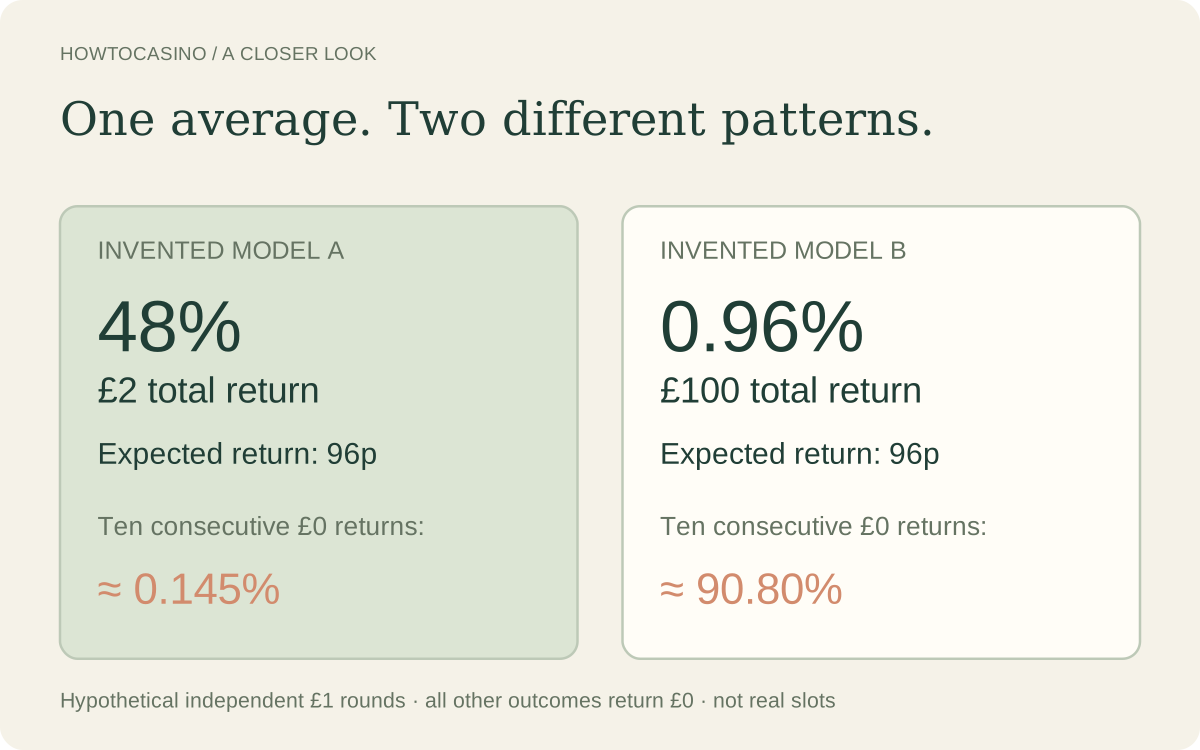
RTP describes an expected return for a specified model, not a guaranteed proportion of your deposit. To see the limit of that information, use two deliberately invented games. Each independent round costs £1; an award below means the complete amount returned, including any stake value, not extra profit.
| Invented model | Possible total return | Probability of that return | Expected return per £1 |
|---|---|---|---|
| A | £2, otherwise £0 | 48%, otherwise 52% | 0.48 × £2 = £0.96 |
| B | £100, otherwise £0 | 0.96%, otherwise 99.04% | 0.0096 × £100 = £0.96 |
Both have a 96% expected total return, but their hit frequencies differ. Under these explicit independent-round models, the probability of ten consecutive £0 returns is 0.52 to the power 10, about 0.145%, for A; it is 0.9904 to the power 10, about 90.80%, for B.
Those are artificial distributions, not predictions for a named slot or a recommendation to play either game. They show why RTP alone cannot tell you the probability of your losing run. Actual features, prize distribution and sampling method matter.
Our RTP and volatility explainers develop those distinctions. Do not turn a short session percentage into either proof of fraud or a guarantee that a fault is impossible.
What evidence helps investigate a slot result?
| Record | Question it helps answer |
|---|---|
| Exact title, version and selected configuration | Which rules and payout units apply? |
| Round ID, date and time | Which event should the operator retrieve? |
| Accepted total stake and any additional paid action | How much was committed to this cycle? |
| Full outcome, feature state and final round return | What should the specified rules settle? |
| Balance movement and game history | Was the recorded amount actually credited? |
A symbol picture is not enough if a win requires a particular path, direction or starting reel. A wild or scatter can also have exceptions. Use the game-rules guide to check the actual conditions rather than borrowing another title’s paytable.
Distinguish an intermediate feature award from a final total, and compare like units. If a complete round stakes 50p and returns 20p, it has lost 30p; seeing a payment does not necessarily mean a profitable round. Our slot beginner guide explains that ledger.
What do a licence, badge or long history actually establish?
Match the exact domain and legal operator to the relevant GB permission. A familiar title, a testing logo or another company’s licence number does not establish that match. The licence-check guide shows the steps.
Where third-party testing is required, the Commission maintains an approved test-house list. That list identifies approved organisations; it does not authenticate every logo displayed on the internet or tell you which version of a particular game was tested.
The testing procedure specifies report details and scope, but does not promise every player access to source code or every internal report. Ask a precise question about the product and disputed round rather than assuming a public certificate must settle it.
A larger history can be more useful than a selected clip, but statistical interpretation still needs the right model, stake levels, feature states and sample-selection method. The regulator’s monitoring guidance takes volatility and sample size into account; there is no universal number of personal spins that proves or clears every fault.
How should you raise an unresolved slot complaint?
- Save the specific round and payment records, along with the applicable rules.
- Ask the operator to explain the identified discrepancy, including any adjustment or incomplete feature.
- Use its formal complaints procedure if the explanation does not resolve the issue, and retain the replies.
- For a relevant unresolved gambling-transaction dispute, follow the named approved ADR provider’s route after eight weeks or an earlier final/deadlock response.
ADR is subject to the provider’s remit and admissibility; a complaint does not guarantee reimbursement. The Gambling Commission can use information for regulatory purposes but cannot resolve your individual dispute or get the money back for you.
A withdrawal delay is also a different question from an incorrect game outcome. The withdrawal guide helps identify review and payment stages without trying to infer a slot algorithm from a missing bank credit.
Related questions
Does a long losing run prove a slot is fixed?
Not by itself. The relevant distribution, feature rules and complete records matter. A documented mismatch between an accepted round and its stated settlement is a more specific issue to investigate.
Can the same RTP have different hit frequencies?
Yes. In the invented examples, a 48% chance of a £2 total return and a 0.96% chance of a £100 total return both average 96p per £1 staked. Neither is a model of your actual slot.
Does random mean all prizes are equally likely?
No. The mapping and prize structure determine their probabilities. RTS 7’s randomness requirements do not imply equal chances for every displayed symbol or award.
Does a saved feature meter prove adaptive compensation?
No. Disclosed random-triggered features can use different rule states. That is distinct from changing probabilities to compensate for previous play. Check the specific feature rules.
Can an error exist even after a game was tested?
Yes. The Commission’s monitoring guidance explicitly recognises that issues can escape testing and cause overpayment or underpayment. That supports investigating evidence, not assuming every unusual result is a fault.
Will the Gambling Commission recover a disputed slot loss for me?
It cannot resolve an individual complaint or get your money back. Use the operator’s procedure and the relevant ADR route where applicable; regulatory reporting is a separate function.