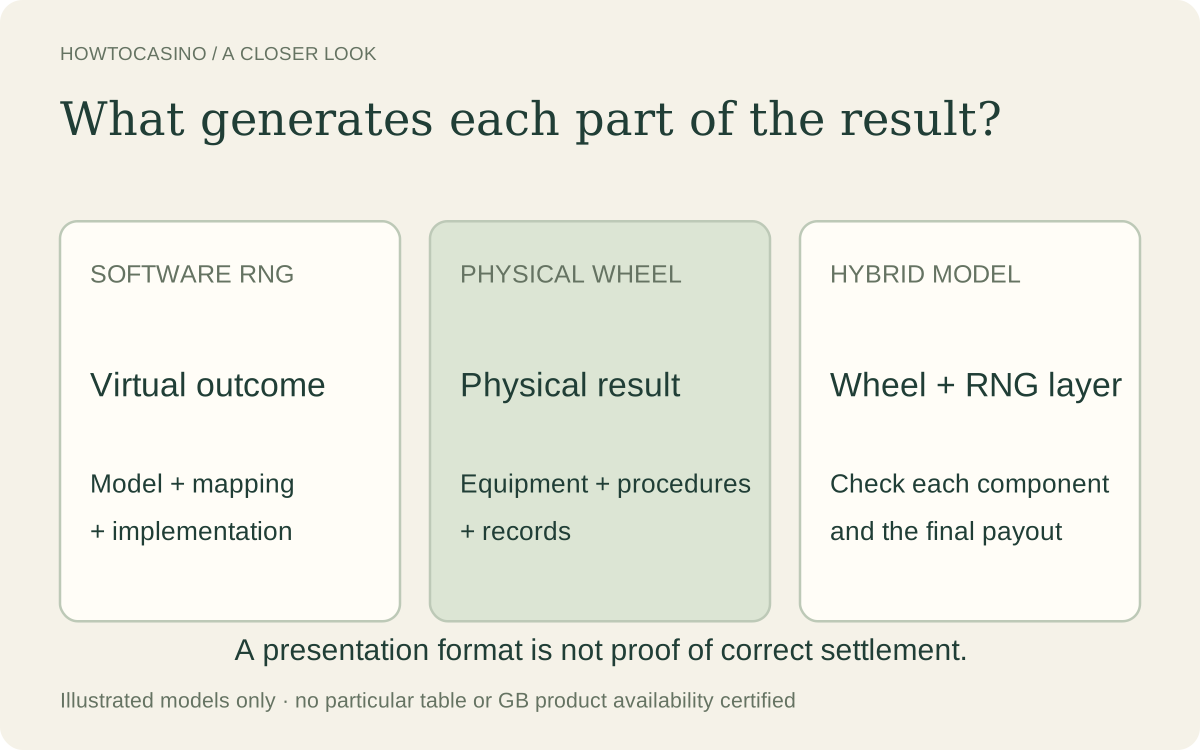
Is the result software-generated, physical or hybrid?
| Model | What produces the result | What to investigate |
|---|---|---|
| Digital RNG roulette | Software under the described game model | Random generation, outcome mapping, rules and deployment |
| Physical live roulette | A physical wheel, which may be dealer-operated or automatic | Equipment integrity, procedures, recording and result logging |
| Hybrid or modified roulette | A wheel result together with another feature layer | Which component determines each part of the final award |
An animated wheel need not be a physical wheel, and a presenter need not manually spin one. Evolution’s international Lightning Roulette description, for example, describes an automatic physical wheel together with RNG-generated Lucky Numbers. That establishes the described product model, not current GB access or a test of your particular version.
The distinction matters because a test of one component does not automatically establish the operation of every other component. Read the exact variant rather than deciding from the visual style alone.
What must RNG roulette do under GB requirements?
RTS 7 requires acceptably random outcomes consistent with the described model and prohibits adaptive compensated behaviour. For a conventional fair single-zero model, the familiar calculation uses 37 equally likely pockets. That calculation is a stated assumption, not our measurement of a table.
Software drawing a result before its animation finishes is not, on its own, evidence that the operator selected a loss for you. Equally, calling software random does not prove its implementation matches the rules. Relevant testing checks the mapping and game behaviour, rather than relying on the animation as evidence.
A modified paytable or feature can change what a winning number pays. Check the product’s complete rules before assuming every straight-up win has the conventional 35:1 profit price.
Does seeing the ball and dealer prove live roulette is fair?
No camera view answers all the relevant questions. RTS 17 requires live operations to be fair and independently auditable. Its implementation guidance covers equipment integrity, documented procedures, trained staff, supervision, recorded surveillance, access and logs.
Those are obligations, not a finding that a particular wheel or studio met them in the round you watched. The regulator also distinguishes the monitoring of physical live equipment from RNG-game performance monitoring.
A clip of a ball moving unexpectedly cannot, without more evidence, identify deliberate manipulation, a recording issue, a perspective effect or some other explanation. Preserve the full round and raise the specific concern; a dismissive “all casinos are regulated” reply is not an investigation either.
Can a run of one colour prove the next result is controlled?
Under the conventional fair independent-spin single-zero model, red covers 18 of 37 pockets on each spin. A previous run does not make black due or change that model’s next-spin probability. The zero pocket is why ordinary red and black are not a 50/50 bet.
That model is useful for explaining probability; it is not a statistical audit of an actual wheel. An observed history needs the correct variant, complete sampling window and sound analysis. Selecting a striking run after it happens is different from defining a test before collecting the data.
The roulette odds reference separates winning probabilities from payout odds. Repeatedly staking more after losses changes exposure; it does not turn a history board into proof of a predictable next result.
What would a specific settlement discrepancy look like?
Use a hypothetical conventional round: a £2 wager on black was accepted before closure, the final recorded pocket was black 17, the profit payout is 1:1, and no additional wagers, features or adjustments apply.
| Item | Amount under the stated example |
|---|---|
| Stake committed | £2 |
| Winning profit at 1:1 | £2 |
| Total return, including stake | £4 |
| Net result | £2 profit |
If the complete ledger instead credits only £2 for that settled wager, ask which record or rule accounts for the difference. Verify that the figure is the complete return rather than a profit-only label or an intermediate display. This identifies a question to investigate; it does not establish intent or prove a system-wide rigging allegation.
For a different paytable, an unaccepted wager, another round ID or an additional adjustment, the expected settlement may differ. Our beginner guide explains how to match each accepted wager to the result.
What if the video, results history and balance disagree?
- Match the round ID and time, not just the last number visible in a video window.
- Record whether the wager was accepted before closure and which positions it covered.
- Keep the game’s result, bet history, displayed award and complete balance movements.
- Identify whether the issue concerns a delayed display, a game settlement or a payment out of the account.
A connection loss does not automatically void an accepted bet. The interrupted-gambling standard distinguishes stages of play and requires the relevant handling policy. Ask for the recorded outcome rather than assuming either that nothing happened or that a refund is automatic.
Studio controls require records, but this does not promise that a customer can receive every internal video, security detail or log. Ask for a clear explanation of the transaction and preserve the evidence you can access.
How much assurance do licensing and testing provide?
Start with the exact domain, legal operator and relevant GB permission. A foreign regulator’s logo, another company’s account or a supplier’s familiar name is not the same check. Our licence guide explains that match.
Then establish what the testing or audit actually covered. RNG tests, release-process checks, security audits and live-studio assurance have different scopes. The Commission explicitly recognises that operational issues can escape earlier checks, so a general assurance claim cannot adjudicate an individual settlement.
A sensible conclusion can be limited: “this operator has the checked permission” or “this rule would produce £4 in the stated example”. Those are more supportable than declaring an unseen game either universally safe or deliberately fixed.
Where can a roulette dispute be taken?
- Save the accepted bets, outcome, rule version, round ID and complete settlement record.
- Ask the operator to explain the exact mismatch through its verified support and complaints process.
- Keep the final response and the date the complaint was first received.
- For a relevant unresolved transaction dispute, use the named approved ADR provider after eight weeks or an earlier final/deadlock response, subject to its remit.
ADR does not guarantee acceptance of every issue or a refund. The Gambling Commission may use reports for regulation, but cannot resolve individual gambling complaints or recover your money. A payment delay also has its own evidence and stages; use our withdrawal guide if that is the actual issue.
Related questions
Does a digital roulette animation prove a hidden physical wheel is being used?
No. Establish the generation method from the actual description. An animation, live physical wheel and hybrid feature model can require different evidence.
Is live roulette automatically fair because the ball is visible?
A camera does not establish equipment integrity, correct procedures, logging or settlement. RTS 17 addresses those controls, but compliance in an individual round needs evidence.
Does ten red results mean black is due next?
Not under the stated fair independent-spin model. On a conventional single-zero wheel, black still covers 18 of 37 pockets. A history board does not guarantee the next result.
Does a mismatch prove deliberate cheating?
Not by itself. Confirm the accepted bet, round, rules, complete return and any adjustment. A fault, display problem or misunderstanding can also need investigation; the cause and intent require evidence.
Does a disconnection cancel an accepted roulette bet?
Do not assume so. The stage of play and published interrupted-game policy matter. Request the recorded settlement before treating the round as cancelled or refunded.
Must I wait eight weeks after a final complaint response before ADR?
The applicable route can be available earlier if the operator has issued its final or deadlock response. The provider’s remit and admissibility still apply; an outcome is not guaranteed.