What are the wheel and betting layout for?
The wheel generates one pocket result. The layout is where you select which results your wagers cover. A chip on a number, on the border between numbers, or on an outside group can mean different things; its position is part of the bet.
On the conventional single-zero model, there are 37 pockets: 18 red, 18 black and green 0. A conventional double-zero wheel has an additional green 00, making 38. Pocket order around the wheel is different from the numerical order on the betting grid.
This guide uses conventional bets and profit payouts. Special multipliers, jackpots, bonus wagers and unusual zero rules can change settlement. The separate single-zero comparison explains how the extra pocket changes probabilities.
What happens in a round of online roulette?
- Open the game rules. Identify the wheel, payout units, limits, zero treatment and any additional feature cost.
- Choose a chip denomination and place the desired wagers on the layout. Read the displayed total, not just the chip value.
- Check that the wagers have been accepted before betting closes. A selected chip or click is not evidence of an accepted bet.
- After closure, wait for the result. A live wheel may already be moving while the betting window is still open; the acceptance deadline controls the wager.
- Match the result to each separate wager, then add all returns and subtract the total committed.
- Use the round record if the displayed return does not match your understanding of the rules.
A streamed table can show a dealer-operated wheel or an automatic physical wheel. A digital presentation may use a software-generated result. Those formats describe how the result is presented and generated; the applicable betting and settlement rules still need checking.
What are inside roulette bets?
Inside wagers are placed on the numbered area of the layout. They can cover one number or a defined group. The following are conventional profit odds: a winning stake is returned in addition to the stated profit.
| Wager | Numbers covered | Profit odds | Total return from a winning £1 wager |
|---|---|---|---|
| Straight-up | One number | 35:1 | £36 |
| Split | Two adjacent layout numbers | 17:1 | £18 |
| Street | Three-number row | 11:1 | £12 |
| Corner | Four numbers meeting at a corner | 8:1 | £9 |
| Six-line / double street | Two neighbouring three-number rows | 5:1 | £6 |
The layout determines which group a chip selects; neighbouring wheel pockets do not automatically form a split bet. Zero-area and double-zero combinations can have different definitions and prices. Do not assume every group of the same size exists or has the same payout.
What are outside bets, and does zero count as even?
| Wager | Conventional coverage | Profit odds |
|---|---|---|
| Red / black | 18 numbers of the selected colour | 1:1 |
| Odd / even | 18 numbered outcomes in the selected category | 1:1 |
| Low / high | 1–18 or 19–36 | 1:1 |
| Dozen | 1–12, 13–24 or 25–36 | 2:1 |
| Column | The 12 numbers in one layout column | 2:1 |
Zero is not a winning outcome for these conventional red/black, odd/even, low/high, dozen or column wagers. Its mathematical status as an even integer does not make it part of roulette’s Even betting category. Under ordinary full-loss zero rules, those wagers lose on 0, and also on 00 where present.
Outside bets cover more numbers but pay less when they win. An even-money price does not mean exactly a 50% chance on a wheel with zero pockets. La Partage or En Prison can change eligible wagers’ treatment on zero; inspect the actual rules rather than assuming them from a French label.
How do you calculate the result of two roulette wagers?
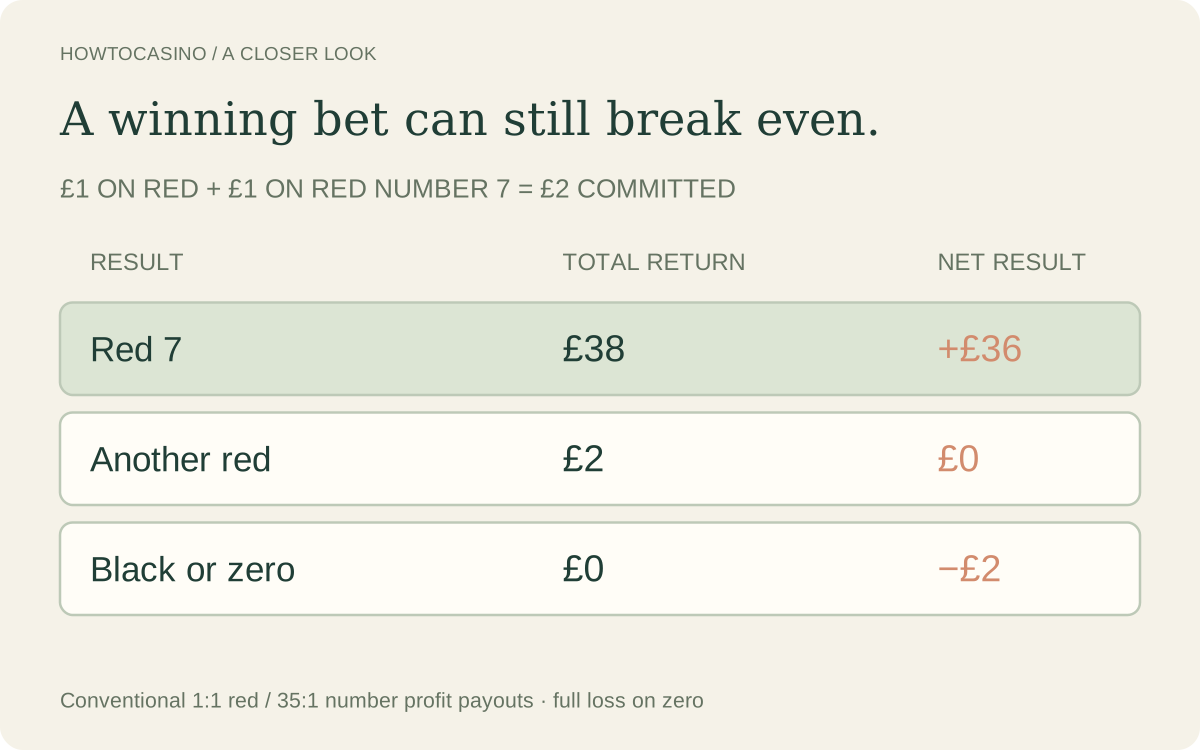
Take an explicitly hypothetical £1 on red and £1 straight-up on 7. Number 7 is red on the conventional wheel, so both wagers can win on that result. Total committed is £2. Assume 1:1 profit for red, 35:1 for the number and full loss on zero, with no special feature.
| Pocket result | Return from red | Return from number 7 | Total returned | Net result on £2 |
|---|---|---|---|---|
| Red 7 | £2 | £36 | £38 | £36 profit |
| Another red number | £2 | £0 | £2 | £0 |
| A black number or 0 | £0 | £0 | £0 | £2 loss |
If the game has 00, it is another full-loss outcome in this example. A winning label on the red wager is not necessarily a profitable round: when another red number wins, its £1 profit merely offsets the lost £1 number wager.
The £36 total return on the winning straight-up bet already includes its £1 stake. Adding that stake again would overstate the result. Covering more positions also commits more money; it does not alter which pocket the wheel produces. The example is a settlement explanation, not a recommended betting system.
Can recent results tell you which number comes next?
Under a fair independent-spin model, a specified number on a 37-pocket wheel has probability 1/37 each spin. A run without that number does not make it due next. A hot/cold display summarises earlier results; it does not supply a changed probability for a standard independent round.
Likewise, increasing a wager after losses changes the amount at risk rather than removing zero or guaranteeing recovery. Bet limits and finite money also matter. Understanding the payout table is useful; interpreting a results pattern as a promise is not.
For the difference between a payout price, a winning probability and house edge, read the zero-wheel comparison. Its figures are tied to stated pocket and payout assumptions, not every game using roulette imagery.
What should you check if a bet or payout looks wrong?
Before a new round, check the displayed total and any repeat, double or undo control. Their availability and timing depend on the interface. Repeating a layout may repeat several wagers; doubling may increase the whole selected amount, not only one chip.
If a round is unclear, note the game and variant, time, round ID, accepted wagers, result and transaction history. Compare each wager with the actual payout table, then ask the operator to explain the settlement. Our licence guide helps identify the correct GB operator and support route.
A disconnection does not automatically cancel an accepted wager or entitle it to a refund. The Gambling Commission’s interrupted-gambling standards distinguish stages of play and require published handling policies. Check the recorded round before placing another bet to “try again”.
These mechanics were checked against public rule pages on 29 October 2026; no live table or account settlement was tested. The international conventional payout source supports the stated model, not current availability of a named GB game.
Related questions
Does 35:1 mean I get £35 in total from a £1 roulette win?
In the conventional profit-odds model, no. It means £35 profit plus the £1 winning stake returned: £36 in total. A display using a total-return multiplier needs a different reading.
Can two roulette bets win in the same round?
Yes, if both cover the winning pocket. In the example, £1 on red and £1 on red number 7 both win when 7 lands. Count all committed stakes before calculating net profit.
Does zero win an Even bet?
No in the conventional model. Zero is outside the layout’s Even category, as well as red/black and high/low. Special zero-return rules may affect settlement without changing that category.
Is an outside bet guaranteed to last longer than an inside bet?
No. The defined outside groups cover more pockets and usually have smaller profit payouts, but any individual wager can lose. Coverage alone does not guarantee a session length or result.
Is live roulette always a person spinning the wheel?
No. A live presentation can also show an automatic physical wheel. Read the table description and rules rather than inferring the mechanism from a camera view.
Does closing a roulette game cancel my accepted wager?
Do not assume so. The outcome depends on the stage and published interruption rules. Check the round history and ask the operator about an unclear settlement rather than expecting an automatic refund.