Why does chip placement matter separately from chip value?
A chip marked £1 describes its denomination. It does not, by itself, tell you which results it covers or whether the final layout contains one chip or several. A chip centred on a number and a chip straddling two numbers mean different wagers.
Read the accepted wager list or highlighted coverage before betting closes. A clicked button, an amount still selected in a tray or an intended pointer position is not evidence that the corresponding wager was accepted.
This is a placement and cost reference. Our beginner guide explains the round sequence; the separate odds reference supplies the numerical payout and probability chart.
Which numbers do common inside positions cover?
| Wager | Position on the conventional grid | Example coverage |
|---|---|---|
| Straight-up | On one number | 17 only |
| Split | On the shared border of two eligible numbers | 23 and 24 |
| Street | At the edge of one three-number group | 16, 17 and 18 |
| Corner | At the shared intersection of four numbers | 32, 33, 35 and 36 |
| Six-line / double street | At the joining edge of two three-number groups | 4, 5, 6, 7, 8 and 9 |
| Zero-area trio, where offered | The specified zero-area position | 0, 1 and 2 in the cited layout |
Layouts can be rotated, so a street is not reliably described as horizontal on every screen. The relevant facts are the defined number group and the position that selects it.
A split requires eligible adjacency on the betting grid, not simply two numbers you like or two pockets next to each other around the wheel. If the interface supplies a named special wager, inspect its definition rather than assuming the ordinary grid rule applies.
What do outside wagers cover?
| Outside selection | Defined numbered outcomes |
|---|---|
| Red / black | The 18 numbers of that colour |
| Odd / even | The 18 numbers in the selected category |
| Low / high | 1–18 or 19–36 |
| First, second or third dozen | 1–12, 13–24 or 25–36 |
| A column | Its 12 grid numbers, not the matching dozen |
Zero is not included in these conventional groups, and neither is 00 on a double-zero wheel. Its everyday mathematical description as even does not put it in roulette’s Even category.
For example, the first dozen is 1–12, while the first conventional column is 1, 4, 7, 10, 13, 16, 19, 22, 25, 28, 31 and 34. Both contain twelve numbers, but they cover different sets. A larger coverage set alone does not guarantee profit across all wagers in the round.
Special zero-return rules can alter a qualifying wager’s settlement without adding zero to its category. Use the actual rules and the odds reference for that distinction.
How do several selected wagers change the cost?
For a hypothetical simple layout, place one 20p chip on each of four straight-up numbers. The total committed is 4 × 20p = 80p, not 20p. Whether a particular table accepts that denomination or layout must be checked separately.
Repeated clicks, a repeat-layout control or a multi-chip package can increase the accepted total. Read the final wager list and total rather than assuming one interaction always adds one unit.
The payout of a winning component must then be compared with all stakes. Our odds reference explains profit and complete returns; the worked package below shows why even a named group can have more than one winning return.
Are racetrack and announced bets just outside bets?
Not necessarily. A racetrack-style control uses wheel order or named groups, and can place a collection of ordinary inside wagers. The control’s position outside the rectangular grid does not make its components red/black, dozens or other outside-category wagers.
The public Sky rules cited here describe named allocations including Orphelins à Cheval. That is evidence for the stated model, not a claim that every GB table or account offers it. An interface can have different packages, units or acceptance rules.
Before using a package definition, establish how many chips it places, on which exact positions, and whether some numbers receive overlapping coverage. A package label is not a complete cost or payout description.
How does the five-chip Orphelins example work?
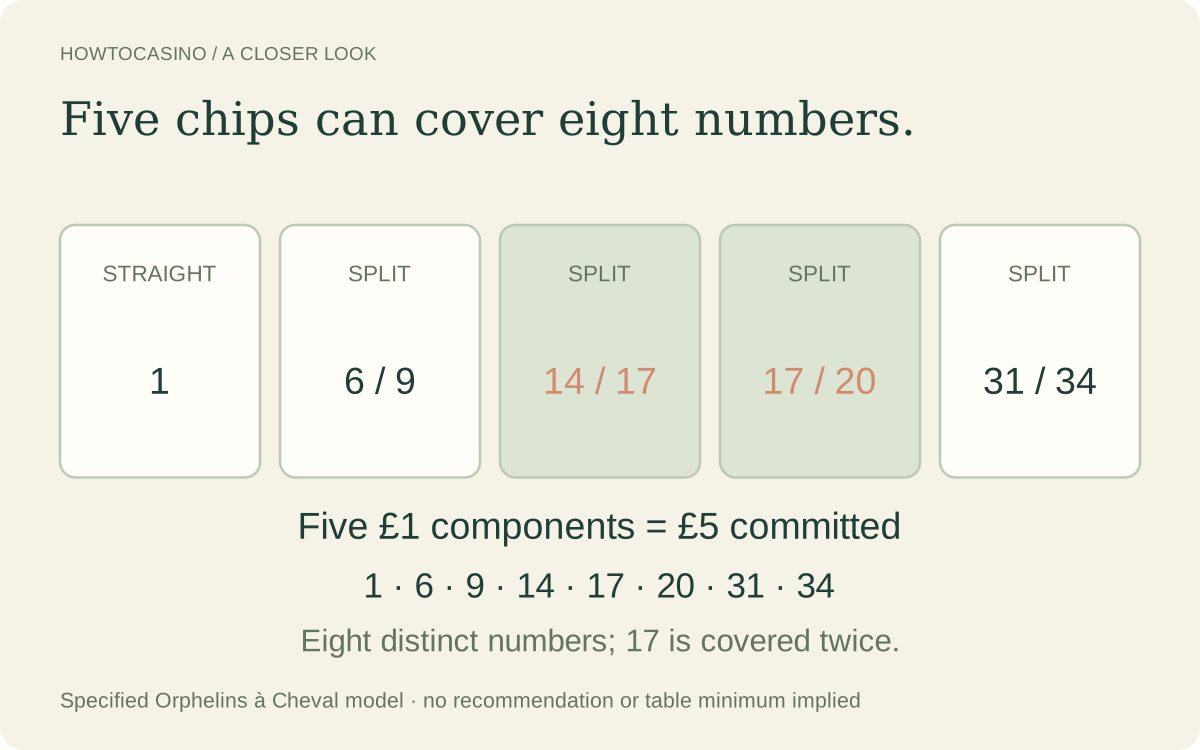
Use the specific five-chip allocation published in the cited Sky rules. Each component below has one £1 chip for illustration, so the complete cost is £5.
| Component | Numbers covered | Stake |
|---|---|---|
| Straight-up 1 | 1 | £1 |
| Split 6/9 | 6 and 9 | £1 |
| Split 14/17 | 14 and 17 | £1 |
| Split 17/20 | 17 and 20 | £1 |
| Split 31/34 | 31 and 34 | £1 |
The union is eight distinct numbers: 1, 6, 9, 14, 17, 20, 31 and 34. Counting the entries without removing the repeated 17 would give the wrong coverage. Number 17 belongs to two separate split wagers, so both win if 17 is the result.
The named package is therefore neither five distinct-number bets nor an eight-chip collection of straight-ups. Its exact internal allocation determines the result.
Does every covered Orphelins number pay the same amount?
No. Keep the stated £5 total stake, conventional straight-up 35:1 profit and split 17:1 profit prices, and no additional features. Complete returns include each winning component’s stake.
| Final pocket | Winning components | Total returned | Net on £5 committed |
|---|---|---|---|
| 1 | One £1 straight-up | £36 | £31 profit |
| 17 | Two £1 splits, £18 each | £36 | £31 profit |
| 6, 9, 14, 20, 31 or 34 | One £1 split | £18 | £13 profit |
| Any other pocket | None | £0 | £5 loss |
If the same five components each used 20p instead, the cost would be £1. A winning 17 would return two amounts of £3.60, £7.20 in total, leaving £6.20 net profit. A single covered split outcome would return £3.60 and leave £2.60 net profit.
These are conditional settlement examples, not a strategy recommendation, a prediction of which number will land or a claim about accepted minimums. Another allocation with the same nickname would require its own calculation.
Does a wider group mean the best or safest bet?
Coverage, price, total stake and special rules all matter. Under conventional full-loss zero rules, changing between standard inside and outside groups does not remove the house advantage. A higher chance of a small component win is not a guarantee of a profitable round or an affordable session.
Before closure, check the exact variant, highlighted numbers, each accepted stake and the complete amount. After a disputed result, save the round ID and wager list. A pointer screenshot alone may not show what was accepted.
Our roulette-fairness article explains how to investigate that evidence. The zero-wheel comparison explains the standard mathematical assumptions without treating them as a guarantee about an actual table.
Related questions
Is a £1 chip the same thing as a £1 total roulette bet?
Only if the complete accepted layout contains £1 in total. Several chips or a named package can commit more. Count all component stakes rather than reading only the selected denomination.
Can any two roulette numbers form a split?
No. An ordinary grid split selects an eligible shared border. Wheel neighbours, arbitrary pairs and specially defined zero-area selections need their actual layout rules.
Does an outside Even bet include zero?
Not in the conventional category. Zero and, where present, 00 are excluded from the ordinary red/black, odd/even, low/high, dozen and column groups.
Is the first dozen the same as the first column?
No. The first dozen contains 1–12. The first conventional column contains every third number beginning with 1. Each covers twelve numbers, but not the same set.
Why can Orphelins cover eight numbers with five chips?
In the stated allocation, most chips are split wagers and 17 appears in two splits. Taking the distinct covered numbers gives eight; counting chips gives five. Those are different quantities.
Does every winning Orphelins result pay 17:1 on the whole package?
No. Settle each component separately. In the specified £5 example, 17 wins two splits for £36 returned, while an outcome covered by only one split returns £18. Neither is a single uniform price on the complete package.