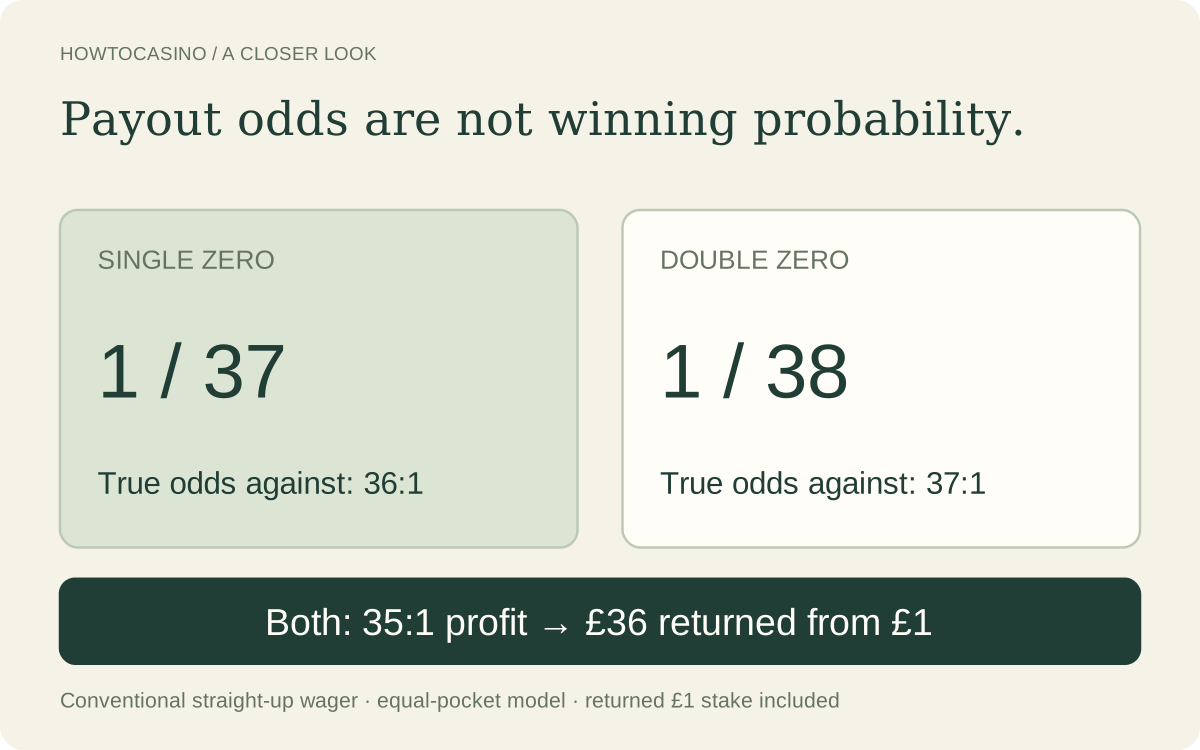
What is the difference between winning probability and payout odds?
Winning probability counts the results covered. Profit odds describe the amount won for each unit staked when the bet wins. Neither tells you the other without the actual wheel and payout rules.
| Term | Conventional single-number example |
|---|---|
| Winning probability on single zero | 1/37, about 2.70% |
| True odds against winning | 36 losing pockets to 1 winning pocket: 36:1 |
| Profit payout | 35:1 |
| Total return from a winning £1 | £35 profit plus £1 stake: £36 |
The true odds against a win and the offered profit price differ. On double zero, that specified number instead faces 37 losing pockets, so the true odds against it are 37:1 while the conventional profit price stays 35:1. A price printed on the layout is not a probability estimate.
What does the conventional roulette payout chart show?
Assume equally likely pockets, one separate £1 wager, conventional profit prices and no multiplier, side feature or special zero settlement. For probability, single zero has 37 pockets and double zero has 38. Percentages are rounded.
| Wager | Pockets covered | Profit odds | Winning £1 total return | Single-zero chance | Double-zero chance |
|---|---|---|---|---|---|
| Straight-up | 1 | 35:1 | £36 | 1/37 ≈ 2.70% | 1/38 ≈ 2.63% |
| Split | 2 | 17:1 | £18 | 2/37 ≈ 5.41% | 2/38 ≈ 5.26% |
| Street / qualifying trio | 3 | 11:1 | £12 | 3/37 ≈ 8.11% | 3/38 ≈ 7.89% |
| Corner | 4 | 8:1 | £9 | 4/37 ≈ 10.81% | 4/38 ≈ 10.53% |
| Six-line | 6 | 5:1 | £6 | 6/37 ≈ 16.22% | 6/38 ≈ 15.79% |
| Dozen / column | 12 | 2:1 | £3 | 12/37 ≈ 32.43% | 12/38 ≈ 31.58% |
| Red/black, odd/even, low/high | 18 | 1:1 | £2 | 18/37 ≈ 48.65% | 18/38 ≈ 47.37% |
Read the actual layout to establish whether a particular split or zero-area group is offered and which numbers it covers. The chart does not make every arbitrary group of two, three or four numbers a valid wager.
Our inside-and-outside bet guide explains chip positions and covered numbers. This page supplies the numerical lookup rather than repeating the whole betting procedure.
How do you calculate profit, total return and net result?
For one winning wager at profit odds of r:1 and stake s, profit is s × r and total return is s × (r + 1). A losing wager returns £0 in the stated full-loss model. For an entire round, add the returns from all wagers and subtract all money committed.
| Example winning wager | Profit | Total return |
|---|---|---|
| £2 on red at 1:1 | £2 | £4 |
| £2.50 on one number at 35:1 | £87.50 | £90 |
| 50p on a dozen at 2:1 | £1 | £1.50 |
If your display already reports the complete amount returned, do not add the winning stake again. A 36× total-return multiplier and 35:1 profit describe the same conventional straight-up settlement only if the stated units match.
A winning component is not necessarily a profitable whole round. Other wagers may have lost. The beginner guide includes a two-wager ledger; the bet-types guide shows a multi-chip package with unequal payouts across its covered numbers.
What do 0 and 00 pay, and is roulette 50/50?
In the conventional double-zero rules cited here, 0 and 00 are separate pockets. A straight-up wager on either pays 35:1 profit, just like another individual number. Double zero does not mean double the prize, and a bet on 0 does not also cover 00.
Ordinary red/black, odd/even and high/low groups exclude the zero pockets. A fair single-zero red wager therefore wins on 18 pockets and loses on 19 under full-loss zero rules. That is why an even-money profit price does not make its winning chance exactly one half.
The zero-wheel comparison explains the conventional 2.70% and 5.26% house-edge models. Those values describe specified prices and outcomes, not a fixed loss that every short session must produce.
Which bets or rules do not fit the ordinary chart?
The conventional American five-number basket covers 0, 00, 1, 2 and 3 and pays 6:1 profit. Its winning probability is 5/38, about 13.16%, and a winning £1 returns £7. The expected total return is 5 × £7 / 38 = £35/38, leaving an expected loss of £3/38 per £1, about 7.89%. It is not the ordinary 5.26% double-zero edge.
Where La Partage applies to an eligible single-zero even-money wager, a zero returns half the stake instead of losing it all. It does not change the probability of red, increase the red profit price or automatically apply to dozens and columns. En Prison holds an eligible wager for later resolution under its own rules.
Multiplier and other modified games can change ordinary prices. A familiar wheel or French label does not establish the complete paytable. Check the actual qualifying wagers, feature costs and settlement rules before importing this chart.
Does “one in 37” mean one win every 37 spins?
No. Under independent fair single-zero spins, each specified number still has probability 1/37 on the next spin. It can miss many times or appear more than once close together; the denominator is not a schedule.
For an explicitly mathematical example, the chance of at least one hit on the same selected number in ten such spins is 1 − (36/37) to the power 10, about 23.97%. It is not 10/37: simply adding probabilities would double-count sequences containing more than one hit.
This counts hits under the stated model. It is not a guarantee, a reconstruction of an unknown table or a cash-flow forecast for changing stakes and other wagers. A previous sequence does not remove the need to state the assumptions.
What should you check before using any roulette odds table?
- Count the actual pocket outcomes and identify the exact wager’s covered numbers.
- Establish whether the price means profit or the complete return.
- Check special zero rules, multipliers, side features and any additional cost.
- Add every accepted wager before calculating a whole-round net result.
- Use the published rules for a disputed round rather than a generic chart from another variant.
Our roulette-fairness guide explains what evidence can and cannot show about an implementation. A correct probability calculation does not itself audit a wheel or guarantee compliance by a website.
Related questions
What is the payout on a single roulette number?
Under the conventional 35:1 profit model, a winning £1 returns £36 including its stake. The actual variant can use a modified paytable, so check its rules.
Does double zero pay more than zero?
Not in the cited conventional double-zero model. A straight-up wager on either 0 or 00 pays 35:1 profit; they are separate pockets and separate selections.
Are the true odds of a single-zero number 35:1?
The true odds against that number are 36:1 under equal-pocket assumptions, because 36 pockets lose and one wins. The offered conventional profit price is 35:1; price and probability are different quantities.
Is red or black a 50/50 roulette wager?
Not with zero pockets included. A conventional single-zero red wager covers 18 of 37 pockets; on double zero it covers 18 of 38. Its 1:1 profit price does not change those counts.
Does La Partage change every roulette wager’s payout?
No. Where offered, it changes the zero settlement for specified eligible even-money bets. Dozens, columns and straight-up numbers do not automatically inherit it.
Does a one-in-37 chance guarantee a hit within 37 spins?
No. It is a per-spin probability under stated assumptions, not a deadline. A repeated-spin calculation must state its independence and game-model assumptions.