Why must you compare the exact version rather than the game title?
Record the title, supplier, version information where shown, selected mode and the chances information in the game you actually opened. The lobby picture and an independent database can describe a product family without establishing the installed configuration.
A dated supplier-authored example shows the problem. The Book of Dead rules document GRS0595-3, dated 14 September 2022, lists five RTP configurations on page 4: 96.21%, 94.25%, 91.25%, 87.25% and 84.18%. That document demonstrates multiple configurations for one title; it does not establish which version is currently installed at a GB operator.
Those figures are not a current availability list or a ranking of five live versions. The document is a dated third-party-hosted copy of the supplier’s rules, not our observation of an account. Do not import its old stake settings into current GB advice.
The UKGC game-information standard requires appropriate accessible rules and chances information. It allows specified forms of chances information; it does not mean every game must publish both RTP and a numerical hit frequency. If an additional statistic is missing, leave it unknown rather than estimate it from a few spins.
Which details belong in a useful slot comparison?
| Detail to record | Question it answers |
|---|---|
| Exact title, supplier and configuration | Are both entries describing the same product and mode? |
| Total stake per paid cycle | What money is committed, including optional paid elements? |
| Winning mechanism | Lines, ways, clusters or another stated pattern? |
| Theoretical return for that configuration | What long-run return model is disclosed? |
| Volatility or hit-frequency information, if available | Which distinct distribution measures are actually supplied? |
| Feature and jackpot rules | What triggers them, what changes and what costs extra? |
| Payout convention and caps | Does the figure mean gross return, profit, a multiplier or a maximum? |
| Device and GB availability | Does the exact version actually open for the relevant service and device? |
Keep theoretical return, a historical observed return and a marketing popularity label in different fields. A recent results panel is a selected sample, not the theoretical probability model. Supplier volatility labels can also use different scales; a five-out-of-five label from one supplier is not automatically equivalent to another supplier’s number.
Winning structure matters for reading settlement, but a count of ways is not a chance of profit. Megaways, paylines and clusters describe different arrangements. Our rules and Megaways guides explain the mechanics without turning a bigger count into a better bet.
This is a method for building a comparison, not a tested catalogue. We have not observed current installed versions for a named-game leaderboard. A future product table should show its date, evidence and unresolved fields alongside each exact configuration.
Can a higher-RTP slot still expose more money?
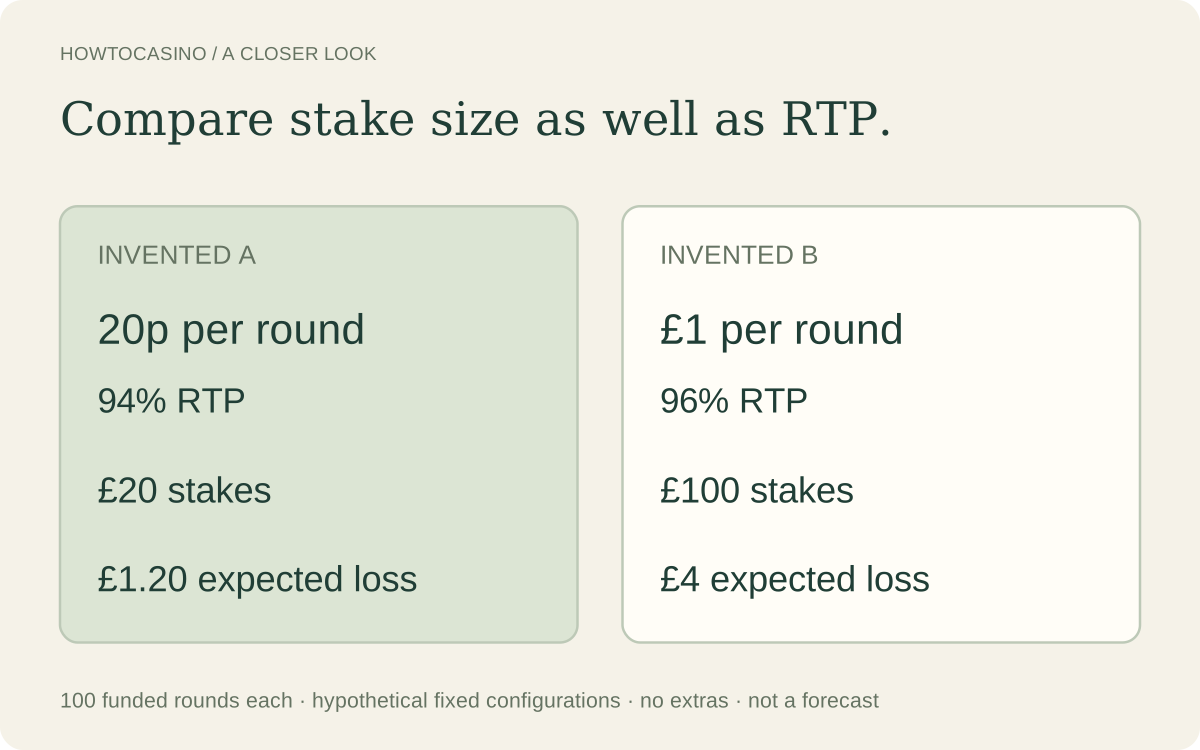
Yes. Compare two explicitly invented fixed configurations over exactly 100 funded, completed rounds. A costs 20p per round at 94% theoretical RTP. B costs £1 per round at 96%. Each cost is the total committed for a round, with no extras, jackpots outside that RTP, fees or promotions. These are not real named games.
| Quantity for 100 rounds | Configuration A | Configuration B |
|---|---|---|
| Total stake per round | £0.20 | £1 |
| Theoretical RTP | 94% | 96% |
| Total stakes | £20 | £100 |
| Expected gross game returns | £18.80 | £96 |
| Expected net loss | £1.20 | £4 |
Expected loss is total stakes multiplied by one minus RTP. A gives £20 × 0.06 = £1.20; B gives £100 × 0.04 = £4. B has the smaller expected loss per pound, but five times the total stakes. Its expected pound loss for this specified comparison is therefore larger.
If both instead had £20 of total stakes under the same fixed return models, expected losses would be £1.20 for A and £0.80 for B. That is an equal-turnover comparison, not necessarily an equal number of rounds or an equal period of time. Neither calculation predicts what either session actually returns.
Use the measure that answers your question. A per-pound percentage, a per-round price and a total period of play are different comparisons. A low minimum stake is not a loss limit, and no one needs to complete the example’s 100 rounds.
What do volatility, hit frequency and features add?
RTP describes a theoretical average. Volatility concerns variation around that average. Hit frequency describes how often a defined paying event occurs. A paying result can still be smaller than the total stake, so a higher hit frequency is not automatically a higher frequency of profitable rounds.
A maximum-win multiplier describes a limit under its rules, not how likely that result is. Feature labels can refer to an included free-spin sequence, a persistent collection state or an additional paid opportunity. Read the trigger, state, price and applicable maximum instead of treating every feature as free.
Do not assume every random slot has identical independent states on every spin. Some disclosed features carry a state between actions. That requires its own rules; it does not validate a claim that a recent losing streak makes a prize due. Our prediction guide separates that claim from evidence about a game model.
A promotion running around a slot can create a separate points or prize system without changing what the ordinary game result means. The Drops & Wins guide explains why tournament scores, game returns and promotional cash awards need separate records.
Which GB rules affect the available comparison?
The current online-slot stake limit is £2 per game cycle for ages 18–24 and £5 for ages 25 and over. These limits are maximums, not recommended amounts. The regulator’s guidance treats the amount as the aggregate stake in a cycle, which can include further paid opportunities within it. A cycle is not automatically each visible reel movement.
The cap applies to online slots; do not transfer it to roulette or blackjack merely because those games appear in the same lobby. An operator or game can impose a lower maximum. The 18–24 band includes a person aged 24; the £5 band begins at 25.
Autoplay cannot be offered for ordinary online gaming under the current standard. GB slot product-design rules also require at least 2.5 seconds between the start of a slot cycle and the start of the next one for the relevant individually initiated slots. An international video showing automated, turbo or differently priced play does not establish the GB version’s controls.
A minimum permitted cycle time is not a suggested playing pace. Compare the rules and costs at your own decision points, without assuming that more rounds or faster play improves the return. A feature-buy example from another market likewise needs its own GB availability check.
What can demos and a shortlist actually tell you?
A demo can help explain controls, displayed patterns and the help screen. It cannot establish a personal future result from a short run. The GB rule for corresponding play-for-free and money games on the same facilities requires matching rules and reasonable steps towards accurate chances and prize distribution; it does not prove that every demonstration on a different website has the same configuration.
The regulator separately addresses enhanced demonstrations and edited footage on supplier websites. A supplier video, third-party demo and an operator’s corresponding cash game should therefore not be silently merged into one observation. An operator’s own free-to-play access also requires age verification.
- Identify the actual GB service and game configuration.
- Record total paid cost and relevant rules before reading a popularity score.
- Compare disclosed return and distribution information on matching bases.
- Mark unsupported configuration, availability or numerical claims as unknown.
- Stop the comparison if the real question is about recovering a loss or relying on a win.
A useful shortlist records facts and trade-offs. It should not promise a winning game, a due jackpot or a slot paying today. Our beginner slot guide covers the playing sequence; this page supplies the comparison method.
Related questions
Which online slot is best to play?
There is no universal best or reliably winning slot. Compare exact configuration, total cost and mechanics. A title, supplier default or popularity list does not establish a current installed version or personal result.
Should I always pick the highest RTP?
A higher RTP reduces expected loss per pound under an otherwise comparable fixed model. Stake size, total exposure and variation still matter; it does not promise a session result.
Do more ways or paylines mean more profit?
The number describes a winning-pattern arrangement, not a complete probability distribution or net-profit measure. Read the exact stake and paytable.
Is a slot that paid recently more likely to pay me?
A selected recent history does not establish a future advantage. Any persistent feature state needs its own disclosed model; a hot label is not a calculation.
Can two casinos show different RTP versions of one title?
A title can have multiple documented configurations. Check the actual game help at the selected service; a supplier document alone does not establish which is currently installed.
Is the £5 online-slot limit for every adult?
No. The maximum total stake per game cycle is £2 for ages 18–24 and £5 for 25+. A lower game or operator maximum can also apply.