What is the difference between a tournament and a random drop?
In a leaderboard tournament, a rule converts qualifying activity into points and ranks participants. A campaign could use a single result, accumulated multipliers or another stated measure. The score needed for a prize can depend on other players, the number of prize positions and the closing rules.
A random award need not depend on finishing high on a board. Pragmatic Play’s current public description of Wheel Drops says normal slot play can randomly award pieces; collecting three pieces permits a prize-wheel spin. Collection, the wheel result and leaderboard placement are different stages.
The supplier’s Enhance toolkit describes configurable qualifications, scoring and reward forms. A provider’s capability list does not mean every operator or campaign uses every feature. Read the selected campaign rather than borrowing a rule from another site.
| Mechanism | What to check |
|---|---|
| Leaderboard | Which events score, how points accumulate, and where prizes begin |
| Random prize drop | Which play qualifies and how an award is selected |
| Piece collection and wheel | How many pieces are needed, expiry/reset rules and wheel prize terms |
| Ordinary game payout | The selected slot’s own rules, paytable and settlement |
What does a network prize pool mean?
A network campaign can share a prize pool and competition across participating operators. A headline pool is therefore not necessarily reserved for customers of the site displaying the advert, and it is not the amount every entrant receives.
For example, clause 5 of Grosvenor’s published 2026 Drops & Wins terms describes sharing with other UK operators. Its detailed tournament provisions require opt-in, participating games and qualifying real-money bets. That is a dated reading of that document on 30 October 2026, not a test of an account’s eligibility.
The exact campaign can exclude certain accounts, games or forms of play. Registration with an operator, an existing game balance and seeing a promotional banner are not the same event as opting into a qualifying competition.
When checking a named casino, establish the exact GB service and operating permission first. The licence-check guide covers that process; a network supplier’s name does not replace it.
How can multiplier points differ from cash returns?
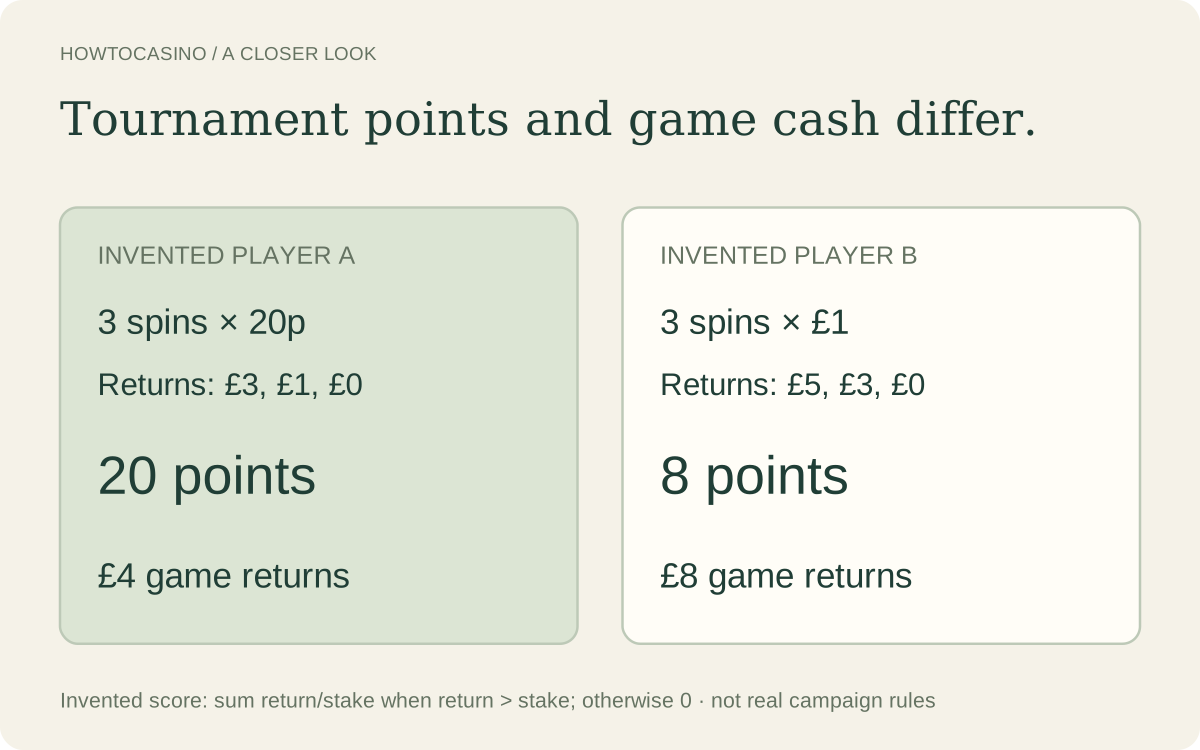
Use an invented scoring rule: for each of three qualifying spins, a return greater than the stake scores return divided by stake. Any return no greater than the stake scores zero. Add the points across those spins. All returns in this example include any returned stake; there are no rounding steps, caps, other spins or promotional awards in the calculation.
| Invented record | Stake per spin | Game returns on three spins | Total stakes | Total game returns | Multiplier points |
|---|---|---|---|---|---|
| A | £0.20 | £3, £1, £0 | £0.60 | £4 | 15 + 5 + 0 = 20 |
| B | £1 | £5, £3, £0 | £3 | £8 | 5 + 3 + 0 = 8 |
B receives more money from these game results and has the higher game-only net result: £5, compared with A’s £3.40. A nevertheless has more points under the invented multiplier formula. Reading a points total as pounds would misstate both records.
This is one possible scoring method, not a universal rule. Grosvenor’s detailed 2026 clauses 13, 15 and 16 describe adding qualifying win/stake multipliers and limiting the counted qualifying bets to the first 5,000. Its introductory headline uses best-multiplier wording. That difference is a reason to read the explicit scoring clauses and seek clarification about conflicting wording before relying on a prize calculation.
Other campaigns can score only a best result, use different eligible outcomes or impose different counting limits. A score that is correct under one formula can be wrong under another. A tie-break rule, such as an earlier achieved score, can also affect position without changing either points total.
Why do wheel pieces and multiplier caps need their own terms?
A piece collection introduces questions beyond the ordinary slot result: which spins can produce pieces, how many are required, when collections expire and how the wheel award is calculated. Without the relevant probabilities, a piece counter does not establish the expected cost of completing a collection.
For a clearly historical GB example, Casumo’s published Winter Edition terms ran from 19 November 2025 to 4 March 2026. They required three randomly awarded pieces and defined a maximum £1 stake base for a wheel multiplier. That campaign had ended by this guide’s consultation date; its URL containing 2026 does not make it a current offer.
Under a separately invented rule that caps the multiplier base at £1, a £2 qualifying stake and a 50× award would give 50 × £1 = £50, rather than 50 × £2 = £100. This arithmetic explains a stake-base cap; it does not interpret ambiguous wording in another promotion or establish that increasing a stake improves its value.
A maximum prize, a cap on the stake used in a multiplier, a limit on awards per person and a maximum counted-spin total are different restrictions. Keep the labels attached to the figures.
Does winning a promotional prize mean the play made a profit?
Account for the underlying play and the separate award. In an invented period, assume total stakes of £20, total game returns of £14 and a separately credited unrestricted cash prize of £5. Exclude fees, other activity and any additional restrictions from this calculation.
| Item in the invented period | Cash effect |
|---|---|
| Total stakes | −£20 |
| Game returns | +£14 |
| Separate credited cash award | +£5 |
| Net result from these items | −£1 |
The award reduces the game-only loss from £6 to £1. It does not make this period profitable. Total stakes are not the same measure as deposits: money returned during play can be staked again. The table measures these cash effects, not a verified withdrawable account balance.
A restricted bonus or a free-spin allocation cannot be inserted into that ledger as though it were unrestricted cash. Check the award’s actual form and conditions. The free-spins guide explains how an allocation differs from realised winnings; the no-wagering guide separates playthrough from other eligibility and account checks.
An advertised shared pool is also not a personal expected return. To combine a promotion with a game’s return model, you would need the relevant award probabilities, qualification costs and definitions. Adding a pool headline to the slot’s RTP percentage is not a valid calculation.
Which tournament and drop conditions should you read?
| Condition | Question to answer |
|---|---|
| Market and eligibility | Does this exact GB campaign apply to the account? |
| Opt-in | When and where must entry be confirmed? |
| Games and stakes | Which games and types or amounts of stake qualify? |
| Time | What are the opening, closing, reset and expiry times, including time zone? |
| Scoring | What counts as a point, and are results added or ranked individually? |
| Limits and ties | Which counted-spin, prize or stake-base caps apply, and how are ties settled? |
| Award | Is it cash, restricted credit, spins or another reward? |
| Crediting and withdrawal | When is it credited, and what further conditions apply? |
GB reward terms must be clear and accessible. A campaign can have no separate entry charge while still requiring paid qualifying spins, which can lose money. Read the full conditions and significant restrictions behind a headline.
If points, a collection or an award look wrong, keep the campaign name and version, opt-in record, relevant game/round references and the operator’s response. Use verified support and the formal complaints route. This guide does not verify a live offer, a personal prize entitlement or a successful credit to an account.
Related questions
Are Drops & Wins points the same as pounds?
No. Points are the campaign’s ranking measure. In a multiplier-scored tournament, a smaller cash return can score more points than a larger one. Read the formula before interpreting the board.
Do all slot tournaments use the same scoring rule?
No. Supplier tools support different configurations. The particular campaign determines which outcomes score, how points accumulate and which limits apply.
Does collecting two of three pieces guarantee a prize?
A partial collection does not by itself establish an award or a guaranteed completion before expiry. Read the collection, timing and reset conditions.
Does no entry fee mean no money is at risk?
A separate entry fee and paid qualifying play are different costs. A promotion can require real-money spins even when it charges nothing extra to join.
Are all prizes cash with no wagering requirements?
The award form and conditions depend on the campaign. Check whether it is unrestricted cash, promotional credit, spins or something else before treating it as money available to withdraw.
Is the Casumo Winter Edition example still running?
The cited terms ended on 4 March 2026. They are included as a labelled historical explanation of a stake-base cap, not as evidence of a current offer.