What do HMRC and GOV.UK say about personal gambling winnings?
HMRC’s Business Income Manual says that betting and gambling, as such, do not constitute trading. Its guidance on the ordinary punter and professional gambler is important: a successful result is not automatically trading income because it arose repeatedly or in a large amount.
For Capital Gains Tax, GOV.UK’s current list of things you do not pay it on includes betting, lottery and pools winnings. These sources answer different tax questions; an Income Tax explanation is not a substitute for checking the CGT position.
The Gambling Commission also states in its public response on customer winnings that UK gambling winnings are tax-free regardless of amount. HMRC remains the primary authority for the tax classification and its exceptions.
This article concerns an individual’s ordinary personal winnings under UK tax rules. It is not the tax position of a casino operator, a payment for services or every transaction that happens to involve a gambling business.
Does a large casino win trigger a tax threshold?
The amount alone does not change an ordinary personal gambling win into taxable income or create a UK customer winnings-tax threshold. For example, the classification question is not answered by calling £100 small and £10,000 large.
That does not mean the operator must pay instantly or without verification. The amount, provenance, balance classification and applicable payment checks are separate questions. Tax treatment is not proof that a disputed game settlement is valid or that a message asking for money is genuine.
Keep records of the operator, relevant game or transaction, amount, date and payout if you need to explain where money came from. Those records support provenance; they do not turn an ordinary win into a different kind of receipt.
What if you play regularly or make a living from gambling?
HMRC expressly says having a system or being sufficiently successful to earn a living does not, by itself, make a punter a trader. “Professional gamblers always pay tax” is therefore too broad, just as “anything a professional receives is tax-free” would be too broad.
The same manual distinguishes providing a service for reward, citing paid television appearances as an example. Whether gambling winnings form part of the proceeds of that trade then depends on the facts.
HMRC also discusses gambling as an element of an existing trade. A connection to a business is not enough to decide every case; the relevant distinction is whether the receipt arises from carrying on the trade rather than merely from an opportunity it provided.
If your situation involves paid appearances, commercial services or gambling integrated with a business, get advice about those facts. Do not classify every receipt using either a lifestyle label or a casino’s payment description.
Which related amounts need separate consideration?
| Receipt or event | Question to ask |
|---|---|
| Ordinary personal casino win | Does it fall within the ordinary gambling-winnings position? |
| Fee for an appearance or other service | Is this payment for work or a business activity rather than the wager itself? |
| Interest after money enters savings | What are the savings-interest rules, allowances and account conditions? |
| Gain after using the money to buy an investment | What rules apply to that later asset or disposal? |
| Gift to another person or money in an estate | Do separate inheritance or gift rules affect the circumstances? |
The money’s origin does not permanently exempt everything it later earns or everything you do with it. Equally, a later tax question does not retrospectively impose a casino-winnings tax on the original receipt.
This table identifies boundaries, not personal outcomes. Tax allowances, account types, residence and the actual activity can matter. Do not apply an assumed percentage to all five categories.
How is later savings interest different from the win?
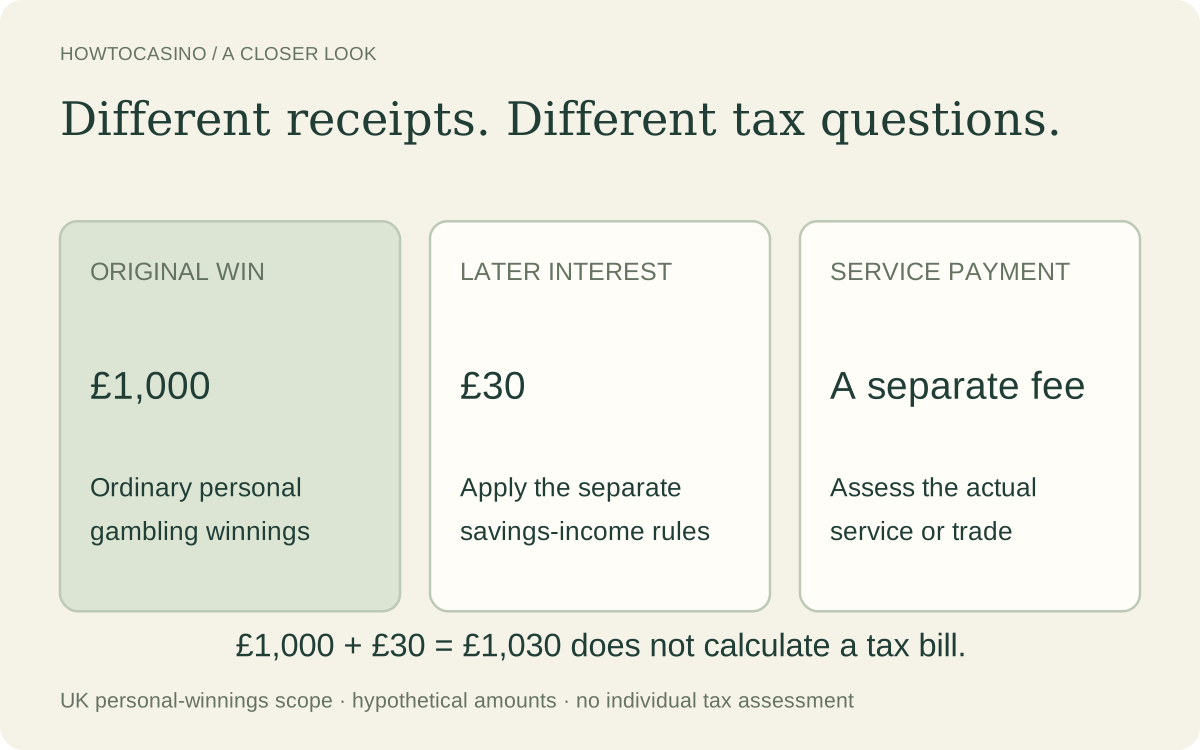
Take an expressly hypothetical ordinary personal £1,000 casino win. You later place that money in an account and receive £30 of interest. There are now two receipts to identify: the original £1,000 gambling win and the later £30 interest.
| Step | Amount in the example | What the arithmetic establishes |
|---|---|---|
| Original ordinary win | £1,000 | The gambling receipt |
| Later interest credited | £30 | A separate savings-income receipt |
| Combined balance, with no other movements | £1,030 | £1,000 + £30; not the amount automatically taxed |
GOV.UK’s savings guidance explains that the tax position for interest depends on the interest, other income, allowances and the type of account. The example does not assume the £30 is taxable or calculate a bill. It shows why “the win was tax-free” does not settle the later-income question.
Can ordinary gambling losses reduce tax on salary or other income?
The ordinary punter’s losses do not become a deduction against unrelated taxable income simply because winnings are outside trading income. HMRC’s guidance pairs the ordinary gambling position with no relief for the corresponding gambling losses.
For a hypothetical ledger, £700 of total stakes and £500 of total returns, including returned stakes, produces a £200 gambling net loss. It does not establish a £200 salary-tax deduction. Keep the accounting result separate from a permitted tax relief.
This is the ordinary personal case, not the accounts of a bookmaker or another taxable gambling business. Business cases need their own analysis rather than being inferred from a player example.
Does the casino’s gambling duty get deducted from your win?
HMRC’s gambling-duty guidance concerns businesses offering the specified gambling services. It is not a statement that an ordinary customer’s win is subject to the same percentage withheld before payment.
A game’s return model, a disclosed payment cost, promotional conditions and the operator’s tax obligations are different concepts. Do not label an unexplained deduction “UK winnings tax” merely because an operator pays gaming duty.
If a payout is lower than expected, ask for the actual balance and transaction breakdown. Our withdrawal and bonus-cancellation guides help distinguish payment stages, promotional funds and remaining own money.
Do you need to declare the win, and what is outside this guide?
An ordinary personal gambling win does not become taxable trading income merely because you complete Self Assessment for another reason. Conversely, that answer does not mean you never need to file a return: other income, gains or circumstances can create an independent obligation.
Use HMRC’s current filing guidance and answer any specific request for information accurately. If a receipt involves a service, business connection or another jurisdiction, ask a qualified adviser how it should be treated rather than hiding it or assuming the ordinary-win label settles it.
UK tax scope and GB gambling licensing are separate. A favourable UK personal tax treatment does not make an unlicensed gambling website lawful for GB customers, and it does not decide a foreign country’s tax or withholding rules. Our licence guide addresses the operator check.
Sources were consulted on 29 October 2026. No individual tax return, personal residence position, overseas tax exposure or particular casino payment was assessed.
Related questions
Do you pay UK tax just because a casino win is £10,000 rather than £100?
The size alone does not create a customer winnings-tax threshold for an ordinary personal gambling win. Separate income, business connections or foreign rules need their own analysis.
Are professional gamblers automatically taxed on all winnings?
No. HMRC says a system or success sufficient to earn a living does not itself make a punter a trader. Separate services and relevant business connections can produce different questions.
Do ordinary betting winnings incur Capital Gains Tax?
GOV.UK lists betting, lottery and pools winnings among amounts on which you do not pay CGT. That does not decide the treatment of a later investment or asset disposal.
Can I deduct personal casino losses from my salary for tax purposes?
An ordinary punter’s losses do not create that deduction. A negative gambling ledger is not the same thing as an allowable tax loss. Business cases have to be considered separately.
Is interest earned after banking a win also automatically tax-free?
No such conclusion follows from the original win. Savings interest has its own rules, allowances and account conditions; the interest needs separate consideration.
Does this mean I never need to submit a tax return?
No. Other taxable income, gains or circumstances can create a filing obligation. Follow HMRC’s current guidance and deal accurately with any specific request for information.