Which baccarat rules does this table explain?
These are the conventional mandatory drawing rules for punto banco, the familiar Player-versus-Banker format. They are not a decision chart for chemin de fer, baccarat banque or every game using baccarat in its title. A live dealer and a computer version can present the same procedure differently; the rules of the selected game remain decisive.
An ace counts one; cards two to nine count their face value; tens, jacks, queens and kings count zero. A hand total keeps only the final digit: seven plus eight is fifteen, so its baccarat total is five. A total of ten counts as zero; baccarat hands do not bust.
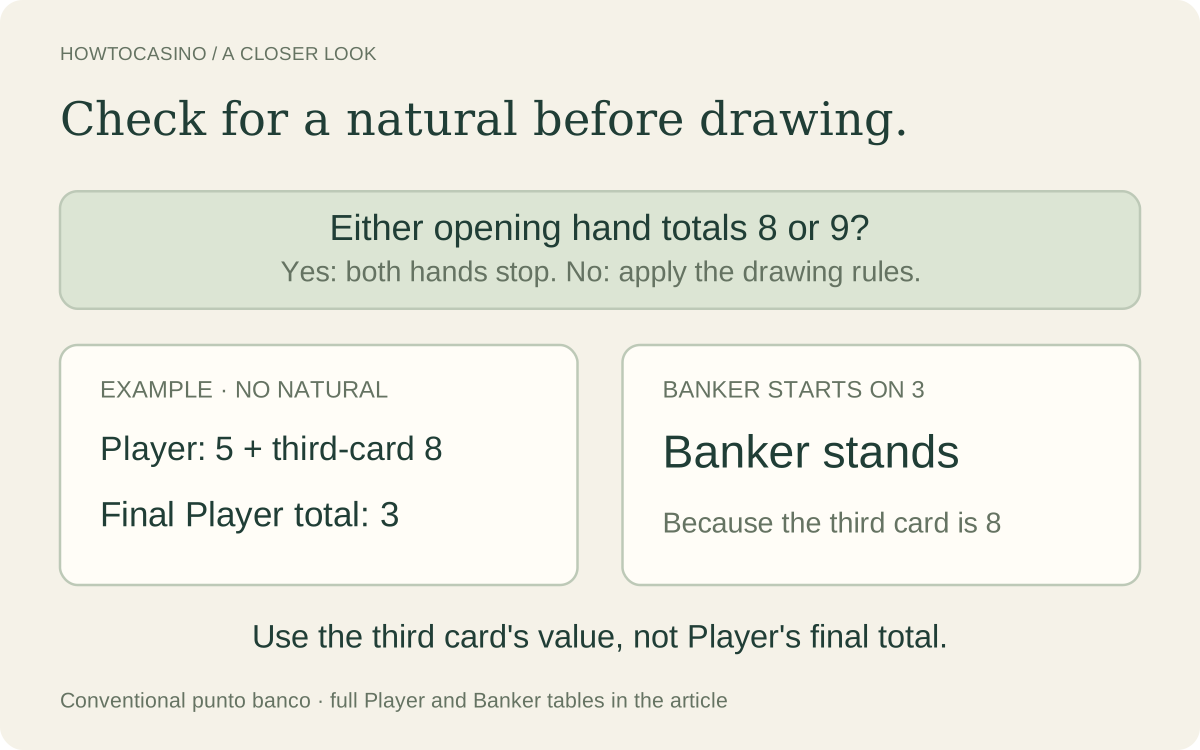
Keep three different numbers separate: Player's initial two-card total, the value of Player's extra card, and Player's final total. The conditional Banker table uses the extra card's value, not Player's final total. A third-card king has value zero for that lookup.
First: does either hand have a natural eight or nine?
Check both opening two-card totals before any draw. If either is eight or nine, no additional card is dealt to either hand. A natural eight does not draw to try to reach nine, and a low opposing hand does not draw to catch up.
| Initial Player total | Initial Banker total | What happens? |
|---|---|---|
| 8 | 4 | Neither hand draws; Player wins |
| 6 | 9 | Neither hand draws; Banker wins |
| 8 | 9 | Neither hand draws; Banker wins |
| 9 | 9 | Neither hand draws; totals tie |
When does Player draw a third card?
Only after excluding a natural on either side, use Player's opening total. Player draws exactly one extra card on zero, one, two, three, four or five. Player stands on six or seven. This instruction does not depend on whether you personally backed Player, Banker or a Tie.
| Player's initial two-card total | Action |
|---|---|
| 0–5 | Draw one card, provided neither hand has a natural |
| 6–7 | Stand; use the Banker rule for Player standing |
| 8–9 on either hand | Natural: both hands stop |
The hand names describe positions. Multiple bettors can back the same hand, but they do not vote on the draw. In this format the dealer follows the table of play; deciding to hit or stand is not a choice offered to the bettor.
If Player stands, when does Banker draw?
If Player stands on six or seven and neither hand has a natural, Banker draws on zero to five and stands on six or seven. In particular, Banker five draws in this branch. Do not apply the conditional ‘Banker five draws only against a third-card four to seven’ rule when Player never received a third card.
| Banker's initial total, with Player standing | Action |
|---|---|
| 0–5 | Draw one card |
| 6–7 | Stand |
| 8–9 | Natural would already have stopped both hands |
Example: Player has a six and a king, total six. Banker has a two and a three, total five. With no natural, Player stands and Banker draws. Banker's action does not depend on treating an absent Player card as a zero-valued card.
If Player draws: the complete Banker third-card table
Use Banker's opening two-card total down the left and the value of Player's third card across the top. Draw means one further card; stand means no further card. This table applies only after Player has drawn and after the initial natural check.
| Banker total / Player's third-card value | 0 | 1 | 2 | 3 | 4 | 5 | 6 | 7 | 8 | 9 |
|---|---|---|---|---|---|---|---|---|---|---|
| 0–2 | Draw | Draw | Draw | Draw | Draw | Draw | Draw | Draw | Draw | Draw |
| 3 | Draw | Draw | Draw | Draw | Draw | Draw | Draw | Draw | Stand | Draw |
| 4 | Stand | Stand | Draw | Draw | Draw | Draw | Draw | Draw | Stand | Stand |
| 5 | Stand | Stand | Stand | Stand | Draw | Draw | Draw | Draw | Stand | Stand |
| 6 | Stand | Stand | Stand | Stand | Stand | Stand | Draw | Draw | Stand | Stand |
| 7 | Stand | Stand | Stand | Stand | Stand | Stand | Stand | Stand | Stand | Stand |
- Banker zero, one or two: draw against every third-card value.
- Banker three: draw unless Player's third card is eight.
- Banker four: draw against Player third-card values two to seven.
- Banker five: draw against four to seven.
- Banker six: draw against six or seven.
- Banker seven: stand.
On a small screen, scroll the table sideways to see every column. A ten, jack, queen or king belongs in the zero column, not a separate column numbered ten. Banker eight and nine are absent because the natural check would already have ended drawing.
Worked examples: third-card value versus final total
| Opening hands; no natural | Player action | Banker action and reason |
|---|---|---|
| Player 2 + 3 = 5; Banker A + 2 = 3 | Draws 8; final Player total is 3 | Stands: Player's third card was 8, even though Player finished on 3 |
| Player 2 + 3 = 5; Banker A + 2 = 3 | Draws K (value 0); final total stays 5 | Draws: Banker 3 draws against third-card value 0 |
| Player A + 3 = 4; Banker 2 + 2 = 4 | Draws 6; final total is 0 | Draws: Banker 4 draws against third-card value 6 |
| Player 2 + 2 = 4; Banker 3 + 3 = 6 | Draws 8; final total is 2 | Stands: Banker 6 draws only against third-card 6 or 7 |
A further card can reduce a baccarat total because only the last digit counts. Player four plus a third-card six becomes zero. That does not permit another draw: conventional play allows at most one extra card to each hand.
The sequence determines completed hands, not the payment on every wager. Our guide to baccarat commission explains why a winning Banker hand can return less profit than a winning Player hand, and how a no-commission variant can change settlement.
How do you check a disputed third-card decision?
- Record the exact title, round reference and initial two cards for each hand.
- Calculate both opening totals and check for an eight or nine on either side.
- Establish whether Player stood or drew. If it drew, record the extra card separately from the final total.
- Use the correct Banker branch and calculate the final totals only after any required draw.
- Compare the resulting hand with the main-bet and any side-bet settlement rules. Ask support for a round explanation if the record differs.
Our guide to reading game rules explains where to distinguish a supplier overview from a particular game's rules. The international official references below support the mechanics; no GB account, table or paid round was tested for this article.
Related questions
Can a baccarat player choose not to take the third card?
Not in conventional punto banco. The drawing procedure is mandatory. Choosing a betting position does not give control over the cards dealt to that hand.
Does Banker always draw on five?
If Player stands on six or seven, Banker five draws, provided there was no natural. If Player draws, Banker five draws only when Player's third-card value is four, five, six or seven.
What happens when Banker has three and Player draws eight?
Banker stands. The relevant number is the value eight on Player's third card, regardless of Player's final total after adding it.
Does a king count as ten in the third-card table?
No. A king, queen, jack or ten counts zero for baccarat hand values. Use the zero column when one is Player's third card.
Can a hand receive a fourth card?
Not under the conventional punto banco rules described here. Each hand starts with two cards and can receive at most one additional card.
Does a natural nine mean both hands stop?
Yes. An initial two-card eight or nine on either hand stops further cards to both hands. Equal completed natural totals can still tie.