What are Ante, Blind and Play?
This is a house-banked poker game: your result is against the dealer, not the other players. You and the dealer each have two private cards and share five community cards. Under the detailed live rules, each side uses its best five-card hand from the seven available; you do not have to force both private cards into it.
Start with an Ante and an equal Blind. The Play is a separate additional bet, sized as a multiple of the Ante. “Check” means adding no Play bet at that stage while retaining a later decision. It does not refund the opening stakes.
BetMGM’s published GB live rules and the Evolution supplier overview are the basis for the sequence below. Exact variants, side bets and limits can differ, so check the named table’s Help and Paytable rather than importing a rule from another poker game.
| Example choice with £5 Ante and £5 Blind | Additional Play stake | Total main-game stake |
|---|---|---|
| Fold without making Play | £0 | £10 lost on the two opening bets |
| Play at 1× | £5 | £15 |
| Play at 2× | £10 | £20 |
| Play at 3× | £15 | £25 |
| Play at 4× | £20 | £30 |
These are hypothetical stakes for arithmetic, not a recommended budget or a claim about a casino’s minimum. A 4× Play is an extra £20 in this example; it is not a £20 total round cost.
For the broader format, read our live dealer casino guide. A visible video stream is not confirmation that the game accepted your bet or decision.
When can you make the Play bet?
| Stage | If you have not made Play | What happens next |
|---|---|---|
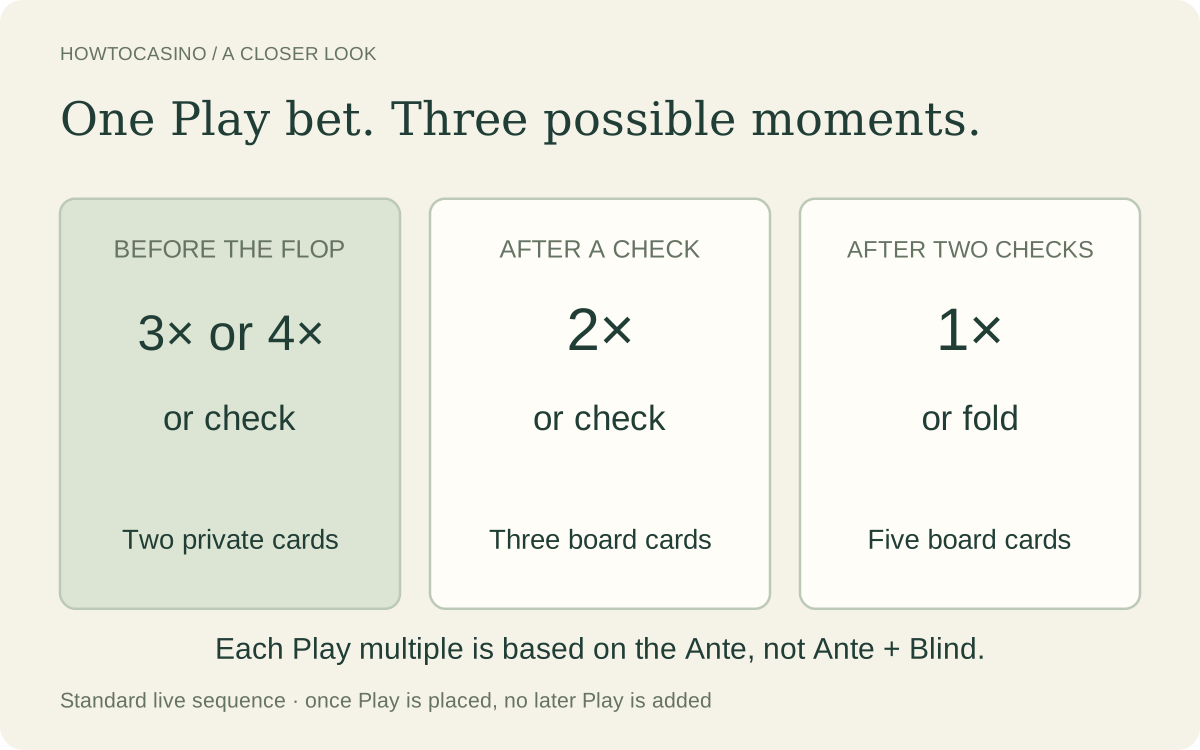
| Your two private cards, before the flop | Check, or Play 3× or 4× the Ante | The first three community cards are revealed. |
| The flop: three community cards | After checking: check again, or Play 2× | The last two community cards are revealed. |
| The river: all five community cards | After checking twice: Play 1× or fold | The dealer reveals and the main bets settle. |
Once you have placed Play, there is no further Play bet to add on later streets. The round continues to the showdown with that stake. Someone who checked before the flop cannot then make the early 4× bet after seeing it.
Folding at the final decision loses Ante and Blind; there is no Play stake to settle. An optional Trips bet has its own rules and may still settle independently. Do not read a fold as cancellation of every possible side bet.
The sequence explains the available choices, not which choice is mathematically best for a particular hand. A larger possible Play stake also means more money at risk; seeing another card for no immediate extra bet does not make the opening stakes refundable.
What if the dealer does not qualify?
In these standard live rules the dealer qualifies with a pair or better. The important exception is that a non-qualifying dealer pushes the Ante only. The dealer’s hand is still compared with yours for Play and Blind. It is possible to lose to the dealer’s higher high-card hand even though neither side has a pair.
| Showdown result | Ante | Play | Blind |
|---|---|---|---|
| You win; dealer qualifies | Win at 1:1 | Win at 1:1 | Paytable for a straight or better; otherwise push |
| You lose; dealer qualifies | Lose | Lose | Lose |
| You win; dealer does not qualify | Push | Win at 1:1 | Paytable for a straight or better; otherwise push |
| You lose; dealer does not qualify | Push | Lose | Lose |
| Equal best five-card hands | Push | Push | Push |
A push returns that bet’s stake with no profit. On a tie, compare the complete best five-card hands, including any relevant kickers. The fact that both players have a pair does not by itself make their hands equal.
When does the Blind bet pay?
The Blind is not another even-money Ante. It pays according to the Blind table only when you win the hand with the required poker category. A winning pair, two pair or three of a kind pushes the Blind. A flush that loses to a stronger dealer hand does not earn the flush Blind award.
| Your winning hand | Published standard-live Blind profit odds |
|---|---|
| Royal flush | 500:1 |
| Straight flush | 50:1 |
| Four of a kind | 10:1 |
| Full house | 3:1 |
| Flush | 3:2 |
| Straight | 1:1 |
| Below a straight | Push |
These are the Blind odds published in the inspected live rules, not a universal promise for every GB table or progressive variant. At 3:2, a £5 Blind makes £7.50 profit and returns £12.50 including its £5 stake. At a push, it returns £5, not £10.
Three complete round examples in pounds
All three examples assume £5 Ante, £5 Blind, no side bets and the standard live paytable above. “Total return” includes returned winning stakes and pushes. Net result equals that total return minus every stake placed in the round.
| Example | Total staked | Returns by bet | Total return and net result |
|---|---|---|---|
| A pair wins after a 4× Play | £5 + £5 + £20 = £30 | Ante £10; Blind £5 push; Play £40 | £55 returned; £55 − £30 = £25 profit |
| A flush wins after a 2× Play | £5 + £5 + £10 = £20 | Ante £10; Blind £12.50; Play £20 | £42.50 returned; £42.50 − £20 = £22.50 profit |
| A high-card hand loses to a non-qualifying dealer after a 1× Play | £5 + £5 + £5 = £15 | Ante £5 push; Blind £0; Play £0 | £5 returned; £5 − £15 = £10 loss |
In the first example you hold A♠ K♦, the dealer Q♠ 8♦ and the board is A♥ 8♣ 7♦ 4♠ 2♣. Your pair of aces beats a pair of eights. Ante and Play win, but the Blind only pushes: the winning hand is below a straight.
For the flush example, you hold A♠ Q♠, the dealer K♠ J♦ and the board is 2♠ 5♠ 9♠ K♥ 4♦. Your ace-high flush beats the dealer’s pair of kings. The £12.50 Blind return is £7.50 profit plus its £5 stake.
For the losing non-qualification example, you hold Q♠ J♦, the dealer K♠ T♦ and the board is A♥ 9♣ 7♦ 4♠ 2♣. Both have ace-high, but the dealer’s king kicker beats your queen. Its lack of a pair saves the Ante; it does not save Play or Blind.
These invented deals illustrate settlement rather than advise how to play the earlier decisions. They do not predict the frequency of any hand or the return from a session.
Is Trips compulsory, and does it depend on beating the dealer?
Trips is optional in the documented live game. It evaluates your final poker hand, normally paying from three of a kind upwards, independently of the dealer and your Play or Fold decision. A main-game loss therefore does not automatically settle Trips as a loss.
Read its own paytable. The two inspected GB-facing pages publish different three-of-a-kind odds for Trips, so we do not combine them into one table. A side-bet return would also need adding to the round ledger above together with its original stake. The main-game examples deliberately contain none.
Is Ultimate Texas Hold’em the same as Casino Hold’em?
No. In the Casino Hold’em rules described by Vivo Gaming, there is an Ante and one post-flop choice to Call at 2× or Fold, with a pair of fours required for dealer qualification. Standard live Ultimate Texas Hold’em instead has the equal Ante and Blind, three possible decision stages and its own qualification settlement.
In particular, do not transfer “dealer does not qualify, so Ante wins” from a Casino Hold’em explanation into Ultimate Texas Hold’em. Here non-qualification pushes Ante. Our Casino Hold’em guide covers that other game separately.
- Check the exact title and whether you are reading main-game or side-bet rules.
- Confirm Ante/Blind equality, the available Play decisions and the dealer qualification clause.
- Read the Blind and optional Trips tables separately.
- Check table limits, maximum payout and what happens after a connection loss before making any commitment.
Related questions
Can you raise again after a 4× Play?
No. In the standard live sequence there is only one Play bet. A 3× or 4× Play before the flop removes later Play decisions; you do not add a 2× and then a 1× bet.
Do you have to use both of your hole cards?
The detailed live rules use the best five-card hand from the seven available cards. Do not confuse that with a rule forcing exactly two private cards and three community cards. Some short promotional summaries use less precise wording.
Does dealer non-qualification mean I cannot lose?
No. Only Ante pushes automatically. If the dealer has the better high-card hand, Play and Blind lose. The pound example above shows a £15 round returning £5: a £10 net loss.