How is Casino Hold’em different from Texas Hold’em?
In Casino Hold’em you compare a hand with the dealer, rather than competing for a pot against other customers. Evolution describes the main hand as the best five cards from your own two cards and five community cards. Other customers’ decisions do not create a betting contest with you.
This guide uses the pair-of-fours qualification and rank-based Ante model documented in Evolution’s published rules. Paddy Power’s public Hold’em help independently confirms the additional 2× Call and the principal settlement branches. Its help page does not identify a current supplier version, so it is supporting rules evidence rather than proof of an account’s present table.
Ultimate Texas Hold’em, 2 Hand Casino Hold’em and Caribbean Stud are separate products. Ultimate’s betting stages and Caribbean Stud’s Ace–King dealer qualification should not be transferred to this game. The Caribbean Stud guide is useful if your actual screen has five private cards and no community board.
What happens in a Casino Hold’em round?
- Place the Ante before the deal. Any optional Bonus or AA wager is a separate decision with its own rules.
- Receive two player cards; the dealer receives two cards. Three community cards form the flop.
- After seeing your two cards and the flop, choose Fold or place the additional Call/Play wager of twice the Ante.
- If you fold, the main Ante is lost and no Call is placed. Do not count an unplaced Call as another loss.
- If you continue, two further community cards complete the five-card board.
- Compare the player’s and dealer’s best five-card hands, then settle the Ante and Call according to qualification and the exact paytable.
There is one described continuation decision after the flop. This is not the sequence of pre-flop, flop, turn and river betting rounds used in player-versus-player poker. A label such as Call or Play names the game’s required additional stake, not an invitation to match another customer’s bet.
How much does the Call cost?
A Call of twice the Ante is additional money. With a £5 Ante, the Call is £10, making £15 committed to the main game. It does not mean the combined stake rises from £5 to only £10.
| Choice with a hypothetical £5 Ante | Additional main stake | Total main money committed |
|---|---|---|
| Fold after the flop | £0 Call | £5, lost on the fold |
| Call / Play for twice the Ante | £10 | £15 |
| Add an optional £1 side wager before dealing | Separate £1 stake | £16 if you also Call; settle that side wager separately |
The £5 example is arithmetic, not a confirmed minimum, maximum or recommendation. Before placing the Ante, allow for the possible additional Call in your budget. A visible £5 Ante button does not describe the full cost of every completed main round.
How do you make and compare the best five-card hand?
Use the strongest five-card combination available from your two cards and the five on the board. It can use both, one or neither of your own cards. Do not require exactly two personal cards as in a different poker variant, and do not compare six or seven cards after a five-card tie.
| Rank, highest first | What it contains |
|---|---|
| Royal flush | A, K, Q, J and 10 of the same suit. |
| Straight flush | Five consecutive ranks of the same suit. |
| Four of a kind | Four cards of one rank, plus a fifth card. |
| Full house | Three of one rank and two of another. |
| Flush | Five cards of one suit. |
| Straight | Five consecutive ranks; an ace can be low in A–2–3–4–5. |
| Three of a kind | Three cards of one rank with two other cards. |
| Two pair | Two pairs of different ranks and a fifth card. |
| One pair | Two cards of one rank and three other cards. |
| High card | No higher listed category; compare the strongest five ranks. |
Compare the category first, then the relevant ranks and kickers within the best five. Suits do not break an otherwise identical poker-hand tie. An ace can be high or low in a straight; it is not a wild card that can replace any missing rank.
Example: the board is A♣ K♦ Q♥ J♠ 10♣. The player has 2♦ 3♣ and the dealer has 4♦ 5♣. Both can use the board’s ace-high straight. The dealer’s unused five does not beat the player’s unused three: those cards are outside the tied best five.
What does dealer qualification mean?
In this documented model, the dealer qualifies with a pair of fours or a higher poker hand. A pair of threes alone does not qualify. A straight or flush qualifies even if it has no pair, because the category ranks above one pair.
Qualification uses the dealer’s complete best hand, including the community cards. If the board itself contains a pair of fours, the dealer can use it; qualification is not limited to the two dealer cards. Conversely, an ace-high dealer hand with no pair remains below the threshold.
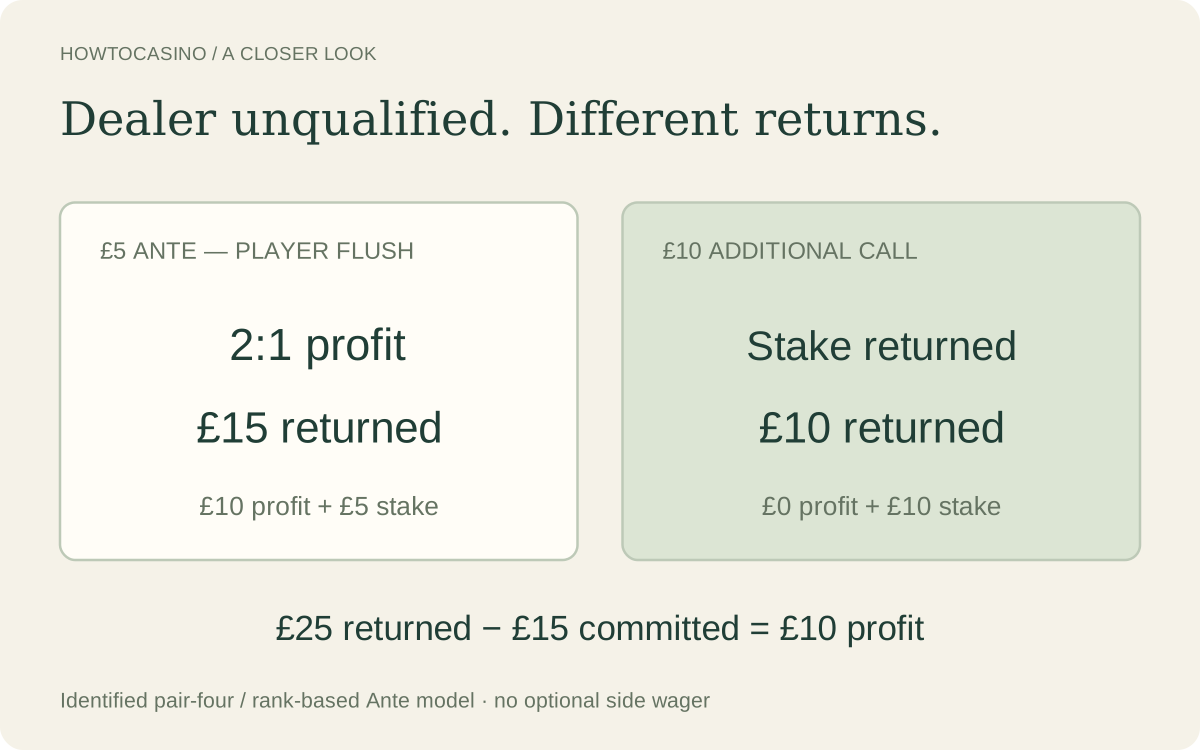
Failure to qualify changes the wager settlements. It does not mean every committed pound receives the player’s hand-category odds, and it does not turn the Call into a winning even-money wager. The Call is returned in that branch; the Ante is paid using the applicable Ante table.
What is the Ante paytable in the documented model?
| Player’s hand when the Ante wins | Ante profit odds |
|---|---|
| Royal flush | 100:1 |
| Straight flush | 20:1 |
| Four of a kind | 10:1 |
| Full house | 3:1 |
| Flush | 2:1 |
| Straight or lower | 1:1 |
This is the identified rank-based Ante table, cross-checked against BGaming’s own published Casino Hold’em rules. It is not the Call table or the optional AA/Bonus table. The low 1:1 row does not by itself make a hand a winner: the result must also fall into an Ante-winning settlement branch.
A high Ante ratio is therefore not paid on the entire £15 main stake in the £5/£10 example. For a flush, 2:1 applies to the £5 Ante. When the dealer qualifies and you beat the dealer, the £10 Call separately pays at 1:1.
How do the Ante and Call settle?
| Completed main result | Ante | Call / Play |
|---|---|---|
| Player folds after the flop | Lost | Not placed. |
| Dealer does not qualify | Paid by the Ante hand-category table | Returned without profit. |
| Dealer qualifies; player has the better hand | Paid by the Ante hand-category table | Wins 1:1. |
| Dealer qualifies; dealer has the better hand | Lost | Lost. |
| Dealer qualifies; exact best-five tie | Returned without profit | Returned without profit. |
The table concerns the main wagers in the stated rule model. An optional side bet can settle differently. A shortened review that says the dealer simply loses whenever unqualified does not supply the necessary distinction between a winning Ante and a returned Call.
What do these outcomes return at a £5 Ante?
Assume a £5 Ante, an additional £10 Call and no side wager. The total committed is £15. Returns below include the original stakes that come back; net profit is the total returned minus £15.
| Result under the identified Ante model | Ante returned | Call returned | Total returned / net profit |
|---|---|---|---|
| Dealer qualifies; player wins with one pair | £10 | £20 | £30 / £15 |
| Dealer qualifies; player wins with a flush | £15 | £20 | £35 / £20 |
| Dealer fails to qualify; player has a flush | £15 | £10 | £25 / £10 |
| Dealer fails to qualify; player has a royal flush | £505 | £10 | £515 / £500 |
| Dealer qualifies; exact tied hand | £5 | £10 | £15 / £0 |
| Dealer qualifies and beats the player | £0 | £0 | £0 / £15 loss |
A valid no-qualification flush example is player A♠ K♠, board Q♠ 8♠ 4♠ 7♦ 2♣, dealer J♥ 9♦. The player has an ace-high flush. The dealer’s best hand is queen-high with no pair, so the Call is returned and the Ante pays 2:1 under this model. The £25 total return is £10 profit, not £25 profit.
If you fold instead, the main loss is the £5 Ante because the £10 Call was never placed. An optional pre-deal side wager would need to be accounted for separately.
How does the optional AA or Bonus wager differ?
The described optional Bonus/AA wager evaluates the player’s two cards and the first three community cards: the first five cards, before the final two board cards. The supplier describes a pair of aces or a higher hand category as qualifying. Two pair or three of a kind can therefore be a higher category without containing an ace.
That early five-card hand is a different object from the eventual best five out of seven used for the main comparison. A stronger final hand does not retroactively replace the first-five side-bet result, and beating the dealer is not the same condition as qualifying for AA.
Side-bet rules can require you to continue the main hand. Paddy Power’s consulted help requires a Call to collect AA winnings. Check your table’s own continuation condition before assuming that a side award remains payable after a fold.
Is there a reliable way to win at Casino Hold’em?
Knowing the cost and effect of a Call does not supply an independently validated optimal decision chart. A strategy depends on the exact Ante, Call and side-bet model. We do not publish an unverified always-call rule or claim that a method guarantees profit.
There is no bluffing the dealer into folding in the documented procedure. The dealer’s hand and qualification settle mechanically. Raising more aggressively like a player-versus-player poker game is not an available route to forcing the house to surrender the pot.
- Before the Ante, confirm the additional Call cost and the exact dealer-qualification threshold.
- Separate the Ante rank table, Call payment and optional first-five side-bet table.
- For a disputed result, keep all nine visible cards, both main stake amounts and the round reference.
- Compare only the best five cards, then apply the appropriate qualification branch.
- Check GB permission and actual game availability separately; this rules explainer is not a current casino recommendation.
The general game-rules guide explains how to read payout units and optional bets. Our casino-odds guide explains why understanding a game and guaranteeing an income are different claims.
Related questions
Is Casino Hold’em played against other players?
The documented main game is against the dealer. Each player uses two personal cards and five community cards to make a best five-card hand; other customers are not competing for the same poker pot.
How much is the Casino Hold’em Call?
In the described model it is an additional twice the Ante. A £5 Ante needs a £10 Call to continue, making £15 committed to the main game.
What does the dealer need to qualify?
A pair of fours or a higher poker-hand category in the documented model. Use the dealer’s best five from seven, including the board; a qualifying pair need not be in the two personal cards.
What happens when the dealer does not qualify?
Under the identified rank-based Ante model, the Ante pays by the player’s hand-category table and the Call is returned without profit. It is not a winning even-money payment on every main stake.
Can both player and dealer use the whole board?
Yes. If the board supplies each side’s best five, unused personal cards do not break that tie. The consulted model returns both main wagers on an exact qualified tie.
Is there a guaranteed Casino Hold’em strategy?
No guaranteed winning method is established here. An optimal decision chart would need validation against the exact wager and payout model, and even an optimal decision does not guarantee a winning round or session.