Which rules does this explanation use?
This is a guide to BetMGM UK’s published standard Live Caribbean Stud Poker rules, checked on 31 October 2026. The help itself warns that variants can differ. We read the public rules; we did not sign in, launch a table or verify the exact currently deployed build.
Evolution’s supplier description corroborates the five-card dealer comparison, Ace–King qualification and 5+1 bonus structure. It does not establish a current operator table or its available limits. At any table, compare its own Help and Paytable with the model below before assuming the numbers match.
Caribbean Stud is a casino banking game rather than player-versus-player poker. You make a main-hand decision against the dealer; another player’s stronger hand does not take your stake. This article explains settlement rather than supplying a claimed optimal betting strategy.
How does a round work?
The described live model uses one standard 52-card deck without jokers and shuffles after each round. There are no community cards for the main hand: your own five cards are compared with the dealer’s five.
- Place the Ante before the deal. Optional side wagers, if offered, are separate commitments.
- Receive five cards and inspect the dealer’s one exposed card. In the published live model, the other four dealer cards are face down.
- Fold to surrender the Ante, or Call by adding twice the Ante. There is no draw to replace unwanted cards.
- For a continued hand, the dealer reveals the complete hand and checks qualification.
- If the dealer qualifies, compare five-card hands and settle Ante and Call under their respective rules.
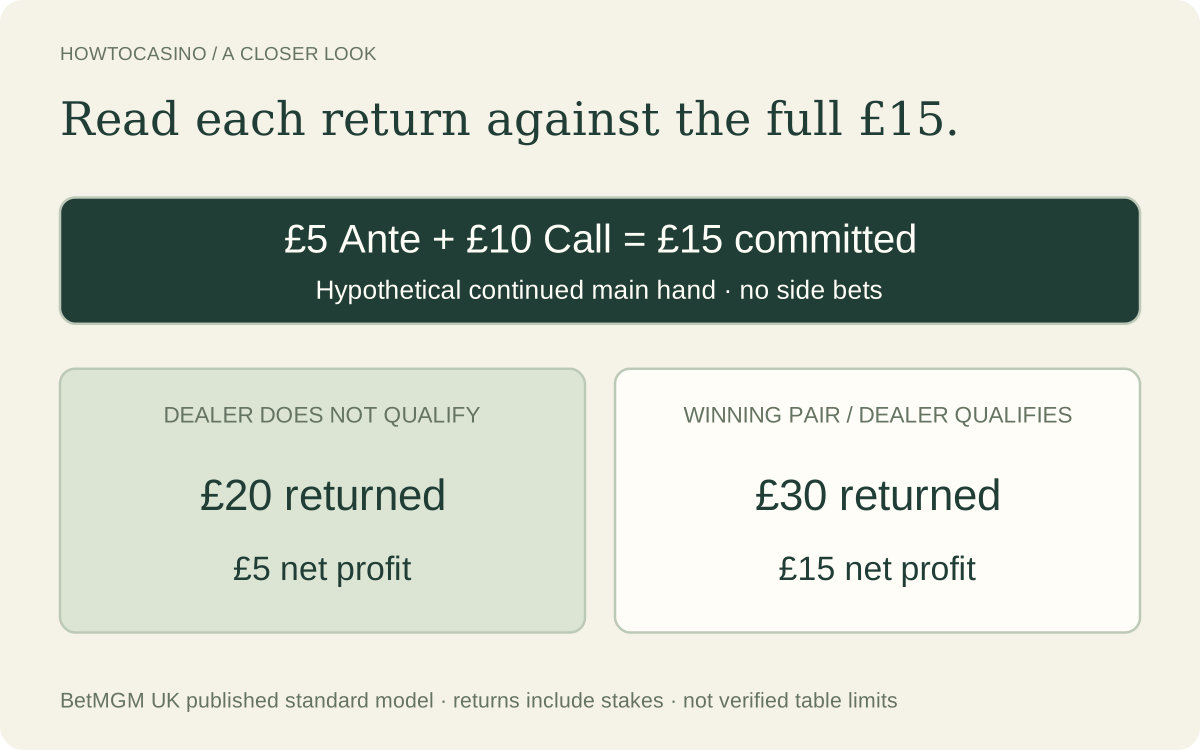
Calling does not mean making the total stake equal to twice the Ante. It means adding a new wager of that amount. A £5 Ante therefore requires a further £10 to continue: £15 in total, before optional bets.
A decision deadline also matters in the live model. The published instructions say that failing to choose in time causes an automatic fold of the main hand. Do not assume that an unanswered screen has preserved your Ante. No universal number of decision seconds is established here.
What does Ace–King dealer qualification mean?
The dealer qualifies with Ace–King high or any stronger five-card hand. A pair, even a low pair, outranks high card and qualifies. An Ace without a King is not enough when the rest of the cards make only a lower high-card hand.
| Dealer hand example | Qualification | Reason |
|---|---|---|
| A♣ K♦ 9♥ 6♠ 3♣ | Qualifies | Ace–King high. |
| A♣ Q♦ J♥ 8♠ 3♣ | Does not qualify | Only Ace–Queen high; no pair or higher combination. |
| 2♣ 2♦ 9♥ 6♠ 3♣ | Qualifies | A pair outranks any high-card hand. |
Qualification is not a claim that the dealer has beaten you. A qualifying dealer can still lose to your stronger hand. Conversely, if the dealer does not qualify, the continued-hand settlement follows the nonqualification rule instead of paying the Call according to your hand’s rank.
How are Ante and Call settled?
| Main-hand event | Ante | Call |
|---|---|---|
| You fold | Lost. | No Call is placed. |
| You Call; dealer does not qualify | Pays 1:1 profit, with stake returned. | Returned without profit. |
| Dealer qualifies and you win | Pays 1:1 profit, with stake returned. | Pays the applicable hand-rank odds, with stake returned. |
| Dealer qualifies and wins | Lost. | Lost. |
| The qualifying hands tie | Returned. | Returned. |
The nonqualification payment applies to a hand that continued. It does not restore an Ante already surrendered by folding. That is why a later view of the dealer’s weak hand is not evidence that a folded main wager should be refunded.
An actual tie compares the complete five-card ranking. Two hands both described as one pair may have different pair ranks or kickers. The category name alone is not enough to call the result a push.
Which Call payout figures apply in this model?
The checked model quotes the following Call profit odds. A winning Call stake is returned separately. The table applies when the dealer qualifies and your hand wins; it is neither the Ante table nor the optional jackpot table.
| Winning hand | Call profit odds |
|---|---|
| Royal flush | 100:1 |
| Straight flush | 50:1 |
| Four of a kind | 25:1 |
| Full house | 10:1 |
| Flush | 7:1 |
| Straight | 5:1 |
| Three of a kind | 3:1 |
| Two pairs | 2:1 |
| One pair or lower | 1:1 |
Other Caribbean Stud summaries use different middle rows, including four-of-a-kind or flush payouts. Do not combine those odds with this model’s examples. Even the same game-family name is insufficient evidence that a table uses this exact paytable.
What do the payouts mean in pounds?
The following calculations use a hypothetical £5 Ante and a £10 Call, making £15 committed to a continued main hand. They exclude side bets, assume no additional payout cap and use the published model’s profit odds. A total return includes returned stakes; net result is total return minus money committed.
| Constructed outcome | Total return | Net result |
|---|---|---|
| Fold before placing a Call | £0 from the £5 Ante. | £5 loss; only £5 was committed. |
| Call; dealer does not qualify | £10 Ante return + £10 Call return = £20. | £5 profit. |
| Call; winning pair against a qualifying dealer | £10 Ante return + £20 Call return = £30. | £15 profit. |
| Call; winning flush against a qualifying dealer | £10 Ante return + £80 Call return = £90. | £75 profit. |
| Call; qualifying dealer wins | £0. | £15 loss. |
| Call; complete hands tie | £5 Ante + £10 Call = £15. | £0. |
For the flush, 7:1 on the £10 Call means £70 profit plus the £10 Call stake. Add the £10 returned from the winning Ante, and the full return is £90. Applying 7:1 to all £15 would incorrectly use the Call odds on the Ante too.
The qualification boundary also changes a very strong hand. A Royal Flush against a nonqualifying dealer still returns £20 in this example. Against a qualifying dealer that it beats, the Call returns £1,010 and the Ante £10: £1,020 total and £1,005 net profit. The same player hand can therefore produce different returns because the dealer qualification branch comes first.
Which hand rankings can cause confusion?
Use five-card poker rankings: straight beats three of a kind, and flush beats straight. Ace can be high in an Ace-high straight or low in A–2–3–4–5, which is a five-high straight. It does not join a wraparound sequence such as Q–K–A–2–3.
Three Card Poker is a different game: it uses three-card rankings, Queen-high dealer qualification and a different continuation amount in the model covered by our guide. Video poker is different again, using holds, a draw and a paytable rather than this dealer qualification branch.
A simple instruction such as always continue with a certain category is not a complete, independently verified strategy for this model. Strategy depends on the precise rules, visible information and paytable. The arithmetic above explains settlement; it does not establish when taking the additional risk has the best expected value.
How do 5+1 and jackpot bets differ from the main hand?
In the published live model, the optional 5+1 Bonus evaluates the best five-card hand from your five cards plus the dealer’s exposed card. It has a separate stake and paytable. Adding that dealer card for the side bet does not change the five-card hand used for the main comparison.
For example, assume your cards are 7♣ 7♦ A♥ K♠ 2♣ and the dealer’s exposed card is 7♥. Your main hand remains a pair of sevens; the six-card set contains three sevens for evaluating 5+1. The two bets can therefore be classified differently on the same deal.
A jackpot wager is another separate product. Its advertised pool is not automatically an amount every qualifying player receives personally; the published model includes sharing rules. Check the exact current prize terms rather than borrowing a universal stake or payout from a review.
Light & Wonder’s separate Caribbean Stud Bonus product also describes a different optional-bonus qualification. A shared Caribbean Stud name does not make that bonus interchangeable with this live model’s 5+1 wager.
What should you check at a GB service?
The checked BetMGM help belongs to its GB service. LeoVegas Gaming PLC, account 39198, had active Remote Casino permission, and betmgm.co.uk was an Active registered domain on 31 October 2026. Those checks establish the service’s permission separately from the rules document; they do not verify a live table, its limits or an individual account’s eligibility.
- Match the complete game title and supplier.
- Compare the Ante, additional Call amount and exact Call paytable.
- Check the deadline, tie rule, optional wagers and any maximum payout.
- Read the selected game’s return information and its stated calculation basis; do not substitute a classic house-edge figure from another model.
- For a disputed settlement, keep the round reference, stakes, player/dealer cards and the exact relevant rule.
The game-rules guide explains how to identify the applicable instructions. If money remains disputed, use the payment-complaint guide to set out the amount and evidence without attempting to recreate the result through more betting.
Related questions
How much does it cost to Call in Caribbean Stud?
In the published model explained here, the Call adds twice the Ante. A hypothetical £5 Ante therefore needs a further £10 to continue, making £15 committed to the main hand before side bets.
What happens if the dealer does not qualify?
For a continued hand, the Ante pays 1:1 and the Call is returned without profit. A previously folded Ante remains lost. With a £5 Ante and £10 Call, the £20 total return means £5 net profit.
Does an Ace qualify the dealer?
Not by itself. The dealer needs Ace–King high or a stronger five-card hand. A pair qualifies even when it is a low pair; an Ace–Queen high hand without a better combination does not.
Does a Royal Flush always receive the 100:1 Call payout?
In this model the Call paytable applies only after the dealer qualifies and the player wins. If the dealer does not qualify, the continued hand receives the separate nonqualification settlement.
Is Caribbean Stud the same as Three Card Poker?
No. This is a five-card game with Ace–King dealer qualification and a twice-Ante Call. The Three Card Poker model covered separately uses different rankings, qualification and continuation cost.
Did you test a live Caribbean Stud table?
No. We checked BetMGM UK’s public standard help, supplier context and GB permission records. We did not verify a current table, deployed build, live minimum or individual account access.