Does “best odds” mean the chance of a hit or the smallest expected loss?
First decide which question a comparison is answering. A high chance of receiving something, a large maximum prize, a small theoretical loss per pound and a high probability of finishing a session ahead are different measures. None can be substituted for the others without the game’s full probability and payout model.
| Figure | Useful interpretation | What it cannot establish alone |
|---|---|---|
| Win or hit probability | How often a defined outcome occurs | Whether its return exceeds the stake |
| Profit payout, such as 35:1 | Profit on a qualifying winning wager | How often it happens |
| Theoretical RTP or margin | Average return or expected disadvantage on a stated basis | Your next result or final balance |
| Maximum award | A limit in the game rules | The chance of receiving it |
| Observed site payout percentage | An aggregate historical result on a defined sample | A ranking of your personal future chances |
This guide compares a small set of clearly labelled examples. It is not an exhaustive ranking of every GB product or an operator recommendation. The Gambling Commission requires appropriate rules and likelihood information before commitment; that information can take different forms, so do not assume every game publishes every statistic.
How do specific rules change the published numbers?
| Specified example | Theoretical return or margin | Necessary qualification |
|---|---|---|
| PokerStars UK Premium Blackjack page | Published RTP 99.67%; complement 0.33% | Named four-deck S17 rules; calculation strategy/basis not fully stated |
| PokerStars UK Classic Blackjack page | Published RTP 99.41%; complement 0.59% | Named eight-deck H17 rules; other rules also differ |
| Single-zero roulette, ordinary conventional wagers | RTP 36/37 ≈ 97.30%; edge 1/37 ≈ 2.70% | Fair equal-pocket model with stated standard payouts |
| Double-zero roulette, ordinary conventional wagers | RTP 36/38 ≈ 94.74%; edge 2/38 ≈ 5.26% | Excludes the differently priced five-number basket |
| Single-zero eligible even-money wager with La Partage | RTP 73/74 ≈ 98.65%; edge 1/74 ≈ 1.35% | Only when that exact half-stake-on-zero rule applies |
| Invented slot version with 96% theoretical RTP | Complementary edge 4% | Illustrative figure, not a market average or named-game offer |
The blackjack entries are operator-published figures consulted on 29 October 2026, not independently audited returns. Their complements use the same basis as those publications. The roulette rows are calculations from explicitly stated mathematical models, supported by conventional rule descriptions; they do not certify a live wheel or GB product availability.
La Partage is particularly easy to mislabel. The reduced edge belongs to qualifying even-money wagers under that rule, not every bet at a table called French roulette. A straight-up wager does not acquire the same half-loss treatment just because it appears on that layout.
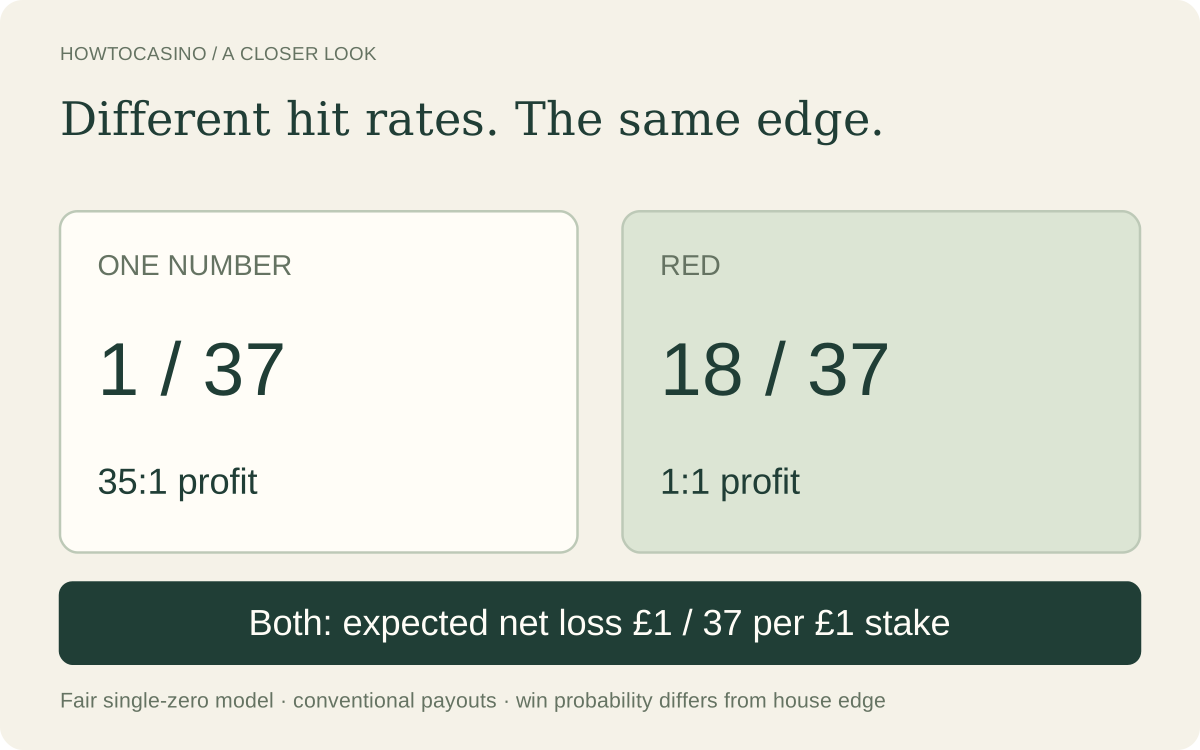
How can two bets have the same edge but very different chances of winning?
Use a fair 37-pocket single-zero wheel and one £1 wager. A conventional straight-up bet wins on one pocket and returns £36 including the £1 stake; it returns £0 on the other 36. Its expected total return is (1/37 × £36) + (36/37 × £0) = £36/37, about 97.30p.
A conventional red bet wins on 18 pockets and returns £2 including the stake; it returns £0 on the other 19. Its expected total return is (18/37 × £2) + (19/37 × £0) = £36/37 again. Each has expected net loss of £1/37, but their hit probabilities are about 2.70% and 48.65% respectively.
The coincidence between a single number’s hit percentage and the rounded house edge is just that: the quantities have different meanings. Covering more numbers changes the distribution of returns. At conventional prices it does not automatically remove the house advantage.
For La Partage on an eligible £1 red wager, the model is 18/37 returning £2, 18/37 returning £0 and zero returning 50p. The expected return is £36.50/37 = £73/74, leaving an expected half-pound loss per 37 pounds staked. Our roulette reference explains the other payout models.
Why do blackjack, baccarat and video poker need their own qualifications?
Blackjack player decisions and action rules influence returns. A single universal “0.5% blackjack edge” omits too much information. Even two published low-margin examples can differ in deck count, S17/H17, splitting and doubling. Our blackjack odds article separates those returns from a natural’s probability.
Baccarat has different Player, Banker and Tie settlements; a commission on a winning Banker wager is not a charge on every result. No-commission variants may change selected payouts instead. Comparing only the word baccarat misses the bet and rule set. The commission explainer works through that distinction.
Video poker depends on the exact paytable and the decisions used in the calculation. A quoted return for one Jacks or Better table cannot be transferred to a different full-house or flush payout, a different royal-flush column, or another hold strategy. The Jacks or Better guide shows what to read without promising that a named paytable is currently available in GB.
Likewise, a slot’s title alone may not identify the active RTP version, feature conditions or jackpot contribution. A low-margin main wager also does not describe a separately priced side bet. These are comparisons of rules, not badges attached permanently to a game family.
Can a lower-edge game still have a larger expected cost?
Yes, if the total exposure differs. Assume two invented games whose expected net losses are expressed per pound of all accepted stakes. Game A has a 1% edge and £800 total stakes, giving an £8 expected loss. Game B has a 4% edge and £100 total stakes, giving a £4 expected loss. These are hypothetical model expectations, not session predictions.
The lower percentage does not make A’s total smaller. Stake size, repeated rounds and recycled returns determine turnover. Time matters through how many accepted wagers occur, but faster play does not improve an unfavourable expectation. A deposit is money added to an account; it can fund multiple successive wagers.
Keep the denominator consistent. If a blackjack source states its edge per initial wager, split and doubled amounts cannot be mixed into that denominator without adjustment. Nor can an aggregate casino payout percentage be treated as a return for one table. The observed figure depends on the mix of games, decisions, samples and awards.
Variance concerns the spread of possible results. A small theoretical disadvantage can coexist with a large short-term loss; a high advertised return is neither a loss cap nor evidence that continuing after losses will recover them. The RTP and volatility guides explain these limits separately.
What should a useful odds comparison let you check?
- Identify the exact game version and the wager being compared, including any separate side bet.
- Read the payout as profit or total return, and distinguish a payout event from a profitable outcome.
- Locate the stated probability, RTP or margin and its calculation assumptions. For decision games, look for the strategy used.
- Check the denominator: opening stake, total committed stakes or another clearly defined base.
- Check zero treatment, commission, special dealer totals, jackpot eligibility and paytable variants that affect this wager.
- Treat theoretical returns as model information. They do not forecast your session, validate an operator or turn gambling into income.
If a list cannot identify these details, its precise-looking percentages may not support the comparison it makes. Use the exact rules and the appropriate specialist explanation rather than choosing an operator because an unrelated page calls it the “most winning” casino.
Related questions
Which casino game is easiest to win?
That depends on what win means. Receiving any return, winning an individual wager and finishing a session in profit are different events. A high hit frequency does not prove the lowest expected loss.
Do red and a single number have the same roulette house edge?
In the fair single-zero model with conventional 1:1 and 35:1 profit prices, yes: each edge is 1/37, about 2.70%. Their hit probabilities are 18/37 and 1/37.
Does French roulette always have a 1.35% edge?
No. That figure describes eligible even-money bets when the specified La Partage half-stake-on-zero rule applies. Other wagers and zero rules need separate calculations.
Is RTP just another name for win probability?
No. RTP weights possible returns by their probabilities on a specified stake basis. Win probability counts the defined winning events; it does not account for their different sizes.
Does a 96% RTP guarantee £96 back from a £100 deposit?
No. It is not a deposit refund or session guarantee. Total stakes may differ from the deposit, and actual short-term results can vary substantially.
Can I rank casinos using their reported payout percentages?
A historical aggregate alone does not establish your future chances. Sample periods, game mix, jackpot awards and calculation bases need checking; it is not the same as an exact game’s theoretical return.