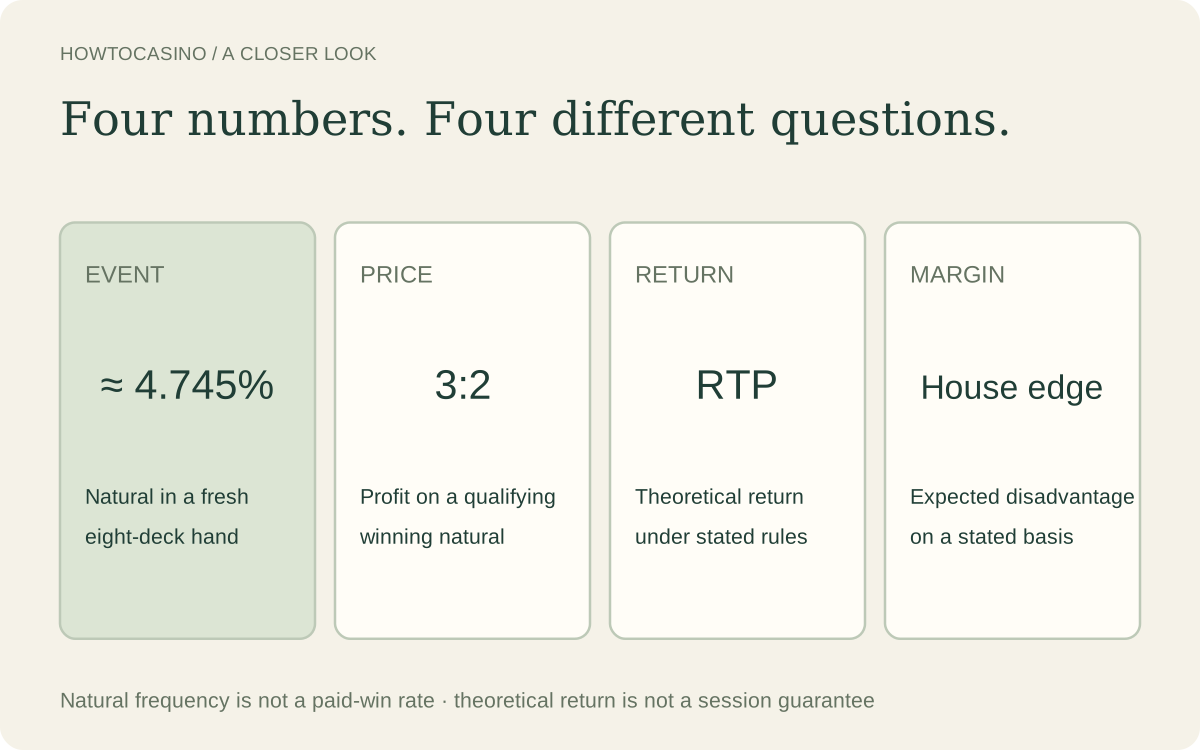
Which “blackjack odds” are you trying to find?
| Measure | Question answered | Common mistake |
|---|---|---|
| Outcome probability | How likely is this event under a stated model? | Treating a natural’s frequency as every-round win probability |
| Payout price, such as 3:2 | What profit does a qualifying winning stake earn? | Reading 3:2 as the chance of winning |
| Theoretical RTP | What average return does the specified model imply? | Expecting that percentage of your deposit back |
| House edge or margin | What expected disadvantage does the model assign to the wager? | Treating it as the chance of losing one hand |
A push returns the relevant stake and is not a profit. An ordinary 21 is not automatically a natural; a natural can push against a dealer natural. Split hands and doubled stakes make an opening “round” different from one unit wager. Any claimed win rate needs these definitions before it is useful.
The Gambling Commission distinguishes designed returns from observed results and notes that player choices can affect blackjack returns. A percentage without rules, decision assumptions and a counting method is incomplete. This article is a probability reference, not a betting or action system.
What is the probability of being dealt a natural blackjack?
Assume a complete, well-randomised shoe of D standard 52-card decks, no jokers, and an unconditional initial two-card hand. There are 4D aces and 16D ten-value cards: tens, jacks, queens and kings. A natural needs one of each, in either order, before splitting.
The probability is 2 × (4D / 52D) × (16D / (52D − 1)). The factor 2 accounts for ace-first and ten-value-first. The second denominator is one smaller because the first card is no longer available. This calculation does not condition on an exposed dealer card or earlier cards removed from the shoe.
| Fresh shoe | Natural probability | Approximate frequency |
|---|---|---|
| 1 deck | 4.82655% | About 1 in 20.72 initial hands |
| 4 decks | 4.75660% | About 1 in 21.02 initial hands |
| 6 decks | 4.74895% | About 1 in 21.06 initial hands |
| 8 decks | 4.74513% | About 1 in 21.07 initial hands |
These figures follow from card counts, not a simulation or an observed account. They describe a possible initial hand, not an award guarantee. A + K after splitting aces can be an ordinary 21 under the table rules; A + 5 + 5 is a three-card 21, not the two-card event counted here.
Once known cards have been removed, the conditional calculation changes. Some software versions reshuffle each hand, while a physical shoe can retain a changing composition between shuffles. Do not silently use the fresh-shoe calculation for every game state.
What do 3:2, 6:5 and 1:1 mean in pounds?
The following table uses a £10 qualifying stake. “Total returned” includes that stake; “net result” is the return minus the £10 committed. The natural is assumed to beat the dealer and qualify for the stated price, without other wagers or deductions.
| Settlement model | Profit price | Total returned | Net result |
|---|---|---|---|
| Ordinary main-hand win | 1:1 | £20 | +£10 |
| Qualifying winning natural | 3:2 | £25 | +£15 |
| Hypothetical natural at a different price | 6:5 | £22 | +£12 |
| Push | Stake returned | £10 | £0 |
| Loss | No return | £0 | −£10 |
The 6:5 row is an arithmetic comparison, not a verified current GB table offer. On this same qualifying £10 natural, it returns £3 less than 3:2. That £3 difference does not by itself give a full-game house edge: you would need the frequency and settlement of every relevant event under the complete rules.
Our payout explanation develops the distinction between profit and total return. A displayed payout should never be treated as a percentage chance of winning.
What do actual published blackjack RTP figures establish?
| Named published rule set | Published main-game theoretical RTP | Calculated complement |
|---|---|---|
| PokerStars UK Classic | 99.41% | 0.59% |
| PokerStars UK Premium | 99.67% | 0.33% |
| BetMGM UK standard Live Blackjack help | 99.28%, described as optimal | 0.72% |
These are attributed operator figures consulted on 29 October 2026, not our independent audit or account results. Classic describes eight decks and H17; Premium describes four decks and S17. Other action and splitting rules also differ. Their 0.26 percentage-point RTP difference cannot be assigned solely to soft 17.
The complement column is 100% minus the published RTP, on that publication’s basis. Blackjack sources may use an opening wager or total committed stakes as their denominator. Do not treat two margins as directly comparable if the bases or player decisions differ. The PokerStars rule pages do not fully document their calculation strategy and denominator.
BetMGM explicitly calls its figure an optimal theoretical payout and gives separate figures for side bets. None of these numbers means a player wins that percentage of hands, achieves that personal return, or finds the same rules under a similar name elsewhere. The in-game rules remain essential.
Is blackjack a 50/50 game because there are two sides?
No. Two sides do not imply two equally likely outcomes. There can be wins, losses and pushes, natural premiums and extra stakes. A player who busts loses an ordinary main wager before a later dealer bust could matter. These asymmetric rules affect the mathematics.
You can also lose more hands than you win without the loss percentage equalling the house edge: events pay different amounts and pushes return stakes. Conversely, a high proportion of small returns does not establish a profitable session. To calculate a complete win probability, specify the game, strategy, shoe model and treatment of every settlement.
The dealer’s mandatory drawing rule helps define that model, but it is not a prediction of the dealer’s next card. Our dealer procedure guide explains the difference between hard 17, soft 17 and a visible upcard.
How does expected loss differ from a deposit or a session result?
Take a deliberately hypothetical game with an expected net loss of 0.5% of opening main-hand stakes under a specified decision model. If those opening stakes total £400, the model’s expected loss is £400 × 0.005 = £2. This is not a claim that every blackjack table has a 0.5% edge.
A £40 deposit recycled into wagers can produce £400 of opening stakes; a deposit and turnover are different quantities. Split and double stakes need their own consistent accounting. A model expressed per opening wager cannot simply be multiplied by a different total-stakes figure without reconciling the denominator.
An expectation is an average over possible results. It neither limits your loss to £2 nor guarantees the money needed to complete a planned number of rounds. A short session can lose the full available balance. Playing longer does not create an obligation for previous losses to be repaid.
Before interpreting an advertised number, record the exact game, natural price, H17/S17, decks and shuffle procedure, extra-stake rules, side-bet prices, decision assumptions and denominator. The broader house-edge comparison shows why the same caution matters across casino games.
Related questions
Is the chance of blackjack the same as the chance of winning?
No. The approximately 4.75% fresh-shoe figure concerns an initial ace plus ten-value card. Winning a completed hand is a different event, and a dealer natural can prevent a natural from earning profit.
Does 99.41% RTP mean a 99.41% win rate?
No. It is the operator-published theoretical return for a named game model, not the proportion of hands you win or a guaranteed personal return.
Does using more decks always explain the whole house edge?
No. Deck count is one rule variable. Natural payouts, dealer drawing rules, splitting, doubling, surrender, dealer-blackjack treatment and player decisions can all matter.
Does a lower house edge guarantee a profitable session?
No. It changes the model’s expected loss on the stated basis, not the certainty or size of an individual session result.
Is 6:5 another way of writing 3:2?
No. On a qualifying £10 stake, 6:5 gives £12 profit and 3:2 gives £15 profit. Each total return also includes the £10 stake. The 6:5 illustration here is not a current GB offer claim.
Do blackjack side bets share the main game’s RTP?
No. They have separate qualifying events, prices and theoretical returns. A main-game figure cannot be assigned to 21+3, insurance or another side bet.