How do you calculate a 3:2 payout?
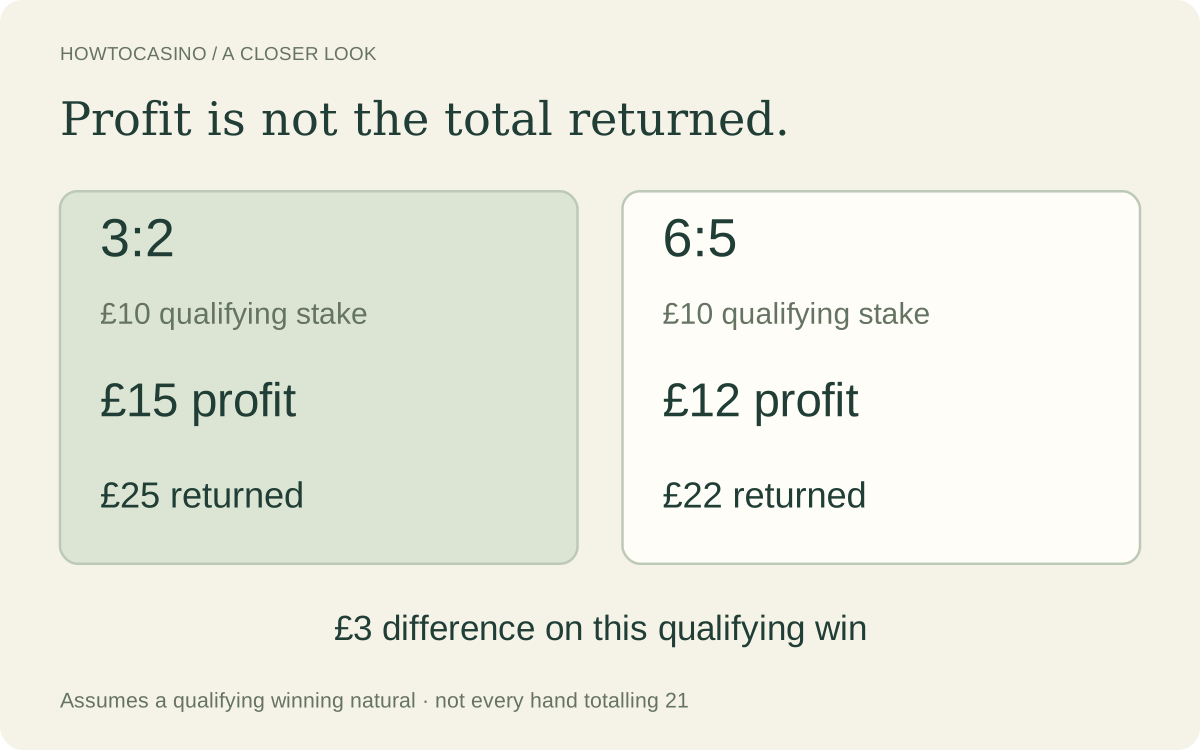
Read the ratio as profit relative to the stake: divide the stake by 2 and multiply by 3. Then add the original stake if you want the total returned. For £10, that is £10 ÷ 2 × 3 = £15 profit; £15 + £10 = £25 returned.
| Qualifying winning stake | Profit at 3:2 | Total returned |
|---|---|---|
| £2 | £3 | £5 |
| £4 | £6 | £10 |
| £10 | £15 | £25 |
| £20 | £30 | £50 |
A £1 qualifying stake would produce £1.50 profit under an exact 3:2 calculation. Actual games can have permitted stake increments and rounding rules. Use the published cash rules when a ratio calculation creates amounts smaller than the currency unit the game settles.
Which hands qualify for the natural-blackjack rate?
Under conventional rules, a natural is the qualifying original two-card ace and ten-valued card. The dealer result and the game's priority rules still matter. Two naturals normally push rather than making the player a 3:2 profit.
A drawn three-card 21 is a different hand. For example, seven–seven–seven totals 21 but is not an original two-card natural. A 21 after splitting an ace is also commonly excluded from the natural category. Do not assign the advertised natural rate simply because the display says 21.
Our guides to a push and splitting explain the separate return and eligibility checks. A special variant may redefine priorities, so the exact qualifying wording belongs with the advertised payout.
How does 3:2 compare with 6:5 and 1:1?
| Profit rate on the same qualifying £10 win | Profit | Total returned |
|---|---|---|
| 3:2 | £15 | £25 |
| 6:5 | £12 | £22 |
| 1:1 | £10 | £20 |
The £3 difference between 3:2 and 6:5 in this example applies when that particular qualifying £10 hand wins. It is not a £3 cost on every deal. Over ten hypothetical qualifying £10 wins, the arithmetic difference in profit would be £30, assuming the rest of the comparison stayed unchanged.
If two rule sets truly differed only in the natural payout, reducing that payout would reduce the return on qualifying natural wins. That statement does not supply the overall house edge. You also need the frequency of each outcome, deck and dealer rules, permitted decisions and the strategy assumption.
Does 3:2 apply to doubles, insurance or side bets?
An ordinary winning main hand can pay 1:1 profit even though the table advertises 3:2 for naturals. A conventional doubled hand increases the stake on an ordinary hand; it does not automatically turn its eventual result into a natural blackjack.
Insurance has its own profit ratio and event, while optional side bets use their own schedules. A banner about blackjack payouts is not the paytable for every wager. Our insurance guide separates a 2:1 profit from the amount returned including that side stake.
This also prevents an accounting mistake when a round contains several bets. Calculate the result of each, add the money returned and subtract all stakes committed. Looking only at a larger winning return can hide a loss elsewhere in the round.
What should you check before comparing table payouts?
- Find the exact natural-blackjack profit ratio and its qualification rules.
- Check pushes, drawn 21s and how split aces are classified.
- Compare deck count, H17/S17, splitting, doubling and surrender rather than changing several assumptions at once.
- Read any special side-bet, multiplier or fee rules separately.
- Treat a quoted RTP as a model with assumptions, not a guaranteed result for your session.
The same care applies when comparing a published RTP figure with your own experience. RTP describes long-run return under a specified model, whereas a session can end with a full loss even at a table paying the larger natural ratio.
Related questions
Does a £10 blackjack at 3:2 return £15 or £25?
It makes £15 profit and returns £25 including the £10 stake, assuming it is a qualifying winning natural. The two numbers refer to different accounting measures.
Is 6:5 a bigger payout because the numbers are bigger?
No. Six divided by five is 1.2, while three divided by two is 1.5. On the same qualifying £10 win that means £12 profit at 6:5 and £15 at 3:2.
Does every blackjack game pay 3:2?
No. Check the actual table rules, including special variants and any conditions attached to a different payout. The word blackjack in a title is not a complete settlement rule.