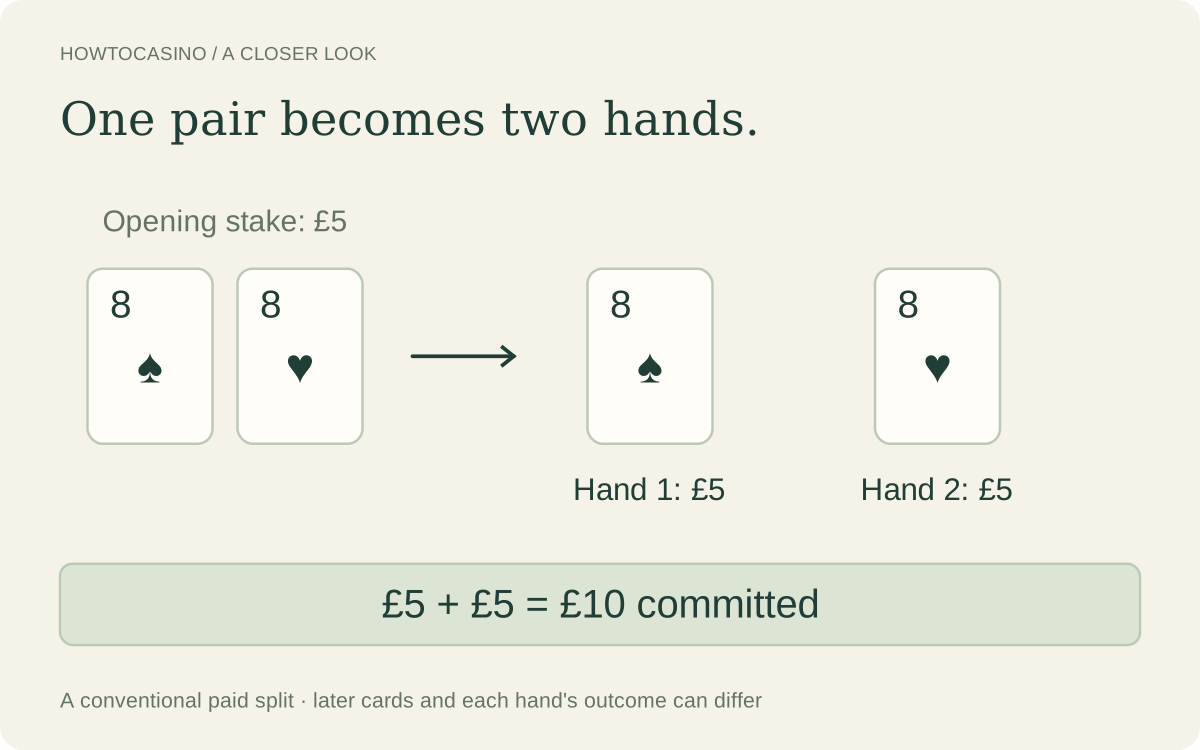
How does a paid split change the hand and stake?
Imagine an opening wager of £5 and two eights. If the table permits the action, a paid split adds another £5 and separates the eights. Each new hand begins with one eight and receives further cards under the split rules. You now have £10 committed, even though only one initial deal began the round.
A split is therefore different from doubling down. A conventional double adds to the stake on the existing hand and limits it to one more card. A split creates separately played hands, although those hands can share constraints imposed by the same table.
The added wager does not buy a guaranteed improvement. Two finished hands can both lose, and a win on one can merely offset a loss on the other. Count the full commitment rather than focusing only on the original £5.
How are split hands paid?
| Illustration: two £5 hands | Total returned | Net against £10 committed |
|---|---|---|
| One ordinary 1:1 win and one full loss | £10 | £0 |
| One ordinary 1:1 win and one push | £15 | £5 profit |
| Two ordinary 1:1 wins | £20 | £10 profit |
| Two full losses | £0 | £10 loss |
These rows assume ordinary 1:1-profit wins and no further bets. A push returns the stake on the hand concerned, while a winning hand returns its stake and profit. A side bet or an additional double changes the amount committed and needs to be added separately.
Which cards can be split, and can you split again?
The table decides what qualifies as a pair. Some rules permit equal blackjack values, including different ten-valued ranks, while a specific game can restrict eligible pairs or subsequent actions. Do not infer eligibility solely from a shared total of 20 or a picture of two matching cards.
Resplitting means splitting another eligible pair formed during the same round. Read both the maximum number of hands and any special ace limit: the number of permitted splits and the number of resulting hands are not the same count. One split creates two hands; another split of one of them creates three.
Published PokerStars variants demonstrate that hand limits differ. Premium and Three-Seat descriptions do not specify the same number of permitted resplits. These are examples of table-specific restrictions, rather than a promise about current availability at other operators.
What is different about split aces and DAS?
Split aces often have tighter restrictions, such as one further card for each ace. Whether aces can be resplit, hit again or doubled must be checked individually. An ace receiving a ten-valued card after a split is commonly treated as 21 rather than a qualifying original natural blackjack.
DAS means double after split. It concerns the availability of the double action on a split hand, not an automatic doubling of every split wager. If two £5 hands are in play and one is conventionally doubled for another £5, the total commitment becomes £15.
Our guide to blackjack payouts explains why natural blackjack's advertised 3:2 rate cannot simply be applied to every 21 after splitting.
Does splitting always mean another cash stake?
This guide's main example is a conventional paid split. Evolution's Free Bet Blackjack is an example of a named variant offering selected free split features. Such a feature requires its own eligibility and settlement explanation; it is not a reason to assume all added hands are cash wagers or all games offer free splits.
- Check eligible pairs, hand limits and restrictions on aces.
- Check DAS and how the original and added stakes settle if the dealer has blackjack.
- Identify any free-bet token, optional charge or special hand priority before using ordinary cash calculations.
- Use a decision guide only if it matches the actual deck, dealer, payout and action rules.
The meaning of split does not establish when it is the best decision. A strategy copied from another configuration can be inappropriate, and more hands mean more possible exposure rather than a guaranteed better result.
Related questions
Does splitting double my chance of profit?
No. It creates additional hands with their own possible results and often increases the money at risk. There is no general rule that the probability of an overall profit doubles.
Is a ten after a split ace automatically blackjack?
Not under the common rule that restricts natural blackjack to the original qualifying two-card hand. Check the game's definition: a resulting 21 may receive an ordinary win rather than a natural-blackjack payout.
Can I split after taking a hit?
The conventional split concerns an eligible opening two-card pair. Do not assume a later pair or another multi-card hand can be split unless the named variant explicitly permits it.