What are you actually betting on?
The insurance decision concerns the dealer's natural blackjack, not whether the player's hand will win. A common trigger for the offer is a dealer ace facing up. A ten-valued second dealer card then completes the relevant natural: ace plus ten, jack, queen or king.
Taking insurance does not change your cards, require the dealer to stop drawing later or refund every kind of loss. If the dealer does not have the qualifying natural, insurance loses even if the dealer later wins with a drawn total of 21. The distinction between a natural blackjack and a later 21 matters.
The half-stake amount is common, but check whether the table specifies a fixed half stake or allows an amount up to that limit. Dealer procedures also differ: a game can check a face-down card or use another dealing procedure. Read the particular table's offer and settlement rules.
How does insurance work on a £10 main bet?
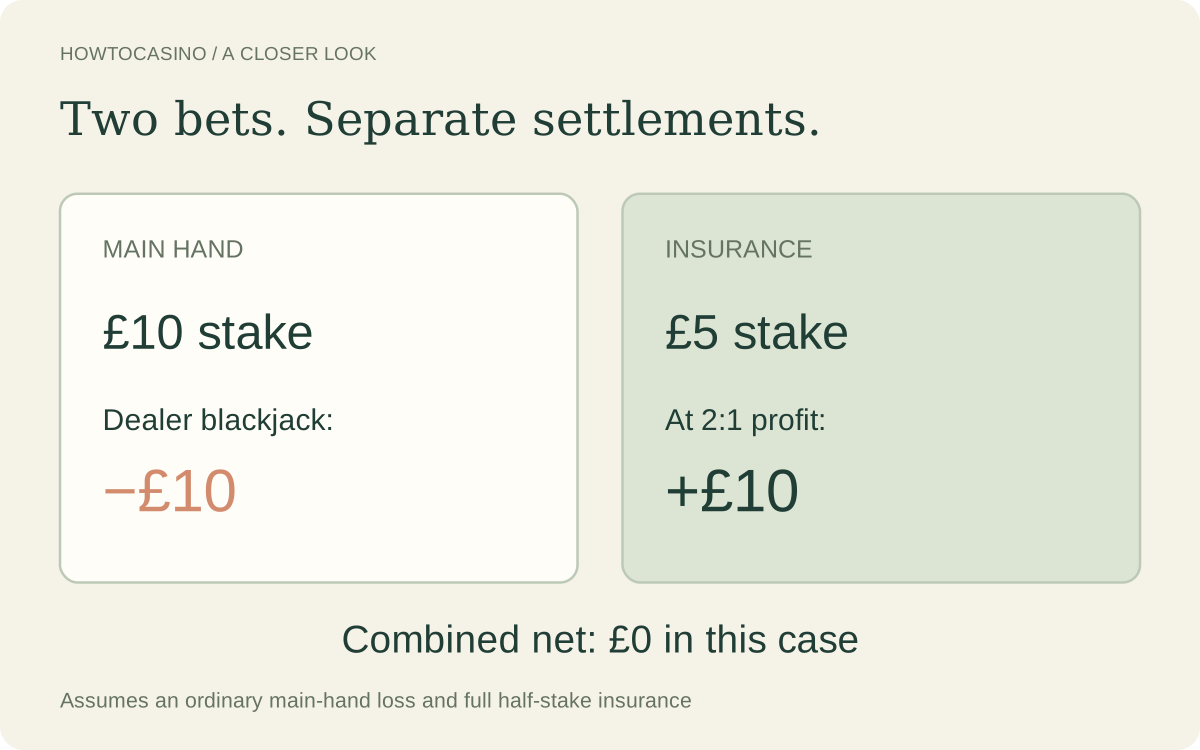
Assume an ordinary main hand that loses to dealer blackjack, a £10 original wager, full £5 insurance and an insurance payout of 2:1 profit. You have committed £15 in total. If insurance wins, it returns the £5 insurance stake plus £10 profit: £15 back, rather than £10 back.
| Outcome in this illustration | Main hand net | Insurance net | Combined net |
|---|---|---|---|
| Dealer blackjack; ordinary main hand loses | −£10 | +£10 | £0 |
| No dealer blackjack; main hand later wins at 1:1 | +£10 | −£5 | +£5 |
| No dealer blackjack; main hand later loses | −£10 | −£5 | −£15 |
| No dealer blackjack; main hand pushes | £0 | −£5 | −£5 |
This is why insurance can offset one particular loss without making the whole decision risk-free. The table assumes no player natural, doubled wager, split hand or special settlement rule. Those cases must be evaluated separately rather than forced into the same four rows.
Is a 2:1 insurance payout good value?
A useful arithmetic test separates the payout from the probability. For a £1 insurance stake paying 2:1 profit, let p be the probability of dealer blackjack at the decision point. The expected net result is £2 × p minus £1 × (1 − p), or £3p − £1. It breaks even at p = 1/3, before any other conditions.
In an invented probability model with a 30% chance, 100 such £1 bets have an expected £60 profit from the winning bets and £70 losses from the losing bets: £10 down overall. At 40%, the same arithmetic would produce £20 up. Neither model is an estimate for the live table in front of you.
The actual probability depends on the remaining card composition and available information. A displayed ace, a previous win or a losing streak alone does not provide a verified probability above the threshold. A payout of 2:1 is therefore not evidence by itself that the bet has positive expected value.
How is even money different?
Even money can be offered when the player already has a natural blackjack and the dealer shows an ace. Under the conventional 3:2 blackjack and 2:1 insurance model, accepting even money fixes the player's profit at the original stake: a £10 main bet earns £10 profit.
The equivalence can be checked directly. If dealer blackjack makes the main hand push, full £5 insurance makes £10 profit. If the dealer has no blackjack, the £15 main-hand profit is reduced by losing the £5 insurance stake, again leaving £10. This calculation depends on the specified 3:2 and 2:1 rules; different payouts require different arithmetic.
What should you check in the actual game?
- Identify the insurance trigger, maximum stake and quoted profit odds.
- Confirm what counts as dealer blackjack and when the game checks for it.
- Read the main-hand rules separately, especially for a player natural, split or doubled hand.
- Keep the insurance charge separate when calculating the full round result.
Insurance belongs with blackjack side bets, while doubling down adds to the main wager in exchange for a final card. Knowing which kind of bet you have accepted is essential when reading the game's history and settlement.
Related questions
Does insurance protect every losing blackjack hand?
No. It pays only on the event defined by the insurance rules, commonly dealer natural blackjack after an ace upcard. If that event does not occur, the side bet loses regardless of what happens to the player's hand.
Do you have to take insurance to continue the main hand?
Insurance is an optional separate wager in the conventional game described here. Declining it does not itself end the main hand; the dealer's check and normal settlement rules still apply.
Is even money always the same calculation?
The familiar equivalence assumes 3:2 profit on a natural blackjack, 2:1 insurance and a full half-stake insurance bet. Different payouts, stakes or dealer-blackjack rules need their own calculation.