What is each blackjack card worth?
| Card | Conventional main-hand value |
|---|---|
| 2–10 | Its printed number |
| Jack, queen, king | 10 each |
| Ace | 1 or 11, using a total that does not exceed 21 where possible |
The main total adds point values, not poker rankings. A king is not worth more points than a jack, and a queen plus a 6 totals 16. Suits do not change this ordinary point calculation; a separately defined side bet may use ranks or suits differently.
This is a hand-total reference. The beginner blackjack guide explains the round, player actions and settlements, while the side-bet guide treats those separate wagers.
How do you count a hand containing one or more aces?
- Count every non-ace card at its conventional value and every ace as 1.
- If this lowest total exceeds 21, the hand has busted; changing an ace cannot reduce it further.
- Otherwise, if at least one ace exists and adding 10 keeps the total at or below 21, add 10 once.
- Use that highest non-busting total. If the extra 10 was usable, the hand is soft; otherwise the unbusted hand is hard.
- Recalculate when another card arrives rather than fixing the earlier ace value permanently.
Adding 10 changes one ace from 1 to 11. You cannot use two aces as 11 in an unbusted hand, because 11 + 11 already equals 22. This procedure is our arithmetic application of the conventional values, not a decision chart.
Can a hard hand contain an ace?
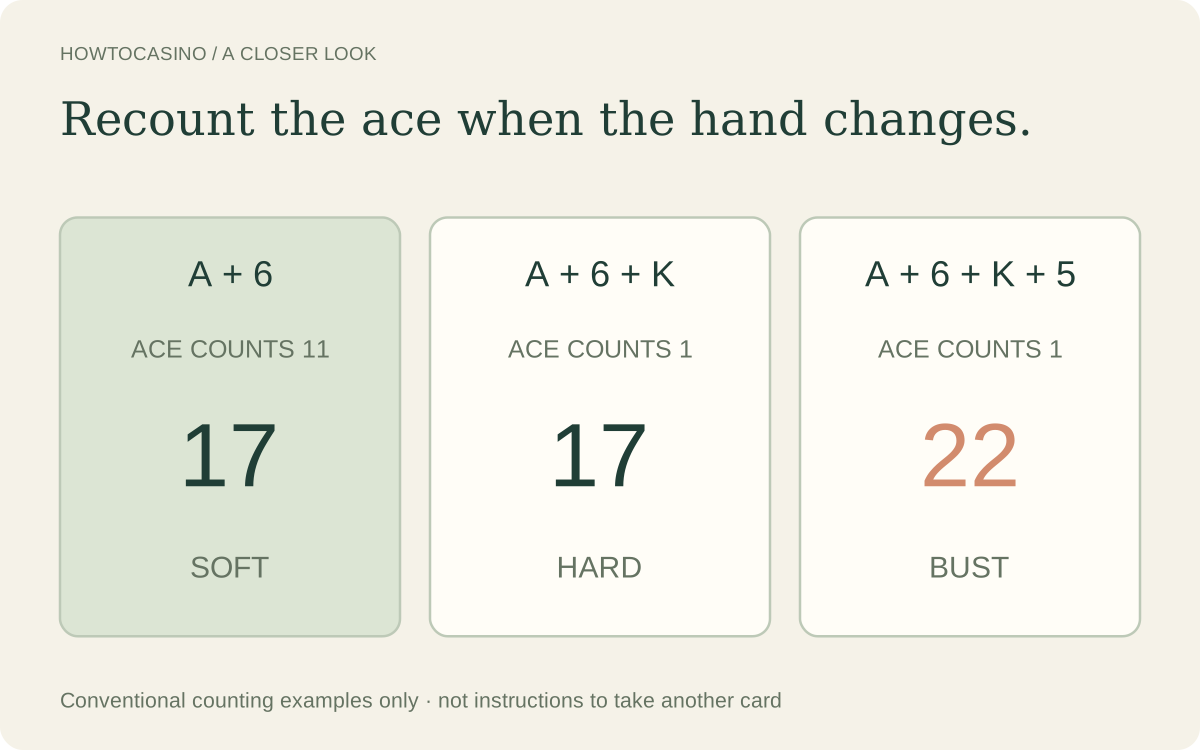
Yes. Ace + 6 is soft 17 because the ace can count as 11. Ace + 6 + king is hard 17 because the ace must count as 1: 1 + 6 + 10 = 17, while using 11 would exceed 21.
| Hand | Lowest total with aces at 1 | Can one ace add 10? | Result |
|---|---|---|---|
| A + 6 | 7 | Yes: 17 | Soft 17 |
| A + 6 + K | 17 | No: 27 would bust | Hard 17 |
| 10 + 7 | 17 | No ace | Hard 17 |
| A + 9 + 5 | 15 | No: 25 would bust | Hard 15 |
A hand without any ace is hard if it remains in play. A hand containing an ace is not automatically soft. The usable 11, rather than the mere presence of the card, is the distinction.
How do two, three or four aces count?
These rows describe card collections for counting. The actual game determines when drawing ends.
| Hand | Calculation | Result |
|---|---|---|
| A + A | 1 + 1 + 10 | Soft 12 |
| A + A + 9 | 1 + 1 + 9 + 10 | Soft 21, not an initial two-card natural |
| A + A + 9 + K | 1 + 1 + 9 + 10; no extra 10 usable | Hard 21 |
| A + A + 9 + 9 | 1 + 1 + 9 + 9; no extra 10 usable | Hard 20 |
| A + A + A + A | 1 + 1 + 1 + 1 + 10 | Soft 14 |
Two aces are not inevitably 22, and an ace does not need a permanent assigned value when dealt. In the third row, the printed king already contributes 10; the optional extra 10 belongs only to upgrading an ace, so adding it again would be an error.
A usable-ace total can be 21. A blanket statement that the highest soft total is 20 overlooks multi-card soft 21. Natural-blackjack classification still needs its separate rule.
Can an ace always prevent a bust?
No. Count the smallest possible total first. Ace + 9 + 5 + 9 has a minimum of 1 + 9 + 5 + 9 = 24, so it busts even with the ace at 1. King + queen + 2 totals 22 and also busts.
For another complete sequence, A + 6 is soft 17. Add a king and it becomes hard 17. Add a 5 and the minimum total becomes 22. Changing the ace to 1 was already used in the previous step; it cannot be used twice to subtract another 10.
These sequences explain counting only. They do not recommend taking another card on those hands or imply that a particular action was available in a game.
Is every total of 21 a natural blackjack?
No. In the conventional rules used here, a natural is an initial unsplit two-card hand of an ace plus a ten-value card. A + A + 9 can make soft 21 and 7 + 7 + 7 can make hard 21, but neither is that initial two-card natural.
The cited rules also distinguish an ace plus a ten-value card after splitting from an original natural. A numerical 21 does not by itself establish the special natural payout. Read the actual variant’s settlement rules.
The 3:2 explanation covers the money calculation, and the splitting guide explains why a newly formed hand may have additional restrictions.
Do dealer rules or side bets change these point values?
A dealer rule about hitting or standing on soft 17 changes the instructed action, not the fact that A + 6 can count as 17. The published Classic and Premium descriptions used elsewhere on this site differ on that action, so do not import one table’s dealer rule into every game.
Our soft-17 guide handles that specific question. Likewise, a 21+3 or other side wager has its own winning conditions; counting the main hand’s points does not settle a separate poker-style combination.
There is also a difference between adding a hand’s point total and an advantage-play card-counting system. This article teaches the former; it does not estimate the next card, supply a betting system or promise an optimal action.
Related questions
How much are a jack, queen and king worth in blackjack?
Each has value 10 in the conventional main-hand point system. Their poker ranks or suits do not make one worth more main-hand points than another.
Can an ace change from 11 to 1 after another card arrives?
Yes. Recalculate the whole hand. A + 6 can be soft 17, while adding a ten-value card leaves hard 17 with the ace counted as 1.
Is every hand containing an ace soft?
No. It is soft only if an ace can count as 11 without exceeding 21. A + 6 + K is hard 17 because the ace must count as 1.
Can both aces count as 11?
Not in an unbusted hand: two values of 11 already total 22. Start with aces as 1 and add 10 once if the complete total allows it.
Is A + A + 9 a blackjack paying the natural rate?
It totals soft 21, but it is not an initial unsplit two-card natural. Its settlement follows the actual game’s rules for that hand, rather than a special payout inferred from the number 21.
Can a hand with an ace still bust?
Yes. A + 9 + 5 + 9 totals at least 24. When all aces at 1 still leave more than 21, changing their values cannot save it.