What is the aim of blackjack?
The comparison is between your hand and the dealer’s hand, rather than between everyone at the table. A conventional main wager can win because the dealer busts while your hand remains in play, or because your valid final total beats the dealer’s. Getting exactly 21 is not required: 19 can beat 18.
A total above 21 is a bust. If you bust during your turn, the ordinary main wager is already lost; a later dealer bust does not rescue it. The order of settlement matters. Games with special dealer totals or other winning conditions need their own rules.
This guide explains a conventional main-hand model, not an optimal strategy or every blackjack variant. Side bets have separate conditions and prices, even when they use some of the same cards.
How do blackjack card values and aces work?
| Card | Value in the conventional model |
|---|---|
| 2–9 | The printed number |
| 10, jack, queen, king | 10 |
| Ace | 11 when usable without exceeding 21; otherwise 1 |
An ace does not permanently become 11 when it arrives. Ace + 6 can count as 7 or 17; its higher usable total is a soft 17. Add a ten-value card and the ace counts as 1, leaving 17 rather than 27. A hand with no ace usable as 11 is hard.
For a second example, ace + ace + 9 totals 21: one ace counts as 11 and the other as 1. It is a three-card 21, not an initial two-card natural. Our soft 17 explanation shows why the word soft changes the dealer’s drawing rule.
What happens during a round of online blackjack?
- Read the rules and main-hand payout before committing a stake. Check which actions and side bets are optional.
- Choose the opening main wager. Add any separate wager when counting the total money committed.
- Receive the initial two-card hand and see the dealer’s exposed card. The dealer’s other-card timing depends on the game.
- Choose permitted actions while the hand is unresolved. A hit adds a card; standing ends your decisions on that hand.
- Once player decisions are complete, the dealer resolves the hand under the published rule. Some already settled hands need no further dealer cards.
- Check the outcome, total returned and any commission or separate wager in the round record.
A live table has a betting window and decision timer; a computer-generated game has its own controls. Read what the game does if you do not respond. A timer does not make a suggested action the best action.
Do not assume every dealer begins with a hidden card or checks for blackjack before you act. Hole-card, no-hole-card and dealer-blackjack settlement rules can affect additional stakes. Our hole-card guide explains the distinction.
What do hit, stand, double, split and surrender mean?
| Action | What happens | Extra commitment or limitation |
|---|---|---|
| Hit | Take another card | No extra main stake in this conventional model; bust remains possible |
| Stand | Keep the current hand | No further cards for that hand |
| Double down | Add an equal stake and take one final card | A £4 opening wager becomes £8 committed; eligibility varies |
| Split | Separate an eligible pair into two hands | Add an equal opening stake; £4 becomes £8 before any further actions |
| Surrender | Give up an eligible hand for a partial return | Commonly half the opening stake; only where the rules permit it |
| Insurance | Place a separate wager against dealer blackjack | Often up to half the opening stake; does not insure every losing hand |
These are definitions, not instructions to choose an action on a particular hand. Double restrictions, equal-rank versus equal-value splitting, resplitting and split-ace treatment differ. Surrender is unavailable in both the cited Classic and Premium descriptions; its appearance in an explainer does not add it to your game.
Read the separate guides to double down and splitting before interpreting the extra amount as a fee or a guaranteed improvement. Both increase the amount at risk.
Is any 21 a blackjack, and does the dealer always stand on 17?
A natural is an initial unsplit two-card hand of an ace plus a ten-value card. Under the conventional rules used here it beats an ordinary drawn 21, while two naturals push. An ace plus a ten-value card after splitting is normally treated as an ordinary split-hand 21; read the exact split rules.
In this conventional model the dealer draws on totals of 16 or less and stands on hard 17 or higher. The dealer follows those instructions rather than choosing a strategy against each player. There is no universal soft-17 rule: the published PokerStars Classic description has the dealer hit soft 17, while its Premium description has the dealer stand on all 17s. Those are examples of different rule sets, not a recommendation or a claim about current lobby availability.
A table marked 3:2 describes the specified winning natural’s profit payout. It does not mean all winning totals of 21 pay that rate. Games with 6:5 naturals, special dealer results or alternative winning conditions must be read separately.
What does a £4 blackjack wager return?
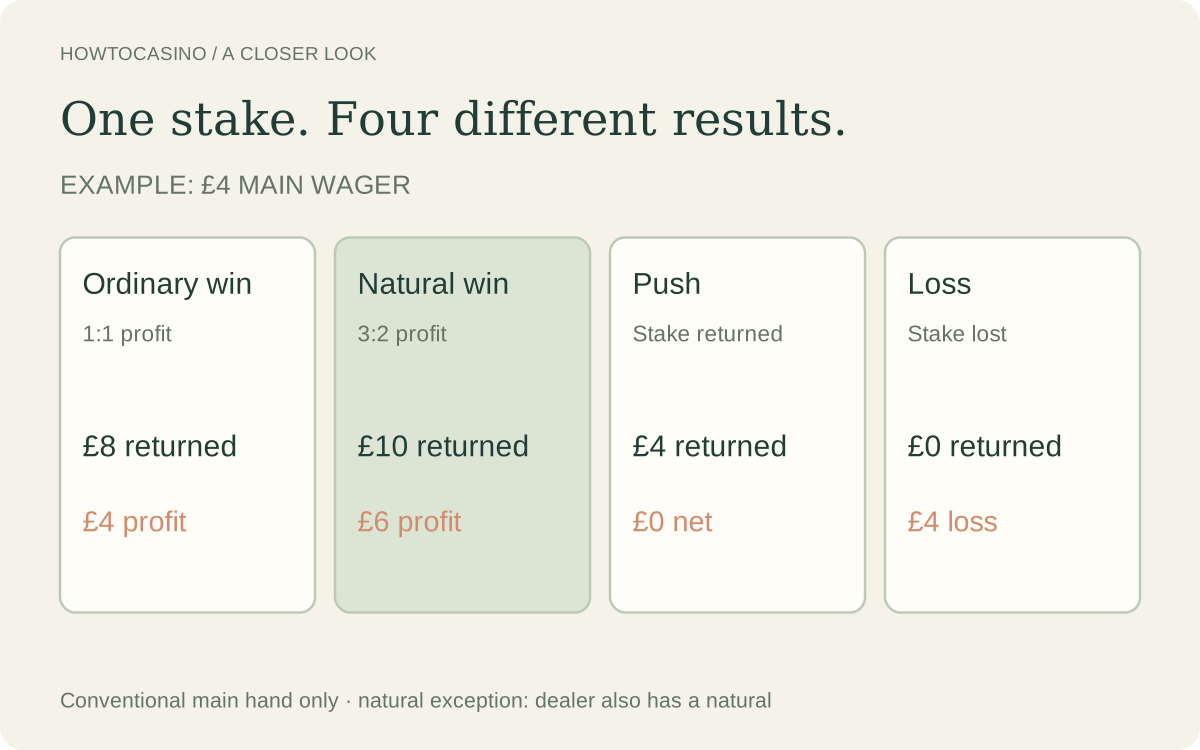
Assume one £4 main wager, an ordinary win paying 1:1 profit, a qualifying natural paying 3:2, no additional wagers and the conventional settlement described above. Total returned includes any returned winning stake; net result subtracts the £4 originally committed.
| Result | Total returned | Net result |
|---|---|---|
| Ordinary winning hand | £8: £4 profit + £4 stake | £4 profit |
| Winning natural at 3:2 | £10: £6 profit + £4 stake | £6 profit |
| Push | £4 stake returned | £0 |
| Lost main wager | £0 | £4 loss |
For example, your 19 against the dealer’s 18 is an ordinary win. Your 19 against the dealer’s 19 is a push. Your busted 23 does not push against a later dealer bust. A split or doubled hand needs a new total-stake calculation; do not reuse the £4 denominator after committing £8.
The 3:2 payout guide works through other stake sizes and the difference from 6:5. Insurance has a separate settlement, so a displayed main-hand win alone does not establish the result across all wagers.
What should a beginner check before playing?
- The main natural payout and any special dealer-result rule.
- Whether the dealer hits or stands on soft 17.
- Permitted doubles, splits and split-ace restrictions.
- Dealer card timing and what dealer blackjack does to extra stakes.
- Opening and total wager limits, optional side bets and decision-time behaviour.
The Gambling Commission’s remote standards require accessible, understandable game rules before a customer commits to gamble. A recognised game name or licence logo does not replace those rules. Check the licensed operator separately, and use the actual game’s help if a generic guide and the client disagree.
Being able to read the game does not remove its risk or guarantee a winning session. Decide what you can afford to lose before opening a real-money round, and stop if keeping to that decision becomes difficult.
Related questions
Do you have to get 21 to win blackjack?
No. In the conventional model, an unbusted 18 can beat a dealer 17. The objective is to beat the dealer without busting; 21 is the highest ordinary total, not the only winning one.
Can an ace change from 11 to 1?
Yes. Ace + 6 can be soft 17; adding a ten-value card leaves 17 with the ace counted as 1. The value is interpreted within the hand rather than fixed when the card is dealt.
What happens if both player and dealer bust?
In the conventional main-hand model, the player’s earlier bust has already lost. A later dealer bust does not produce a push or return that lost stake. Check special variants separately.
Is a push the same as a win?
No. A conventional push returns the main stake with no main-hand profit. Separate side bets may have different outcomes, so check the total across all wagers.
Does every blackjack game offer surrender?
No. It is a table-specific option, with its own timing and dealer-blackjack restrictions. The cited PokerStars Classic and Premium descriptions do not offer it.
Does a blackjack rules guide tell me the best action for every hand?
No. A correct strategy depends on the exact rules and hand composition. This guide explains the round and settlement; it does not claim to supply an optimal decision chart.