What does ‘jacks or better’ actually mean?
For the ordinary one-pair category, the pair must be jacks or a higher rank: queens, kings or aces. A single high card is insufficient. Two jacks plus three otherwise unrelated cards qualify as a high pair; an ace with four unrelated cards does not.
A lower pair is not paid simply as a pair, but a hand containing lower cards can still make a different qualifying combination. Two eights and two fours form two pair. Five consecutive ranks can form a straight. ‘Better’ does not mean every card in the hand has to be a jack or higher.
| Example completed hand | Category or issue |
|---|---|
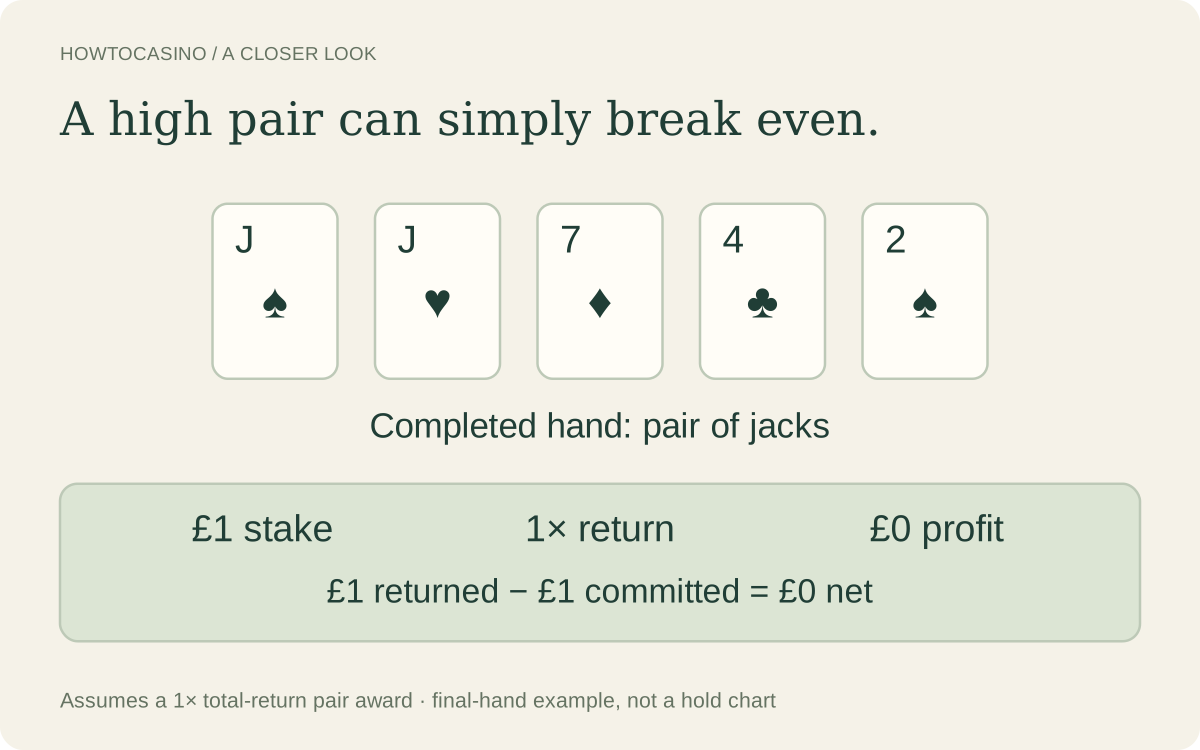
| J♠ J♥ 7♦ 4♣ 2♠ | Qualifying high pair |
| 10♠ 10♥ 7♦ 4♣ 2♠ | Low pair alone does not qualify |
| 8♠ 8♥ 4♦ 4♣ K♠ | Two pair; use its own paytable row |
| A♠ K♥ 9♦ 6♣ 3♠ | An ace alone is not a high pair |
These examples classify completed hands. They are not instructions on which opening cards to hold. A final hand's category and the best decision before the draw are separate questions.
How does a Jacks or Better round work?
- Read the exact title and paytable, coin value, coins per hand and number of hands being purchased.
- Receive the initial five cards after the paid deal.
- Use Hold to retain selected cards. The other cards are replaced on the draw under that version's rules.
- Check the final five-card combination against the applicable payout column.
- Compare the total award with the entire cost of the deal to find the net result.
You are matching combinations against a schedule, rather than bluffing an opponent or trying to beat a dealer's poker hand. Our general video poker guide explains the controls and how several hands can increase the total stake.
Classic Jacks or Better is not the same as a wild-card or bonus-poker title. If twos substitute for other ranks, or special four-of-a-kind categories pay differently, establish which game you have actually selected before using a Jacks or Better explanation.
Which hands pay, and can more than one row pay?
A conventional schedule progresses through high pair, two pair, three of a kind, straight, flush, full house, four of a kind, straight flush and royal flush. The actual amount for each category is set by the paytable. Do not infer a whole schedule from the minimum qualifying pair.
A flush has five cards of one suit. A full house has three cards of one rank and two of another. A royal flush consists of ten, jack, queen, king and ace in one suit. An ace can be low in an A–2–3–4–5 straight under the cited rules, but a sequence cannot wrap around through K–A–2.
The highest qualifying award is settled under the cited rules; overlapping descriptions are not separate prizes to add together. A royal flush is also five cards of one suit, but that does not mean a second flush payment is added to the royal award.
The unpaired cards beside one pair are often called kickers. They do not generate an additional standalone high-pair prize. Whether to retain any particular extra card before drawing needs the exact strategy conditions; the fact that it looks high does not establish the best hold.
What does a 9/6 Jacks or Better paytable mean?
The usual 9/6 shorthand describes the full-house and flush awards: nine and six units respectively per one unit staked in the referenced schedule. It is not a winning frequency, a nine-to-six hand score or a complete RTP calculation. Another documented operator table pays eight for a full house and five for a flush, illustrating why checking both numbers matters.
Even two tables described as 9/6 still need all their other rows and stake-column conditions checked. Royal-flush qualification, coin scaling, additional charges and variant features can change the comparison. A short label is not enough evidence to quote a theoretical return.
| Hypothetical 9/6 example; one 20p unit | Total award | Net result |
|---|---|---|
| High pair at 1 unit | £0.20 | £0.00 |
| Flush at 6 units | £1.20 | £1.00 profit |
| Full house at 9 units | £1.80 | £1.60 profit |
Why can the five-coin royal payout be different?
In the cited coin-based rules, the royal row awards 250 credits for one coin and 4,000 for five coins. The latter is more than five times the former. Reading only the one-coin column and multiplying it by five would therefore give the wrong prize for that particular schedule.
| Conditional example with a 10p coin | Stake | Royal award | Net result |
|---|---|---|---|
| One coin; 250 credits | £0.10 | £25.00 | £24.90 profit |
| Five coins; 4,000 credits | £0.50 | £400.00 | £399.50 profit |
This is a conversion of documented credit awards into an invented 10p unit, not a claim about an available GB stake or a recommendation to increase a bet. The higher coin setting also commits more money on every paid hand, including losing hands.
Do not turn this into a universal five-coin rule. Some games express awards as multipliers of the selected total stake rather than these coin columns. Check the paytable and any special-award condition shown by the actual game; our guide to reading game rules explains how to identify the relevant unit.
Does a 9/6 paytable guarantee a good result?
No. The expected result depends on the complete schedule, game procedure and the decisions used in the calculation. A quoted optimal-play return does not establish the return from different holds, and a high theoretical percentage does not predict a short session or guarantee a profit.
Our RTP explanation distinguishes a long-run theoretical return from a refund of your own stake. A strategy chart also needs to match the full paytable and rules. Do not transfer a chart from another title merely because both screens have five cards.
Deuces Wild changes both card behaviour and the minimum paying category. Its wild royals and five-of-a-kind hands make a Jacks or Better chart an unsuitable substitute without verifying the underlying game.
What should you save if a payout looks wrong?
- The full game name, supplier and displayed paytable, including every relevant coin column.
- The cash value of a credit, coins per hand and total number of hands.
- The final five cards, round reference and actual award credited.
- Any extra feature stake or special-award eligibility shown before the deal.
Check whether you are comparing an award in credits with a cash stake, or a single-hand prize with the cost of several hands. Ask for a calculation against the recorded rules if the difference remains. The sources below include international and historical product documents; they do not establish GB availability, current limits or a tested account experience.
Related questions
Does a pair of aces count as jacks or better?
Yes. Under the conventional high-pair category, pairs of jacks, queens, kings and aces qualify. A single ace is not a qualifying pair.
Can low pairs ever be part of a winning hand?
Yes. A low pair alone is below the high-pair threshold, but two low pairs can qualify as two pair, and three or four matching low ranks belong to their respective categories.
Does a 1× Jacks or Better payout mean £1 profit on £1?
Not when 1× means total return. In that case £1 is returned from a £1 stake, so the net result is zero. Check the paytable's unit and definition.
Is every 9/6 game mathematically identical?
No. The label identifies two conventional payout cells. The remaining awards, coin conditions, game procedure and any extra charges still need checking.
Do I always need five coins for the royal award?
No universal rule applies. Some coin-based schedules give an enhanced royal at five coins; other implementations use a different stake and multiplier structure. Read the selected game's rule.
Is Jacks or Better the same as Deuces Wild?
No. Deuces Wild uses twos as substitutes and has different qualifying categories and paytables. A high pair that qualifies in Jacks or Better is not automatically a prize in Deuces Wild.