What is in the Cash or Crash ball machine?
The original Evolution game is a live game show with one bet per round and a twenty-level payout ladder. Its published rules describe 28 balls: 19 green, eight red and one gold. Drawn balls stay separate until the round ends, so the pool is not reset after every draw.
| Ball | Published original-game effect |
|---|---|
| Green | Advance one ladder level; a decision is offered when the shield is not active. |
| Red without a shield | The still-active part of the bet loses. Cash already taken earlier is separate. |
| Gold | Advance a level and receive a shield against one subsequent red. |
| Red with a shield | Break the shield without losing the remaining bet; the red does not advance the level. |
A second chip added to the same betting position increases the one bet; it is not evidence of two independently cashable bets. Check the total bet before the betting window closes.
Cash or Crash should also be distinguished from generic multiplier crash games. Its coloured-ball pool, finite ladder and gold shield are the mechanism explained here, rather than an assumption about another game’s random-number model.
What do Take All, Take Half and Continue mean?
| Decision | What it does | What remains exposed |
|---|---|---|
| Take All | Secures the current applicable cashout and ends your participation in that round. | No remaining active bet from that round. |
| Take Half | Secures half of the current applicable cashout and continues the other part. | A reduced bet base remains in play. |
| Continue | Takes no cash at that decision and keeps the active part in the round. | The current remaining bet remains at risk. |
The current King Casino public rules say the initial default is Continue. Read the active selection and timeout behaviour in the actual game; do not assume a missed decision always cashes you out. The public documentation does not establish a universal decision countdown or later default for every GB client.
A cashout taken during the round is accumulated for settlement at the round’s end in the described rules. The game show continuing on screen does not mean your Take All failed; check the accepted decision and history. Conversely, a button you tried to press is not proof that the decision was registered before the window closed.
Does Take Half keep using the original stake afterwards?
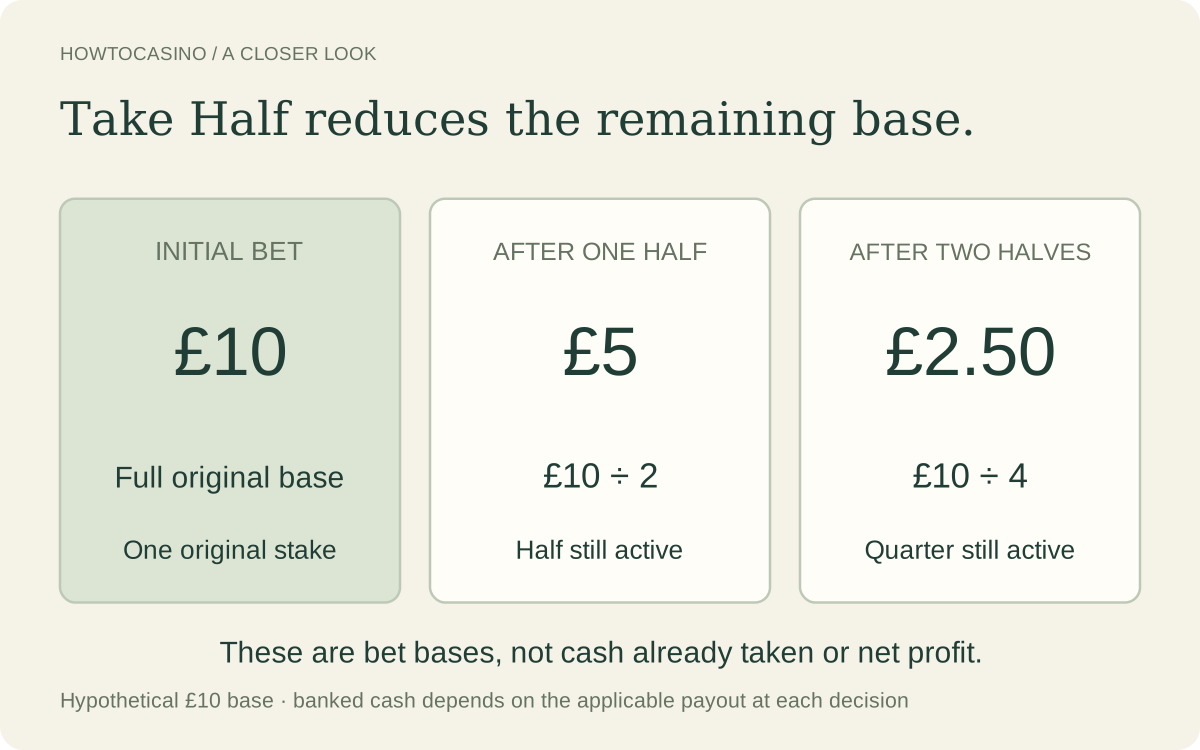
No. The documented rule reduces the bet base used for later payouts. If your original stake is S, one Take Half leaves S ÷ 2 active; a second leaves S ÷ 4. It is not a fresh full-size bet on the next ladder step.
| Hypothetical initial bet | Number of accepted Take Half decisions | Remaining base for later multipliers |
|---|---|---|
| £10 | 0 | £10 |
| £10 | 1 | £5 |
| £10 | 2 | £2.50 |
| £10 | 3 | £1.25 |
These are remaining bet bases, not the amounts you have banked. The amount secured at each Take Half depends on that decision’s applicable multiplier. Do not add the banked payout to the remaining base and call both guaranteed cash.
If a later unprotected red ends the round, the active remainder loses but earlier accepted cashouts are separate. If you Take All later, the round’s return consists of the accepted earlier cashouts plus that final cashout; compare the recorded total with the original complete stake.
The current public GB text uses payout and winnings terminology without explicitly settling whether its displayed multiplier includes the returned stake. We therefore do not present an unconditional pound-profit calculation from that notation. Confirm the in-game convention before converting a displayed “×” into a personal net result.
Does the gold shield make the rest of the game safe?
The gold ball protects against one red, not every later red. While that shield is active, the published supplier description skips the ordinary decisions and green draws can continue up the ladder. The protected red consumes the shield; it does not itself move the level upward.
After the shield is used, the remaining bet is exposed to the next unprotected red again. There is only one gold ball in the described pool, and balls are not replaced within that round. The game does not issue a new shield after each successful green.
The published ladder has an enhanced column associated with the shield breaking. Public descriptions differ on exactly when the higher figure first applies at the unchanged level. To avoid importing the wrong transition, the comparison below illustrates the stated columns without calculating an immediate post-break cashout.
| Ladder level | Ordinary published multiplier | Enhanced published multiplier |
|---|---|---|
| 1 | 1.2× | 1.2× |
| 2 | 1.6× | 1.7× |
| 3 | 2× | 2.2× |
| 10 | 21.5× | 24× |
| 20 | 18,000× | 50,000× |
For a sequence that avoids that transition ambiguity, consider gold at level one, a green at level two, then the red that breaks the shield without advancing it. A later green reaches level three; the enhanced column there is 2.2×. Any monetary cashout still uses the actual remaining bet base and the game’s payout convention, not automatically the original stake.
The 50,000× headline belongs to an enhanced top-level outcome. It is not the ordinary level-twenty figure, a probability of reaching that level, or a universal pound payout limit.
Do the ball probabilities change after green draws?
Yes, assuming each remaining ball is equally likely in the stated no-replacement model. Each drawn green reduces the number of green balls left, while the red count stays at eight until a red is drawn. The following are separate conditional snapshots, with no gold or red drawn yet and no shield active.
| State before the next draw | Remaining pool | Chance the next ball is red |
|---|---|---|
| Start of the round | 19 green + 8 red + 1 gold = 28 | 8 ÷ 28 ≈ 28.57% |
| After one green | 18 green + 8 red + 1 gold = 27 | 8 ÷ 27 ≈ 29.63% |
| After three greens | 16 green + 8 red + 1 gold = 25 | 8 ÷ 25 = 32% |
These are one-next-draw red probabilities under explicit conditions, not the chance of finishing the whole round in profit. A gold draw changes the state, and an active shield changes the consequence of a red. Do not use the unprotected-loss interpretation for a protected red.
An increasing red fraction does not mean the next ball is certain to be red or that a colour is “due”. It also does not prove which cashout decision is best: that would require the relevant ladder, remaining pool, accepted earlier cashouts and a properly specified mathematical objective.
What if you miss a decision or lose the connection?
Do not assume the live draw pauses, the stake is refunded or a cashout happens before the next red. The exact accepted bet, default decision and interruption policy matter. A supplier’s old fact sheet or another operator’s help is not proof of the current policy on your table.
- Check the active decision/default before committing a bet.
- If the connection fails, retain the time and round reference rather than repeatedly submitting new bets.
- On return, check History for the accepted stake, Take Half/Take All decisions and final settlement.
- Ask official support for the decision log if the result differs from what you expected.
Our live dealer casino guide explains why a video stream, an attempted button press and an accepted decision are different records.
What should a GB player check in the exact game?
King Casino’s GB-facing public Cash or Crash rules were directly accessible on 2 November 2026. That is a documentation check, not proof of account eligibility, an installed-game inspection or a funded test. Its page title calls it a slot, but the rules describe the Evolution live ball-draw game show.
- Exact title and provider, with current Help, Paytable and Bet Limits.
- Initial stake, current remaining bet base and banked cashouts as separate amounts.
- The active shield state and applicable ordinary or enhanced ladder value.
- Whether the displayed award includes the stake and which cash cap applies.
- Decision expiry, disconnection and round-end payment rules.
- The operator’s current GB licence and exact domain.
No universal RTP, minimum stake, maximum cash award or automatic-cashout promise is established here. For the broader category, use our live casino game shows guide; it explains why backing a feature and merely watching it are different.
Related questions
Is Cash or Crash an Aviator-style crash game?
The named Evolution game uses a live coloured-ball draw, twenty-level ladder and one-use gold shield. Generic crash-game terminology does not establish its rules or the return on a particular bet.
Does Take Half protect everything I have won on screen?
It secures only the accepted partial cashout. The reduced remaining bet continues at risk; a later unprotected red can end that active remainder. Keep the banked amount and remaining stake base separate.
Can a second red be protected after the first shield breaks?
Not by that shield. It protects one red and is then consumed. The described pool has only one gold ball and does not replace drawn balls during the round.