Was the wrong number in the game, wallet or bank?
Start with the entry that does not reconcile. A game result, a cash-wallet update, a reserved withdrawal and a bank receipt are connected records, not interchangeable evidence. A displayed win may include the returned stake; a pending bank entry may not be a completed payment.
| What appears wrong | Records to compare | Question to ask |
|---|---|---|
| Game award | Round ID, accepted stake, final result and applicable paytable | What should this exact round return, including or excluding the stake? |
| Wallet credit or deduction | Opening cash, transaction history and any bonus pot | Was the same award posted twice, omitted or reversed? |
| Withdrawal amount | Requested amount, method, deductions and reservation record | Was a smaller payment deliberate, split or erroneous? |
| Bank or wallet-provider receipt | Posted payments, currency, references and any reversal | Was one payment missing, duplicated or converted? |
A smaller-than-expected receipt could involve a separately disclosed charge, currency conversion or one instalment of a payment. Ask for the actual explanation and calculation rather than assuming a particular cause. A larger receipt could be a valid separate payment, a duplicate or an error; the difference alone does not prove which.
If the amount is agreed but the withdrawal has simply not arrived, use our withdrawal-stages guide. If a correctly credited deposit appears twice as a bank debit, use the card-dispute guide: that is a different transaction problem.
What should you do before another transaction changes the record?
- Save the exact round or payment reference, date, currency and amount. Keep the account history and relevant rules.
- Describe the discrepancy without guessing its cause: expected amount, recorded amount and difference.
- If an error seems to be recurring, stop using the affected game and report it through official support. Do not try to reproduce it for money.
- Ask which entry was wrong, what correction is proposed and whether a payment-provider reversal is already in progress.
- Keep disputed extra money available while the issue is checked. Contact your bank through its normal channel if a receipt is unrecognised or a repayment message looks suspicious.
An email, chat message or telephone call saying “send it back” does not establish either the debt or the recipient’s identity. Open the operator’s genuine app or website yourself, obtain the case reference and verify any proposed return method independently. Do not send funds to new payment details supplied by an unverified caller.
If a substantial repayment is disputed, or you have already spent the money, seek independent advice about your own circumstances. This explanation does not decide a legal debt, a defence or the validity of an operator’s claim.
How do you calculate an underpaid game award?
Use the accepted stake and the exact version’s rules, not the amount another player received or a multiplier shown in an unrelated clip. The following invented example assumes the correct paytable and qualifying result have already been established: a £5 stake should return 12× the stake, including its stake component.
| Item in this hypothetical round | Amount |
|---|---|
| Accepted stake | £5 |
| Correct total return: £5 × 12 | £60 |
| Actual total return credited | £45 |
| Difference in the award: £60 − £45 | £15 |
| Correct net round profit: £60 − £5 | £55 |
| Actual net round profit: £45 − £5 | £40 |
The award shortfall is £15, not the whole £60 and not £20 after adding the stake again. If £10 of that exact shortfall is later finally credited, £5 remains unresolved. A separate account balance or unrelated pending withdrawal does not enlarge this round’s discrepancy.
The arithmetic is conditional: it does not prove the assumed result qualified for 12× in a real game. A stated cap, ineligible side bet, different configuration or profit-versus-return notation can change the expected amount. Ask support to identify the rule and the accepted result before arguing from a screenshot alone.
What if a correct game return was credited twice?
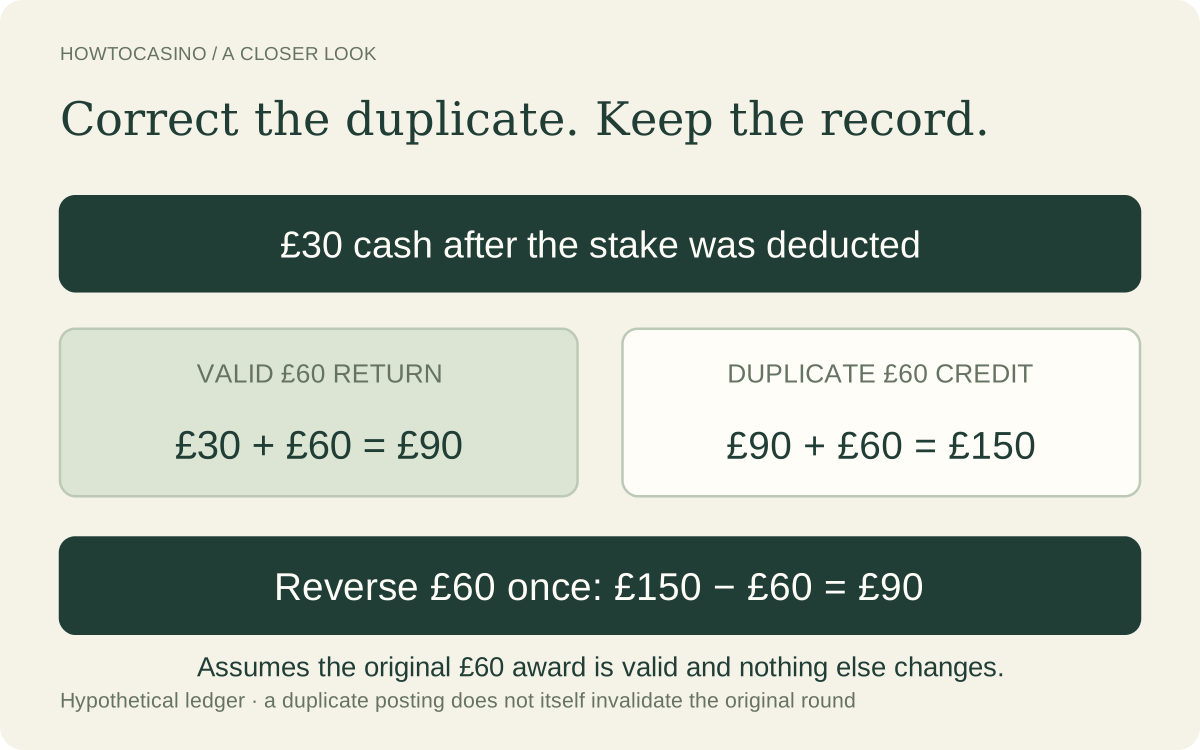
Suppose the cash balance is £30 after the stake has already been deducted. A valid total game return of £60 should take it to £90. If two £60 credits are posted by mistake, the screen instead shows £150. Assume no bonus, further bet, other payment or fee.
| Ledger event | Cash balance |
|---|---|
| Post-stake opening balance | £30 |
| First £60 return | £90 |
| Duplicate £60 return | £150 |
| Reverse only the duplicate £60 | £90 |
On those assumptions, the apparent excess is £60. Removing both credits would leave £30 and would also remove the valid £60 award. If the operator says the original round was invalid too, that is an additional disputed claim requiring its own rule and explanation; it is not established merely by identifying a duplicate posting.
Ask for the transaction references of both credits and the proposed reversal. If money has moved to a withdrawal pot, follow the same £60 through the transfer rather than counting the available balance and reserved amount as separate copies of it.
What if the casino sends a withdrawal twice?
A duplicate bank receipt needs a separate reconciliation. Imagine one agreed £100 withdrawal, reserved outside a separate £50 available casino balance. Two completed £100 payments reach the bank against that one request. With no other payment due, the apparent extra receipt is £100, not the full £200 received.
Record how any return is handled. If the payment provider reverses one of the £100 transfers, the bank then holds the original £100 receipt and the duplicate has been removed. A further manual £100 repayment would correct the same apparent error twice. Ask both parties to identify any pending recall or reversal before agreeing a separate transfer.
The separate £50 casino balance is not a duplicate withdrawal and is not automatically part of the £100 adjustment. Nor does this example establish that every repeated receipt is an error: two genuine withdrawal requests could legitimately produce two payments.
Keep posted payments, pending items, completed reversals and merely requested recalls distinct. If the casino account is debited as well as a bank reversal occurring, ask for a combined statement showing where the adjustment was applied.
Can a casino just call a win an error and remove it?
An operator may have contractual error and malfunction provisions, but the existence of a clause does not establish the facts of your round or that a particular use of it is fair. UKGC’s fair-terms condition requires transparent, fair terms and compliance with them.
For example, BetMGM’s GB terms distinguish errors, malfunctions and interruptions; they describe action concerning affected winnings and a repayment request where those winnings were already withdrawn. That is an operator-specific clause, not a universal rule allowing every casino to remove any winning balance.
- Ask for the exact clause and version applied to the transaction.
- Ask whether the alleged fault affected the outcome, the award calculation, a duplicate posting or only the display.
- Ask which transactions and amounts were corrected, including the treatment of the original stake.
- Request the recorded game result, settlement calculation and written final position if the explanation is disputed.
A negative wallet balance, a repayment request and an authorised bank debit are different matters. Do not assume a message authorises the operator to take any sum from any payment method, or that a negative screen by itself proves an enforceable debt. A significant disputed demand needs individual advice.
What does UKGC guidance say about confirmed game faults?
The Commission’s remote RNG game/software-fault guidance covers confirmed faults that cause underpayment or overpayment. It expects affected amounts and customers to be established and remedial action explained. For underpaid players, direct reimbursement is the default expected remedy where possible; the remedy should not require further gambling or minimum spend.
A confirmed fault can be established through exact transactions or, where those are unavailable, an appropriate estimate of the affected game’s shortfall. That is not permission to multiply your personal deposits by a generic RTP figure and claim the difference. A single losing session is not evidence that a mathematical fault occurred.
Regulatory reporting of a confirmed fault is the licensee’s responsibility. Its reporting timetable is not your promised refund deadline. The Commission’s reporting guidance also does not decide whether one customer’s alleged overpayment must be repaid.
What if you disagree with the correction?
Send a concise chronology with the original amount, actual entries, corrections already completed and the precise difference still disputed. Keep a separate line for each round, wallet adjustment and bank payment. Ask for a calculation, not only a statement that the account has been corrected.
For an eligible GB gambling-transaction dispute, the operator’s named independent ADR service can become available after its final position or the applicable eight-week complaints period, allowing for appropriate pauses. ADR is free to customers; a referral does not guarantee either repayment to you or cancellation of a demand.
Our unpaid-casino complaint guide explains the clock and evidence in detail. Our suspended-account guide covers restrictions while a review is pending. Neither replaces the need to reconcile the specific error first.
Related questions
Is an unexpected casino credit free money?
Do not treat it that way. It may be a valid separate payment, a duplicated entry or an error. Preserve the records, leave the disputed amount available and obtain an explanation through official support before spending or returning it.
Should I use RTP to calculate my missing payout?
A game’s theoretical RTP does not determine what one round or session must return. For a particular award, compare the accepted stake, qualifying result and applicable paytable. Confirmed systemic-fault remediation is a separate process.
What if the bank has already reversed the extra payment?
Give the operator the reversal reference and ask it to reconcile the completed correction before any separate repayment. A bank reversal, wallet deduction and manual transfer must not silently count as three corrections of one excess payment.