Which money are you trying to recover?
| What happened | Starting route | Important distinction |
|---|---|---|
| Authorised, settled gambling lost money | Identify any separate evidenced error or breach; a loss alone does not establish a refund | Do not describe an authorised payment as fraud because the result disappointed you |
| Own cash or recognised winnings remain unpaid | Verified operator withdrawal enquiry or financial complaint | Retained money differs from historical deposits already spent |
| Duplicate debit, wrong amount or missing deposit credit | Reconcile operator/payment records; contact the actual provider promptly about its process | A pending authorisation and posted charge can be different |
| A payment was genuinely not authorised | Contact the bank/provider immediately through a trusted channel | Do not wait for casino ADR before reporting suspected fraud |
| A transfer was authorised after a suspected scam | Report promptly to the bank/provider for the applicable assessment | A genuine scam and an ordinary contract dispute are different |
Start with one specific amount and reason. I deposited £100, I lost £100 and the operator still holds £100 are different factual statements. A generic request for all my money back can conceal the transaction that actually needs correction.
Own retained deposit balance is subject to withdrawal rights, with necessary regulatory-obligation qualifications. That is not permission to reverse every earlier settled wager or treat restricted promotional credit as ordinary cash. The unpaid-casino guide covers a specific unresolved withdrawal or winnings dispute.
If the whole business has closed, use the closure-and-funds guide as well. A card dispute and an insolvency claim do not have identical scope or guarantee that money exists to pay a claim.
Are a refund, chargeback and Section 75 the same thing?
| Route or record | What it concerns |
|---|---|
| Merchant refund | The business returns a specified payment or part of it |
| Withdrawal | Money remaining in an operator account is paid out through its process |
| Pending-authorisation release | A card hold is released; establish whether a final debit ever posted |
| Card chargeback | A card-scheme dispute process raised through the issuer where its rules permit |
| Section 75 | A separate, qualified statutory credit claim concerning breach or misrepresentation |
| Fraud reimbursement | The applicable payment-fraud route, based on authorisation, method and facts |
The Financial Ombudsman Service explains that chargeback reasons, evidence and time windows depend on scheme rules. A bank does not have to raise every requested dispute, and a chargeback is not a universal right to undo a casino deposit or recover a later withdrawal.
Section 75 is different. The FOS general guidance requires a qualifying credit arrangement, relevant supplier breach or misrepresentation and the necessary debtor-creditor-supplier relationship. Its cash-price range is more than £100 and no more than £30,000. That is not a rule that all casino payments over £100 qualify, or that adding several deposits proves the required cash price.
For current covered GB online-casino gambling, UKGC’s credit-card condition prohibits credit-card payments, including through a money-service business. This guide does not suggest credit, a wallet or a cash advance as a way to create protection. Nor does that prohibition alone decide every historical or other-market Section 75 claim.
Ask the actual provider which process fits the truthful facts and what evidence it needs. A missing credit for a deposit is not the same transaction as money credited correctly, later gambled, and then lost. The debit-card guide explains the funding and account-payment stages.
How do you calculate the actual disputed amount?
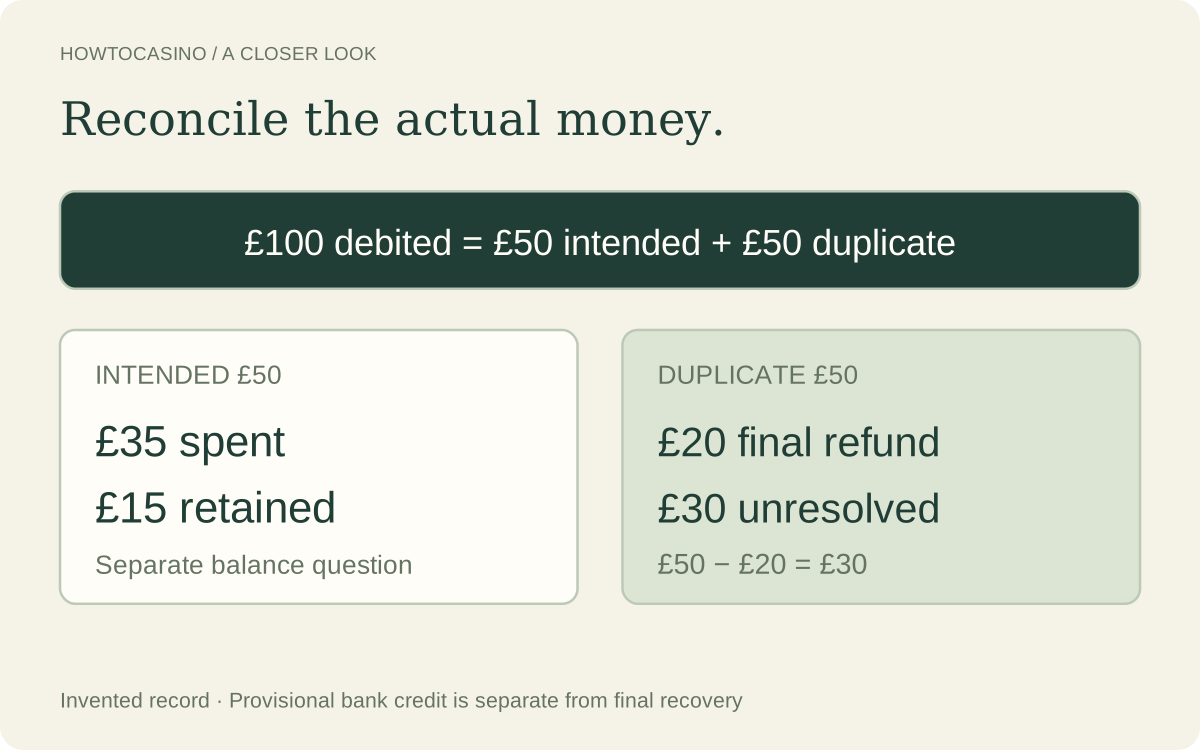
Consider an invented cash-only record. Two £50 bank debits occurred, but only one £50 deposit was intended and credited to the casino. Assume the second £50 is an identified duplicate with no credit or service supplied. From the correctly credited £50, £35 was lost in authorised settled play and £15 remains as cash. There is no bonus, open bet, fee or other transaction.
| Separate item in the fictional record | Amount | Treatment |
|---|---|---|
| Bank debits initially posted | £100 | Two £50 debits, not proof of a £100 unused casino balance |
| Intended credited deposit | £50 | £35 spent + £15 retained |
| Authorised settled losses | £35 | Not added to the duplicate-payment claim merely because they were losses |
| Cash still held by the operator | £15 | A separate balance/withdrawal question |
| Identified duplicate debit | £50 | The original payment-error amount under the explicit assumptions |
| Final partial refund of that duplicate, actually received | £20 | Reduces that payment-error amount |
| Duplicate amount still unresolved | £30 | £50 − £20, separate from the £15 retained balance |
After the final £20 refund, net bank outflow is £80. The record reconciles as £35 spent + £15 retained + £30 unresolved duplicate = £80. It does not become an £80 claim to reverse authorised gambling losses. The £30 payment issue and £15 retained balance also need their own records and process.
Now assume the bank separately shows £30 temporary credit while investigating. That entry is provisional; it does not establish a final successful chargeback or another £30 owed on top of the same disputed payment. Monzo and NatWest’s public help explain that temporary credit can be removed after an unsuccessful dispute.
If the operator later refunds the same transaction, tell the bank so both sides can reconcile the duplicate recovery. Keep final receipts, provisional entries, reversals and operator credits identifiable rather than counting every positive entry as permanent money recovered.
What should you send with a genuine payment dispute?
- Exact transaction date, amount, payment method and reference.
- Statement descriptor, with any explanation of why you recognise or dispute it.
- Whether the item is pending, posted, credited, spent, reserved or refunded.
- Operator deposit/withdrawal history and the specific missing or duplicate entry.
- Relevant support replies, refund references, accepted terms or round evidence.
- A calculation of the precise amount still disputed, excluding money already finally returned.
Use that wording only when it reflects the facts. It is not a legal allegation, a threat or a script for changing an authorised transaction into fraud. Send sensitive records through the actual recipient’s secure channel; do not give passwords, PINs or full account documents to public reviewers or this editorial site.
Bank procedures can differ even on pending transactions and merchant-contact steps. Do not turn one bank’s waiting period into a universal rule for suspected fraud or payment errors. Contact the actual provider promptly and follow its applicable instructions.
A short screen glitch or losing sequence does not prove a game fault. For an identified disputed round, keep the accepted wager, result and rule version; the roulette-wheel guide explains why a video frame and a settlement record are different evidence.
Which time limit applies to a casino-payment complaint?
| Process | Timing distinction |
|---|---|
| Card-scheme dispute | Contact the issuer promptly; scheme reason and trigger determine the window. Around 120 days is qualified general FOS guidance, not one casino-refund deadline |
| Genuinely unauthorised payment | Report immediately; the FCA’s described outer limit is not a reason to wait |
| Qualifying payment/e-money-service formal complaint | Current FCA DISP rules use 15 business days after the receipt day, with an exceptional-reasons route to 35 business days |
| Other financial-business complaint | The applicable ordinary eight-week response route may apply instead; do not classify every bank issue as a payment-service complaint |
| Casino financial complaint and ADR | Use the operator’s procedure and the relevant unresolved-dispute route; see the separate guide for the eight-week/deadlock details and qualifications |
| FOS referral about a financial business | Normally six calendar months from its final response, with eligibility and specified exceptions |
The payment-service exception requires a timely holding response explaining exceptional delay and the final deadline; it is not a routine permission to ignore every complaint for 35 business days. A formal bank complaint clock is also different from the time a chargeback investigation or merchant challenge takes.
Do not copy a chargeback window into a fraud report, the casino’s complaint clock into the bank’s process, or a FOS final-response referral limit into the initial transaction report. Ask which process applies and keep the relevant receipt date and final response.
If bank handling remains disputed, its formal complaint and FOS route concern that financial business. An eligible casino financial dispute has its own operator and independent dispute route. Neither process automatically decides every social-responsibility allegation, creates missing assets or guarantees payment.
Does a casino rule breach or self-exclusion failure guarantee a refund?
No automatic personal refund follows from that allegation in this guide. Preserve the dates, exclusion or control involved and the specific failure, then use the appropriate complaint and reporting channels. Whether a separate legal remedy exists depends on the facts and applicable law.
UKGC’s self-exclusion page describes closing an excluded account, returning money held in it and removing marketing details. Money remaining in an account is different from every historical deposit or gambling loss. The regulator says it cannot refund money spent gambling or resolve an individual transaction complaint.
Regulatory reporting still has a purpose: the information can inform enforcement. It is not a personal recovery service, and a fine or licence finding does not itself calculate what a particular reader is owed.
Keep needed protection in place while a dispute runs. Do not gamble again to win the amount back, open a replacement account or make a further payment to unlock a supposed refund. The GAMSTOP guide explains the official exclusion service, and the Support and safer gambling link below provides routes for getting help.
Related questions
Will a casino refund money just because I lost it?
An authorised settled loss alone does not establish a refund claim. If a separate payment error, retained balance or alleged breach exists, identify the specific facts and amount rather than treating all historical deposits as unused money.
Can I charge back a casino deposit that was never credited?
Ask the operator and actual payment provider to reconcile the debit and account value promptly. Whether a card dispute can be raised depends on the applicable rules and evidence; it is not a guaranteed recovery route.
Is a temporary chargeback refund final?
No. The cited bank help explains that temporary credit may be challenged and reversed. Keep it separate from final operator receipts, and tell the bank if the same transaction is refunded elsewhere.
Should I wait eight weeks before reporting an unauthorised payment?
No. Contact the bank or provider immediately through a verified channel. An unauthorised-payment report has a different route from an ordinary casino complaint or its ADR process.
Does Section 75 automatically protect casino deposits over £100?
No automatic eligibility follows. The qualifying credit arrangement, cash price, payment chain and breach/misrepresentation matter. Covered GB online-casino credit-card gambling is prohibited; do not use credit or a wallet bypass to try to create protection.
Can UKGC get my gambling losses back?
The regulator does not resolve an individual transaction complaint or recover that customer’s money. Relevant reports can inform regulatory action, while a specific payment or contractual dispute follows its applicable route.