Has the business closed, or only your account?
| Situation | First distinction to establish |
|---|---|
| Only your account is closed | The business may still operate; ask about the account decision and money |
| Website or app unavailable | An outage alone does not establish insolvency or a permanent exit |
| GB service or brand closing | Read the notice for the legal entity, dates and return/contact route |
| Administration or liquidation announced | Verify the process, jurisdiction and appointed officeholder |
| Licence status changed | Read the actual register entry and notice; status alone does not settle your balance |
Save what the official notice actually says. A social-media rumour, failed login and licence surrender are different evidence. Do not assume that every brand sharing a name or group has the same legal company, protection arrangement or closure date.
If you want to end your own account access or request data erasure, the account-closure guide covers that separate process. This page deals with a service or business closing and the money it holds.
Record the exact company and licence entry using the licence-check guide. Permission to serve GB customers does not establish where the company is incorporated, whether it is solvent or how an insolvency claim would rank.
What do the customer-funds protection ratings mean?
Covered remote operators must keep customer funds in separate client bank accounts. That operational separation alone is not insolvency protection. The consumer summary uses three broad levels: not protected, medium and high. The formal ratings guidance has four exact labels because not protected has two categories.
| Exact rating label | Meaning and scope |
|---|---|
| Not protected - No segregation | Permitted only for non-remote and ancillary remote operators; not the ordinary covered online-casino minimum |
| Not protected - Segregation of customer funds | Funds are kept apart operationally but form part of business assets in insolvency; the minimum for covered remote operators |
| Medium protection | Additional distribution arrangements, such as qualifying accounts or insurance; no absolute repayment guarantee |
| High protection | A formal trust legally and practically separate from the company, with an independent trustee or external-auditor controls |
High is the highest described level, not a promise of immediate payment. A casino balance must not be presented as a personal bank deposit covered by a government or FSCS repayment guarantee. Read the actual arrangement and any administrator’s explanation of how it operates.
The operator assesses and applies its rating. UKGC guidance expressly warns against implying that the Commission approved that individual rating. Reading a disclosure is also different from auditing the underlying accounts; this guide has not inspected an operator’s actual funds.
Find the customer-funds or insolvency section in the applicable terms, including any change notice. Save the version and date. A footer saying licensed, or a general statement that money is separate, does not identify the complete protection category.
Which money counts as customer funds?
The definition includes cleared deposits for future gambling, winnings or prizes left with or still owed by the operator, and crystallised but unpaid loyalty or other bonuses. Crystallised means an entitlement has actually arisen; a conditional promotional display is not automatically the same thing.
UKGC’s consumer guide excludes stakes on an open bet whose event has not yet occurred from these customer-funds protection arrangements. That exclusion does not itself settle or void the bet, remove every contractual claim or turn a possible future return into money already held for you.
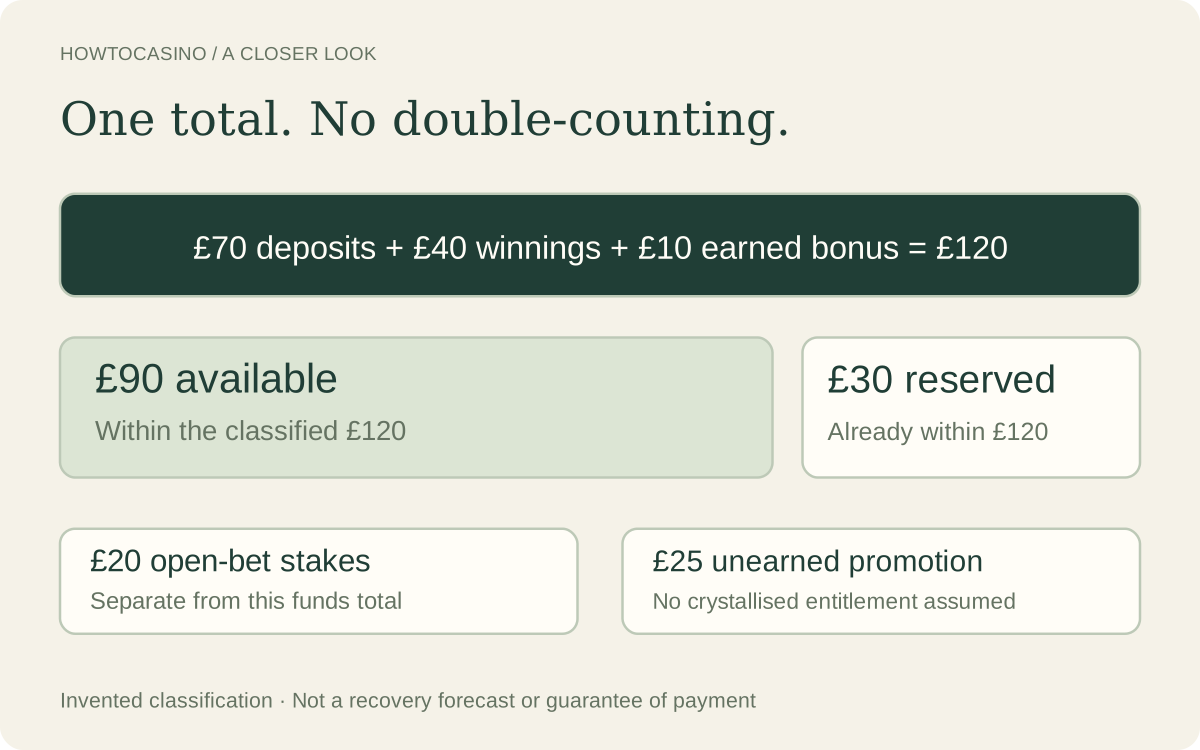
Consider a fictional, fully reconciled record. There are £70 of remaining deposits, £40 of settled winnings and £10 of earned, crystallised but unpaid bonus. These are non-overlapping categories, giving £120 customer funds. Of that same £120, £30 is already reserved for a requested withdrawal.
| Fictional item | Amount | Treatment under the stated assumptions |
|---|---|---|
| Remaining deposits + settled winnings + earned unpaid bonus | £70 + £40 + £10 = £120 | Classified customer-funds total |
| Withdrawal reservation already within that total | £30 | A subset of £120, not another £30 to add |
| Available portion after reservation | £90 | £120 − £30; not a recovery promise |
| Separate open-bet stakes | £20 | Outside this example’s customer-funds protection total |
| Separate unearned promotional display | £25 | No crystallised entitlement assumed |
Adding every visible figure would double-count the withdrawal and mix different categories. Neither £195 nor £150 is the classified total in this example. Nor is £120 a guaranteed distribution: classification, individual entitlement and actual recovery are three separate questions.
Keep open bets, pending withdrawals and restricted rewards identifiable. The withdrawal guide explains why a request or reservation is not proof that the money has arrived at the payment account.
What should the casino disclose or remind you about?
The current disclosure condition requires covered operators to state the protection level and method in their terms. It also requires written acknowledgement before gambling with funds on the first deposit, and on the first deposit following a relevant change in protection terms.
For a not-protected rating, the current condition additionally requires a reminder once every six months referring to the value of customer funds, with acknowledgement before those funds can be used for gambling. UKGC’s consumer guidance dates that change to 31 October 2025. The reminder value is a snapshot and can change afterwards.
Acknowledging the message confirms receipt; it does not add insurance or upgrade the rating. The gambling-use restriction is not an instruction to deposit again, continue playing or treat acknowledgement as a prerequisite for every withdrawal.
As one attributed example, Midnite’s public terms, section 9.6, described its arrangement as medium protection when checked on 30 October 2026. That is its published disclosure, not our verification of the underlying account or a finding about every UK casino. The Midnite guide separates that disclosure from wider licensing checks.
What happens during an orderly closure or GB-market exit?
UKGC’s ordinary remote-closure guidance expects clear notice, plans to return customer funds even after the website closes, and continuing contacts for unclaimed money or complaints. Bets settling later also need a communicated policy. These expectations are not proof that a financially failed business has money to distribute.
For the non-insolvency remote context described in that guidance, the regulator considers two weeks the minimum notice and four preferable. It also discusses four weeks of post-closure web access. Those examples do not create a universal four-week claim-expiry rule or automatic forfeiture of every unclaimed balance.
- Save the official closure notice, terms and relevant dates.
- Identify the legal company and its verified return/contact instructions.
- Reconcile available cash, existing withdrawals, earned rewards and open bets.
- Keep transaction references and a record of the request and response.
- Check how contact and unresolved claims continue after the main site closes.
Treat an unexpected recovery message as unverified until you have checked it independently. Do not send passwords or unredacted account documents to a public forum, and do not make a fresh payment or wager to unlock a supposed refund. A requested payment and a completed receipt need separate evidence.
Who handles the money if the business is insolvent?
Establish the actual process and appointed officeholder through official company and case information. The Insolvency Service explains how creditors can identify a practitioner and supply a claim where applicable. Its general UK guidance is not proof that a particular GB-licensed operator is incorporated in the UK or subject to that exact procedure.
Ask how the customer-funds arrangement and your recorded money are being treated, what evidence is needed and which deadline applies to the actual case. Do not assume every protected-funds claim is ordinary unsecured debt: trust arrangements and the legal process can matter. Do not infer a recovery percentage from the balance screen or rating alone.
Assets, costs and priorities can limit or prevent distributions; a process can take years. Administration can seek to rescue a business, while liquidation is a different process. Neither label alone tells this guide what an individual will receive.
For a transaction dispute, keep the operator’s complaint and applicable independent dispute route distinct from the insolvency claim. The unpaid-casino guide explains complaint evidence and timing. ADR does not create missing assets or guarantee a distribution.
UKGC can use relevant information for regulation, but it does not decide an individual transaction complaint or recover that person’s money. Follow the verified operator or officeholder’s actual process, and seek advice appropriate to the jurisdiction if the legal treatment is unclear.
Related questions
Does a Gambling Commission licence guarantee my casino balance?
No. Licensing and the customer-funds arrangement are separate questions. A separate client account alone is not insolvency protection, and a casino balance must not be treated as a guaranteed personal bank deposit.
Are segregated casino funds protected if the business goes bust?
Not necessarily. Under the Not protected - Segregation of customer funds category, money is kept apart operationally but forms part of business assets in insolvency. Read the disclosed category and method.
Does high protection mean instant repayment in full?
No such guarantee follows from the label. It describes the highest stated protection level and a formal, independently controlled trust arrangement. The actual process and funds still need examination.
Is a pending withdrawal extra money on top of the balance?
Only if the actual record establishes separate amounts. In this fictional example, £30 is already reserved within £120, leaving £90 available. Adding the reservation again would double-count it.
Do I lose every claim four weeks after the casino website closes?
The closure guidance’s web-access example is not a universal claim-expiry rule. Check the real notice, continuing contact and applicable claim process rather than assuming automatic forfeiture.
Will the Gambling Commission get my money back?
It does not resolve an individual transaction complaint or obtain that customer’s money. Regulatory reporting, an operator or eligible ADR complaint, and an insolvency claim are different routes.