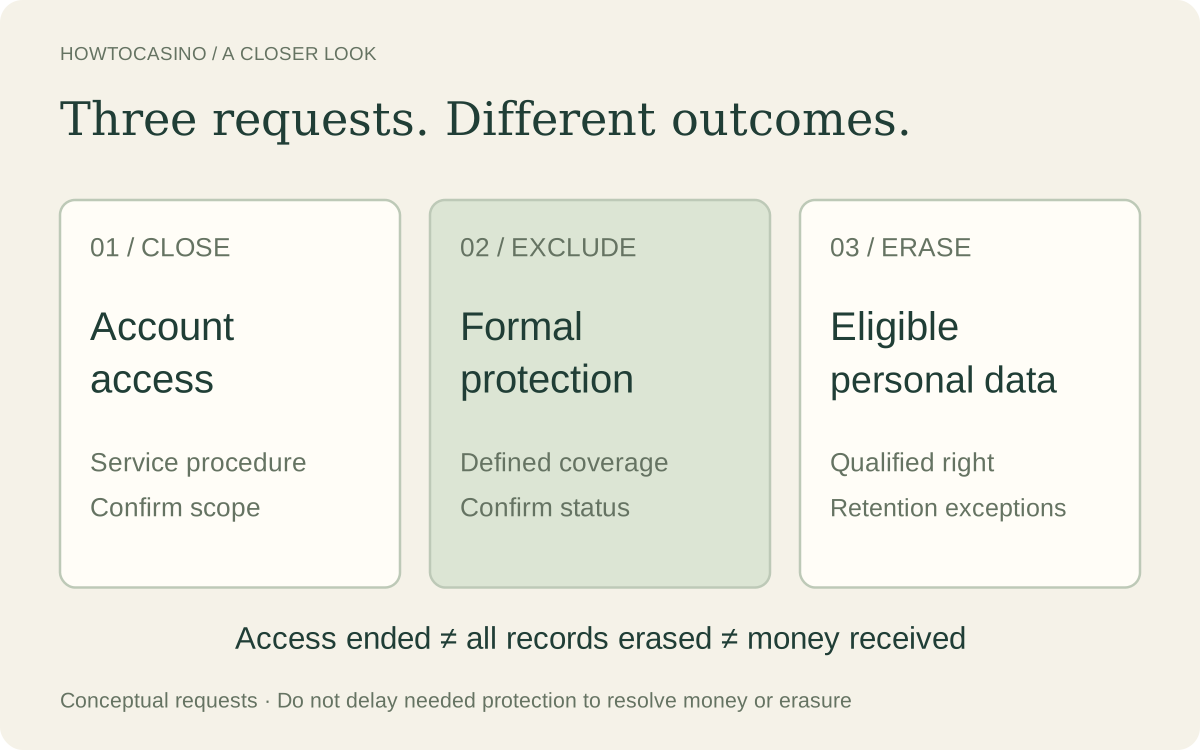
Do you want to end access, exclude yourself or erase data?
| Request or control | Main purpose | What it does not establish alone |
|---|---|---|
| Ordinary account closure | End access or the customer relationship under that service’s procedure | National self-exclusion or deletion of all records |
| Cool-off or time-out | Apply the specified temporary access restriction | The same duration or scope as another protection |
| Operator self-exclusion | Use a formal exclusion arrangement with its own conditions | Automatic coverage of every unrelated operator |
| Multi-operator exclusion | Use the relevant scheme across its covered services | Erasure of every record or a refund of past losses |
| Data-erasure request | Ask for eligible personal data to be deleted under data rights | That every retained category must be erased |
| Marketing preference change | Stop the specified advertising contacts | Closure of the account or every necessary service message |
Tell the operator the intended outcome rather than relying on the word delete. If the purpose is protection from gambling harm, identify the formal measure you need. An ordinary closure label must not be assumed to provide equivalent protection.
The GAMSTOP guide explains the official multi-operator service and its coverage. A request to close or erase a casino account does not cancel an existing exclusion or justify replacing the account elsewhere.
How do you find the correct closure or deletion route?
Start from the verified service’s current help, account controls and privacy information. Identify the exact domain and responsible legal entity. Menu labels can change, and a public guide for another group brand or country does not prove the process for this account.
| Public example consulted 30 October 2026 | What the help distinguishes | What was not tested |
|---|---|---|
| Sky Vegas / Sky Betting and Gaming closure help | Regular closure, exclusions, cool-off and a separate data-deletion request | No logged-in menu, closure outcome or personal-data deletion |
| Midnite help dated 22 April 2026 | Standard and permanent closure; an unspecified request defaults to standard in that policy | No submitted request or individual status change |
The examples show why a universal instruction such as press delete and everything disappears is unreliable. Midnite’s word permanent describes its service-closure category; it is not our certification of national scheme coverage or complete data erasure. Sky’s help treats erasure as a separate request.
- Confirm the correct operator and private request channel.
- State the specific action or separate actions wanted.
- Ask when each takes effect and which service or account it covers.
- Ask how to handle remaining cash, an existing withdrawal and unsettled transactions without further play.
- Keep a reference and confirmation of what was actually actioned.
Do not send passwords or identity documents to an unsolicited closure agent or to HowToCasino. If a genuine recipient reasonably needs to verify identity, follow its verified secure process. The ID guide explains why checks and later legal-information requests are distinct.
What happens to balances and pending withdrawals?
Preserve a dated balance and transaction record where practical and safe. Ask about available own funds, reserved withdrawals, unsettled bets and promotional amounts separately. A closed-account status does not itself prove forfeiture, settlement or payment to a bank.
Here is a fictional snapshot: £100 of cash is split between £60 available and £40 reserved for an existing withdrawal. A separate £25 promotion is restricted under its own terms. Assume the £40 is already outside the available pot and there are no other transactions.
| Item in the fictional record | Amount | What to ask |
|---|---|---|
| Available cash | £60 | How will this be returned through the verified process? |
| Existing reserved withdrawal | £40 | What is its reference, current stage and remaining step? |
| Total cash across those two states | £100 | Do not count the same £40 again as available cash |
| Separate restricted promotion | £25 | Which accepted promotion/cancellation terms apply? |
The example is not an unqualified £125 cash claim. Even the £100 cash figure needs the actual settlement and applicable regulatory position in a real case. The own-money rules and promotional conditions must not be collapsed into one number.
Some ordinary-closure help recommends dealing with a remaining balance before closing access. Do not make that a reason to postpone needed self-exclusion. Ask for the protection and for a verified way to resolve the money question alongside it. UKGC’s self-exclusion guidance describes closure and return of account money; it does not establish a right to recover every earlier gambling loss.
A requested withdrawal and a completed receipt differ. Keep the payment reference and complaint records if needed; the withdrawal guide explains the stages. You do not need another wager or deposit to document an existing balance.
Why can a casino keep some data after an account closes?
Account access and personal-data processing are different questions. The ICO describes a qualified right to erasure, with exceptions such as necessary legal-obligation or legal-claim records. An operator should explain the categories and reasons rather than treat every request as automatically valid or automatically refused.
The current casino AML retention guidance gives a scoped example: identification/verification and supporting records are normally kept for five years after the business relationship ends, with specified exceptions. That is not a rule that all data disappears five years after a closure button is pressed. Other record categories, triggers and legal obligations need their own analysis.
| Data-rights question | Useful clarification |
|---|---|
| What can be erased? | Which data falls within the request and erasure conditions? |
| What is retained? | Which categories, lawful basis, purpose and period apply? |
| Why is a category refused? | What specific exception or outstanding need is relied on? |
| What about backups? | What action or beyond-use arrangement applies pending replacement? |
| What has happened so far? | Distinguish acknowledgement, assessment, partial action and completion |
ICO guidance also addresses backups: where immediate overwriting is impractical, applicable erased data should be put beyond use pending the established replacement schedule. This does not make every backup instantly erasable, and it does not justify indefinite unrestricted reuse of data that should be erased.
Do not request deletion of necessary exclusion or compliance records as a route to gambling access. Marketing suppression, exclusion and legal-record retention can require different treatment from ordinary promotional profiles. Ask for the relevant explanation rather than assuming all continued storage has the same purpose.
How should you word a closure or erasure request?
Use clear, separate requests through the appropriate verified channel. The ICO says an erasure request can be spoken or written without special legal wording. A record of a written request can nevertheless help identify what was asked, when received and how the organisation replied.
Do not send this as one vague demand to delete everything if you need a specific formal protection. Make that action explicit and ask for its effective status. You can raise a money or data question separately without waiting to seek the protection.
The ICO’s current public page describes a normal one-calendar-month response period, with identity checks and specified extensions that can affect the process. That is a qualified response timeframe, not a guarantee that every casino record will be deleted within 30 days. The page is flagged for review following data-law changes, so consult its current guidance for a particular deadline.
Keep the reference and the substance of the reply. A request acknowledged message does not establish completed closure, exclusion, erasure or payment. Ask which action is complete and which specific issue remains outstanding.
What if the operator does not resolve the request?
Separate the dispute. For a money, accepted-bet or account-terms issue, use the operator’s published complaint procedure and the applicable independent dispute route where eligible. The unpaid-casino guide explains the evidence and complaint clock; closure does not by itself resolve the identified transaction.
For a data-rights issue, first raise the concern with the organisation and ask for its erasure/retention explanation. The ICO guidance describes the route to complain to the ICO if dissatisfied. A privacy complaint is not a substitute for tracing a missing withdrawal or a promise of compensation.
If only marketing is the problem, use the messaging guide to identify genuine opt-out and suspicious-message routes. Erasing every record is not the only way to state a marketing preference, and necessary suppression records may be relevant.
If the operator has closed your account itself, ask for the recorded reason, applicable terms and treatment of money. That differs from the whole business ceasing trade or becoming insolvent; the operator-closure guide explains that separate situation.
Related questions
Does closing a casino account delete all my personal data?
No automatic equivalence is established. Erasure is a separate qualified right, and necessary legal or compliance records may need retention. Ask what has been erased, what remains and why.
Is permanent closure the same as GAMSTOP?
Do not assume that. A service can use permanent for its own closure category. Operator exclusion and the national scheme have defined, separate coverage and conditions.
Must I wait for a withdrawal before self-excluding?
Do not delay needed protection while resolving every payment issue. Ask for the formal protection and a verified way to handle existing funds or transactions alongside it.
Does a casino have to delete everything within 30 days?
No. The ICO describes qualified response timing and erasure conditions, not universal deletion of all records within 30 days. Identity, extensions and lawful retention exceptions can matter; its current guidance is under review following data-law changes.
Can a casino retain all data for exactly five years after closure?
Do not generalise that period. The cited casino AML rule concerns specified records and a business-relationship trigger, with exceptions. Ask for the category, legal basis and period rather than a blanket retention claim.
Does account closure mean my balance has been paid?
No. Ask for the actual transaction and receipt evidence. Available cash, reserved withdrawals and restricted promotional amounts must be kept separate, and a status change is not a bank receipt.