Why can slots feel hard to stop?
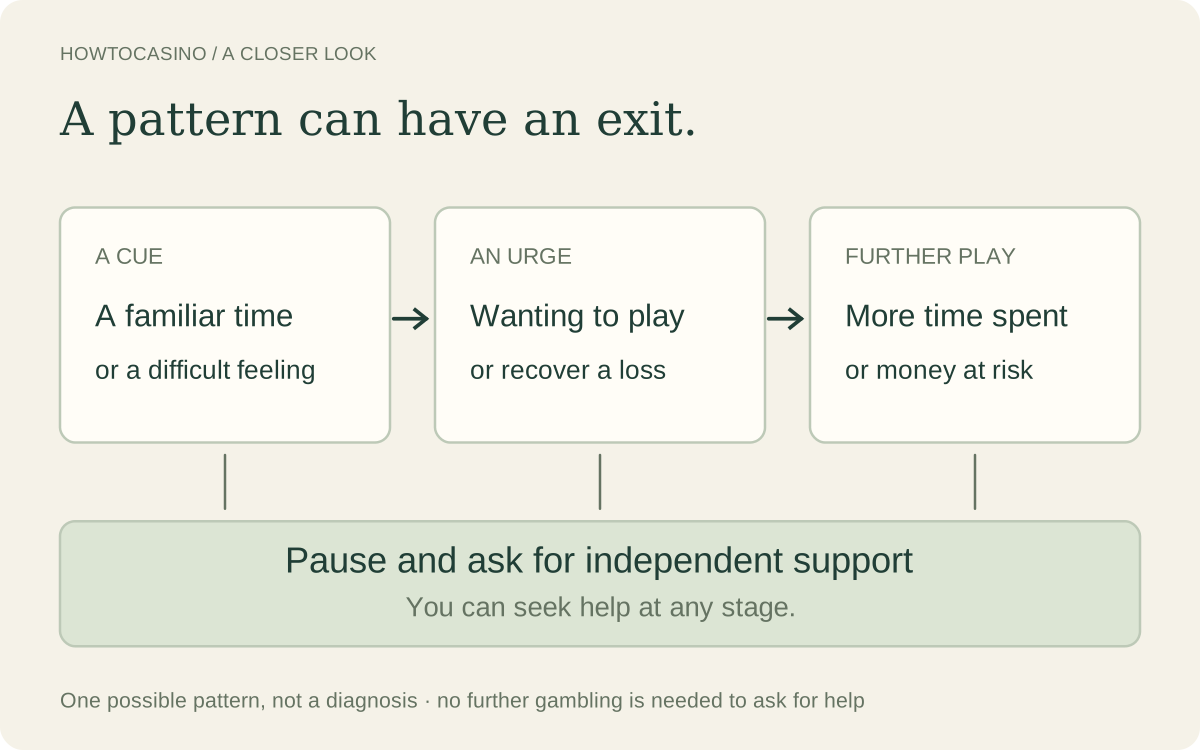
An uncertain result can keep attention on what might happen next. For some people, gambling also becomes part of a familiar routine, a way of escaping difficult feelings, or an attempt to repair a previous loss. These influences can reinforce one another: feeling upset after losing may become a reason to carry on.
GamCare describes emotional coping, habits and chasing losses among the reasons people find stopping difficult. The Royal College of Psychiatrists explains that gambling problems can have several contributing factors. A short explanation about a reward or a brain chemical cannot tell you why a particular person is struggling.
Gambling disorder is a clinical term. Enjoying a game or having an urge is not by itself a clinical diagnosis. A persistent loss of control needs appropriate assessment. This guide explains possible patterns and routes to help; it does not assess or diagnose you.
Do slot features explain everything?
Product design matters, but it is not the only influence. The Gambling Commission has addressed features that increase the intensity of online slots. Its assessment of changes introduced in 2021 reported indications of reduced play intensity, rather than proof that harm had been eliminated.
Current GB technical standards require players to initiate individual slot cycles, set a minimum 2.5-second interval from the start of a game until the next cycle can begin, and restrict features that shorten result presentation. Systems must not celebrate a return that is no greater than the total stake. These are operator requirements, not a recommended playing pace or a guarantee of safety.
Randomness requirements also prohibit misleading substitutions such as replacing losing outcomes with artificial near-miss losses. A naturally occurring result may still look close to a win. Its appearance does not establish a better chance on a later spin.
A licensed game, a small stake or a slower pace can still be associated with harm. Switching to a different casino game is not a treatment for difficulty controlling gambling.
When is it worth asking for help?
You can ask for help as soon as gambling concerns you. There is no requirement to lose a certain sum, gamble every day or reach a score on a checklist. Harm can affect finances, health, work and relationships in different combinations.
- You repeatedly spend more time or money than you intended.
- You carry on to recover losses, even after deciding to stop.
- Gambling takes priority over sleep, bills, work or people you care about.
- You hide gambling, borrow because of it or feel anxious about what has happened.
- You feel unable to stop, or are worried about someone else’s gambling.
These are reasons to talk to someone, not a diagnosis made by this website. An affected partner, family member or friend can seek their own support even if the person gambling is not ready to do so.
What can you do when you want to stop?
- Step away from the game and create some distance from the next urge. Do not make another deposit to try to recover what has already gone.
- Contact independent support. An adviser can help you decide what is manageable today, including if you have stopped and then returned to gambling.
- Use the controls that fit your situation: operator self-exclusion, GAMSTOP Online, device blocking and your bank’s gambling-payment controls can work alongside each other. Their coverage differs.
- Protect essential spending. Prioritise bills and ask a qualified debt-advice service for help if gambling has left money problems.
- If it feels appropriate and safe, tell someone you trust what support you would like. Agree practical help without sharing passwords, PINs or access to financial accounts.
Our support page brings together independent help and practical controls. The GAMSTOP guide explains the scope of online self-exclusion; account closure and stopping promotional messages are separate processes.
Where can you get independent help in Great Britain?
| Route | What the checked provider says | Next step |
|---|---|---|
| GamCare | The National Gambling Helpline is free on 0808 8020 133, 24 hours a day. Live chat is available through its official website. Its local support finder covers England and Scotland. | Use GamCare’s current support page for contact and local options. |
| Wales | The NHS All-Wales Gambling Helpline is free on 0808 281 9265, 24 hours a day, including from mobiles and landlines. | Use the NHS Wales service page for the helpline and treatment referral routes. |
| Healthcare | A GP or local NHS service can explain healthcare options. The NHS England page includes specialist-clinic information. | Check the individual service’s area and eligibility; pathways differ across GB. |
Contact details were checked on 30 October 2026. The 24-hour description above applies to the helplines, not to a promise of immediate treatment appointments. The provider links appear in the sources for this section.
You do not need to send this website account records, medical details or a description of your losses. HowToCasino publishes information and does not provide counselling, manage exclusions or handle casino accounts.
What happens when you ask for support?
You can start by saying that gambling is hard to control or that you are worried about someone else. You do not need a polished explanation. Support can address urges and triggers as well as practical concerns; professional assessment can establish whether treatment such as a talking therapy is appropriate.
Ask the service what information it needs and how it uses it. GamCare says people using its helpline or live chat can choose not to give their name or address initially. That does not mean no data is collected: helpline calls are recorded, live-chat transcripts are stored, and technical details such as a phone number or IP address may be retained.
Confidentiality has safeguarding and legal limits, and treatment or a referral may require further identifying details. Read the provider’s own policy rather than relying on an absolute promise of anonymity. If a first step has not worked, you can ask again or discuss a different support route.
Related questions
Why are slots addictive for some people?
Unpredictable outcomes can become linked with anticipation, routines, difficult emotions or attempts to win losses back. Several factors may contribute, so no single feature explains every person’s experience. Difficulty stopping is a reason to seek support, not a personal failure.
How do I stop slot machine gambling?
Step away from the game and contact independent support. Operator exclusion, GAMSTOP Online, device blockers and bank controls can help alongside support, but their coverage differs. Do not try to recover losses through another deposit.
Can roulette or blackjack also become hard to stop?
Yes. Gambling-related harm is not limited to slots. The fact that a game has different rules or a different pace does not make switching games a treatment for difficulty stopping.
Do I need to lose a lot before asking for help?
No. Concerns about time, control, sleep, relationships or money are enough to start a conversation. Help is also available to family and friends affected by another person’s gambling.
Is gambling support completely anonymous?
Ask the provider. GamCare allows helpline and live-chat users to withhold a name or address initially, but may retain recordings and technical data. Confidentiality has safeguarding and legal limits, and treatment referrals can require more details.
Does a return to gambling mean support has failed?
You can seek support again after returning to gambling. An adviser can help you review what happened and what support or controls might be useful now. There is no requirement to keep gambling or to recover losses first.