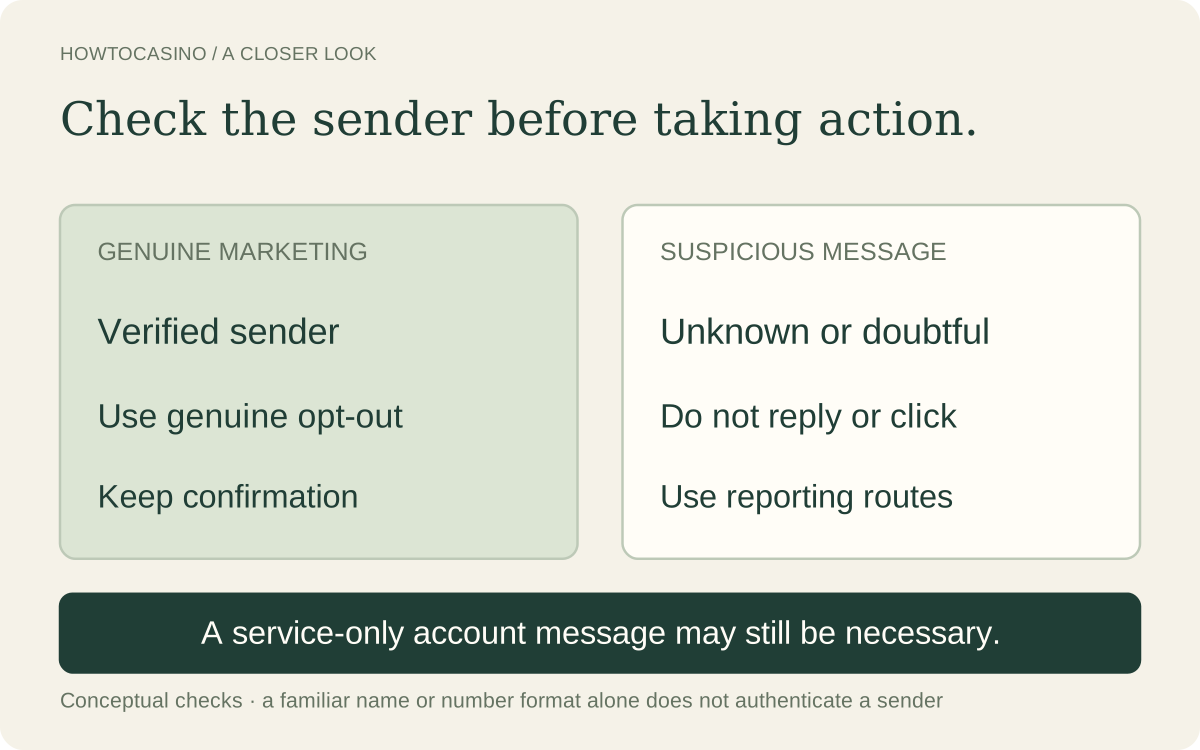
Should you click unsubscribe or reply STOP?
For a message from an organisation you recognise and can identify as legitimate, follow its genuine opt-out instructions. An email may contain an unsubscribe option; a marketing SMS may describe a STOP reply. If instructions are missing, find the organisation’s official website or privacy contact independently.
For an unrecognised or suspicious sender, do not reply or follow the message’s links, including an unsubscribe link. Use the email service’s spam/phishing tools or the mobile network’s reporting route. A familiar name, logo or number format does not by itself prove who sent the message.
| Situation | Practical route |
|---|---|
| Recognised, verified operator marketing | Use the genuine channel preference or opt-out instruction |
| Unclear message claiming to be a familiar casino | Find the operator independently and ask whether it sent the message |
| Suspicious email or SMS | Avoid links and replies; use provider/network reporting and blocking |
| Unknown sender with no opt-out details | Do not supply more personal information to discover whether it is real |
Our fake-advert guide explains independent address and attribution checks. The same care applies to a promotional message: a promise of a free reward is not evidence that an instruction or login screen belongs to the named operator.
Which casino marketing preferences should you change?
The GB direct-marketing preference condition requires covered remote operators to offer product and channel choices, with opt-out as the default, for new and existing customers. Its examples include casino, betting and bingo products, and channels such as email, SMS and phone. The interface and products offered can differ; no particular nine-box screen is required here.
Check the scope of your actual setting. Turning off casino emails may not describe SMS, betting messages or another company’s mailing list. If you want all the organisation’s direct marketing to stop, say so clearly rather than assuming a narrow checkbox covers every contact.
Registering an account is not a substitute for the applicable product/channel permissions. The separate electronic-marketing consent condition requires informed, specific consent unless expressly permitted by law, and a withdrawal opportunity in each contact. Generic privacy wording or an accepted set of account terms should not be treated as proof of every marketing preference.
Use the verified account or contact route and keep the confirmation. HowToCasino does not control casino mailing lists or process player identities. You do not need to send us your phone number, account details or documents to use this guide.
Why might some account emails still arrive?
A purely administrative or customer-service message without promotional material is different from direct marketing. Its purpose and content matter, not just the subject line or the label transactional.
| Illustrative message | What to examine |
|---|---|
| Withdrawal-status confirmation | A factual account update can be a service communication |
| Security alert or account-verification request | Check authenticity and purpose through the operator’s verified route |
| A bonus offer attached to an account update | Promotional content can change the marketing classification |
| A public banner or social-media advert | It is not the same direct-message channel as a marketing email or SMS |
Opting out of promotions does not itself erase the account relationship or every necessary notification. Equally, an organisation should not hide bonus advertising inside a supposed service message to disregard a marketing choice. If a message mixes the two, keep the complete content when asking why it was sent.
The account explainer separates the operator’s service from adverts and review websites. Check which organisation sent or arranged the communication; a shared game supplier does not mean every sender is the same business.
Can you object to marketing, and does the company have to delete everything?
The ICO says an objection to the use of personal information for direct marketing must be respected and cannot be refused. It also covers profiling for that purpose. No special legal phrase is required. Make the intended scope clear, especially if you want more than a particular channel stopped.
An opt-out, an objection, deletion, account closure and self-exclusion are not identical requests. An organisation may need a minimal suppression record of an email address or number so that it does not add the person back to marketing later. Retaining that necessary record is different from continuing to use the details to promote gambling.
General PECR guidance contains a conditional products-and-services soft opt-in, including the sender’s own similar products and opt-out opportunities. It is not a blanket permission for another organisation’s offers, and it does not displace additional GB gambling marketing requirements.
Do not confuse response times with permission to continue sending adverts. The general one-calendar-month objection-handling response period is not a month-long marketing grace period. The UKGC electronic-marketing condition requires electronic marketing to end as soon as practicable after consent is withdrawn, unless the consumer consents again.
Use only necessary information to identify the contact or account through a verified channel. The ICO’s guidance says any further identification request must be necessary and proportionate; this page does not establish that every opt-out needs an identity-document upload.
What if you are self-excluded and still receive casino promotions?
Formal self-exclusion is a protection for someone seeking support to stop gambling. It is different from simply changing an email preference. An ordinary marketing opt-out does not, by itself, prevent gambling or create an exclusion.
The Commission says operators must take all reasonable steps to prevent marketing to self-excluded customers. Its specific database requirement is to remove or flag the person in the relevant company or group marketing databases within two days of receiving the completed self-exclusion notification. That two-day rule is not a universal deadline for every ordinary unsubscribe.
The operator’s responsibilities also cover contracted third-party marketing. Keep the sender, message, date and evidence of the completed exclusion when reporting a suspected failure through verified channels. An unrelated fraudulent sender may be a different problem; do not respond to a claimed bonus by following an unverified account link.
The GAMSTOP explainer covers scheme and licensing scope. Nothing in this guide suggests opening another account, reactivating play or changing a payment method to avoid an exclusion.
What should you record and where can you report continuing messages?
- Keep the message, sender details and date, with personal information masked when sharing evidence publicly.
- Record when and how you changed preferences or objected, and the scope of the request.
- For a legitimate organisation, raise continued marketing through its verified support or privacy contact.
- For suspicious SMS, use the network’s reporting route; Ofcom describes the free 7726 service supported by most UK mobile networks.
- For email, use the mail provider’s spam/phishing tools and follow the ICO email guidance’s complaint route if needed.
The ICO’s current spam-text and nuisance-call reporting page says reports inform its investigation and action, and that it does not respond to complaints individually. That page is not a dedicated marketing-email form; use the route linked from the email guidance for an email issue.
Reporting is not a guarantee that every future message will stop, that a fraudulent sender will comply or that compensation will follow. Blocking can reduce delivery to your device, while a genuine organisation’s preference or suppression record addresses a different part of the problem.
If the messages are making it harder to take a break, use the independent Support and safer gambling links on this site as well as the communication controls. The aim is to remove pressure, not to keep promotional offers active in case they become valuable.
Related questions
Should I reply STOP to every casino text?
No. Follow genuine opt-out instructions only for a recognised legitimate sender. For an unknown or suspicious message, avoid replying or clicking and use the network’s reporting or blocking tools.
Why am I receiving casino emails if I never registered?
The cause cannot be established from the brand name alone. The message could involve a different sender, previously collected details or impersonation. Do not infer valid consent or provide more information through an unverified link.
Does unsubscribing close my casino account?
No automatic account closure or self-exclusion is created by a marketing choice. Use the verified process for the separate action you want.
Do all casino messages have to stop within 48 hours?
There is no universal 48-hour unsubscribe deadline stated here. The UKGC condition says electronic marketing must end as soon as practicable after consent withdrawal. The separate two-day database rule concerns completed self-exclusion notification.
Can the company keep my email after I object?
A minimal suppression record may be needed to prevent further marketing. That is different from using the address for promotions or retaining unrelated information without a basis.
Will stopping casino emails remove every gambling advert?
Not necessarily. Direct emails and SMS, service messages, public website adverts and platform advertising are different channels. The scope of your request and the relevant controls matter.