Which Dead or Alive game do these rules describe?
This explains NetEnt’s original five-reel, three-row Dead or Alive with nine fixed paylines. It does not describe Dead or Alive 2, Dead or Alive 3 or Hacksaw Gaming’s Wanted Dead or a Wild. Similar names and Western artwork are insufficient to identify the rules.
The supplier’s public feature description and the game rules published by GB-facing Wizard Slots agree on the 12-spin starting award, sticky positions, five-reel condition for extra spins and 2x free-spin multiplier. The original Touch rules on Rational CDN add the explicit once-per-feature restriction. These are public documents; we have not tested a casino account or loaded a real-money game.
The Touch document and NetEnt’s desktop Game Sheet are descriptions of original builds. The latter is version 1.1, dated 3 July 2020. They help resolve the feature’s rules, but their old controls, currency examples and payout settings do not establish the configuration currently supplied to a British account.
What actually stays sticky?
In the base game, the Wanted poster is a wild substitute. During the free-spin feature, a wild that appears stays in the same cell for the rest of that feature. Later spins continue around the held positions, allowing those wilds to take part in further line evaluations. A held cell is not an expanding wild covering its entire reel.
The cited original rules start each new feature with no sticky wilds. Wilds collected during it remain through the additional five spins if that award occurs. They clear when the feature finishes; they are not carried into subsequent paid spins or a later, separate free-spin feature.
A wild replaces eligible ordinary symbols, not the Scatter. The general wild-symbol guide explains how substitution differs from triggering a bonus.
When do five extra free spins trigger?
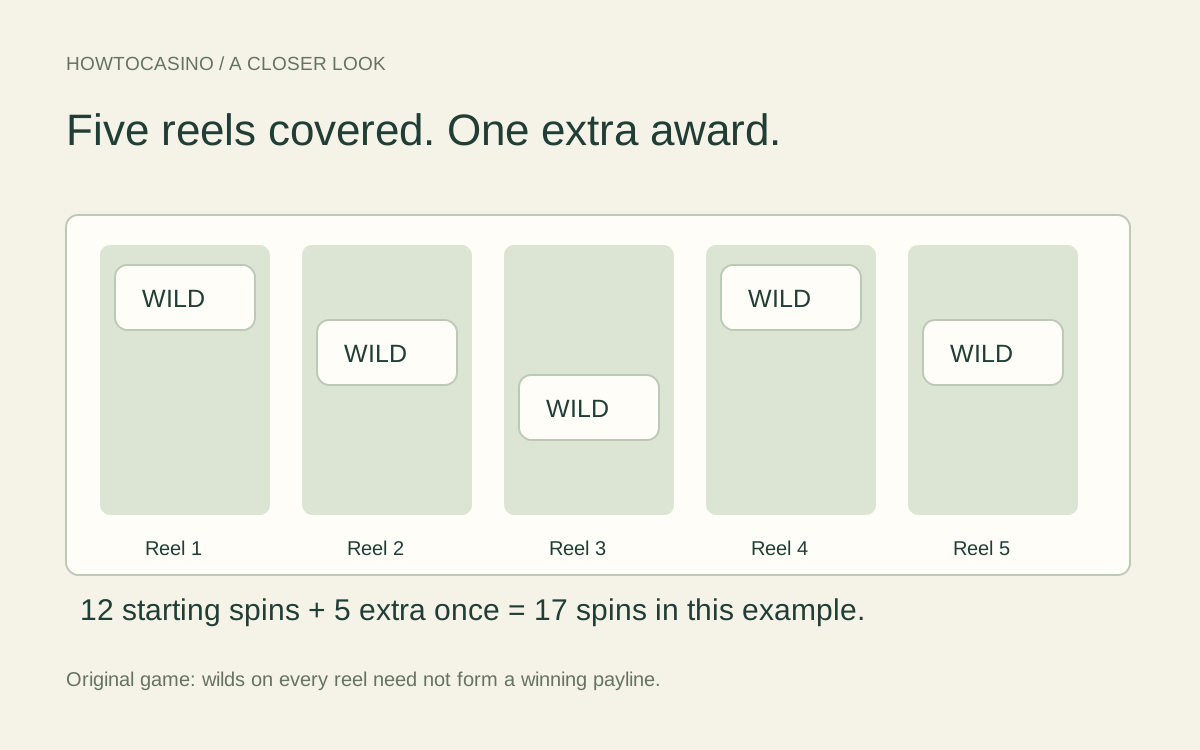
The test is whether every reel has at least one sticky wild. The held wilds can accumulate over different spins: they do not all need to arrive together. Five wilds concentrated on fewer than five reels do not meet the condition.
| What is on the reels? | Does the extra-spin condition apply? | What to check |
|---|---|---|
| One sticky wild on reel 1 | No | It stays held, but reels 2–5 still need coverage. |
| Five sticky wilds spread across reels 1–4 | No | The fifth reel has no wild, irrespective of the total number collected. |
| At least one sticky wild on each of reels 1–5 | Yes, if this feature has not already received the award | Add five free spins; retain the held wilds. |
| Further wilds after that extra-spin award | No second award under the cited once-only original rule | Evaluate line wins; do not add another five merely because coverage remains. |
Reel coverage and a winning wild line are separate checks. Coverage asks which columns contain wilds. A line win also depends on the row positions along one of the nine payline paths and the paytable. Use the game’s line overlay before treating five covered reels as a particular five-symbol line win.
The original Touch rules say Scatters do not appear during free spins. Their extension is the sticky-wild award, not another set of 12 spins from three Scatters. A description claiming that every wild adds five spins, or combining a 12-spin Scatter retrigger with this award, does not match those cited rules. Check the actual rules if your loaded game describes another build.
Worked example: 12 starting spins is not 12 remaining spins
This is a hypothetical counter example under the original once-only rule, not a played round or a prediction. Assume the fifth free spin supplies the first sticky wild on the last uncovered reel.
| Stage | Calculation | Spins remaining |
|---|---|---|
| Feature begins | 12 awarded; none used | 12 |
| Four spins have finished | 12 − 4 | 8 |
| The fifth spin finishes and completes reel coverage | 8 − 1 + 5 | 12 |
| Two further spins finish | 12 − 2 | 10 |
At the coverage award, the feature has received 17 spins in total: 12 initially plus five extra. Five have already been used, so 12 remain. The display need not show “17 remaining”. Subsequent held wilds do not repeatedly renew the same award. If the coverage condition is never met, the original allocation remains 12.
The row positions, symbols and payouts are deliberately unspecified here. The arithmetic checks the spin counter only; it cannot calculate a return or the likelihood of reaching the feature.
Does every sticky wild double the win?
No. The original feature applies a 2x multiplier to eligible free-spin line wins. It is not a separate 2x multiplier for each sticky wild. Additional wilds can change which line combinations qualify, but they do not turn the feature multiplier into 4x, 8x or a factor based on the number held.
For a hypothetical £0.30 line award before the feature multiplier, applying 2x gives £0.60. If the game already displays the final £0.60 award, doubling that display again would incorrectly produce £1.20. Check whether a paytable or result is showing a base value or an amount that already includes the multiplier.
Wizard Slots’ current public rules describe paytable amounts that change with the selected stake. The older coin-based documents describe coin value and bet level separately. Read the units in the loaded game rather than multiplying a pound amount by an unrelated coin or line figure. A feature return is also different from net profit after the paid spin that triggered it.
What should you check in the game itself?
- Confirm the complete title and supplier, then open the rules and paytable. A sequel or another studio’s similarly named game needs its own rules.
- Look for the initial free-spin allocation, the all-five-reels condition and whether the extra-spin award is restricted to once.
- Read the actual RTP entry, stake units and any award limit. Public supplier headlines and older rule documents do not identify your installed configuration.
- If the counter or result appears wrong, save the game name, round reference, time, stake and relevant history. Ask the operator to reconcile that specific round against its rules.
Wizard Slots’ published rules say unfinished rounds resolve automatically after a period of inactivity, without specifying the duration there. The older Touch document refers unfinished-round procedures to the operator’s website. We cannot infer an unlimited right to resume, a universal deadline or cross-casino persistence from these descriptions.
To compare GB operators carrying NetEnt, use the NetEnt casino guide. A provider listing or public game page does not confirm that this exact title is available to every account. Check the exact game and operator before depositing.
Free spins awarded inside the game are a game feature. If a casino promotion is paying for your spins, its eligibility and wagering terms are a separate question; the sticky-wild rules do not settle those conditions.
Related questions
Can a sticky wild move to a different row?
In the cited original rules it stays in its existing cell for the remaining feature. Do not confuse a held symbol with an expanding or moving wild from another game.
Does the fifth wild always award five extra spins?
Only if it completes coverage of all five reels and the once-only award has not already occurred. The fifth wild in the feature can still leave a reel uncovered.
Can the original feature reach 29 free spins?
The original once-only rule documented here starts with 12 and adds five at most once: 17 spins in total if triggered. It does not support adding another 12 from Scatters during the feature. Check a different build’s own rules before transferring a figure such as 29.
Does a demo confirm the casino’s RTP and payout limit?
A demo can help identify controls and feature logic, but it does not establish which configuration a real-money account receives. Check the rules supplied by the operator for the exact game you open.