What is collected, and when is it applied?
Pragmatic Play describes two connected rules. Its exact-title game page says the accumulated total applies when a new multiplier symbol hits. The supplier’s release announcement specifies that a multiplier joins the running total on a winning spin. Both conditions matter when reading a result.
- First, identify the eligible win for that free spin and its complete tumble sequence.
- Check which new multiplier symbols qualify on that winning result; add their values to the existing feature total.
- Apply the updated total once to the eligible pre-multiplier award.
Keep three quantities separate: the eligible award is money, the stored meter is a factor, and the final return is the settled amount after the factor applies. A 35× meter is neither £35 in the balance nor a 35% chance of another win.
A tumble is another evaluation within the same spin. It is not a new paid stake each time symbols fall. Combining the eligible awards from that sequence before applying its factor avoids multiplying a partly settled amount twice.
A four-spin example: the meter and the return can diverge
Suppose an already-running free-spins round has collected 20×. This is an invented existing state, not the feature’s starting value. The amounts below are assumed eligible awards in pounds before multiplication, not quoted paytable results or a played round. Assume no cap, rounding difference or separate award affects them.
| Free-spin result | Meter after this result | Return from this result |
|---|---|---|
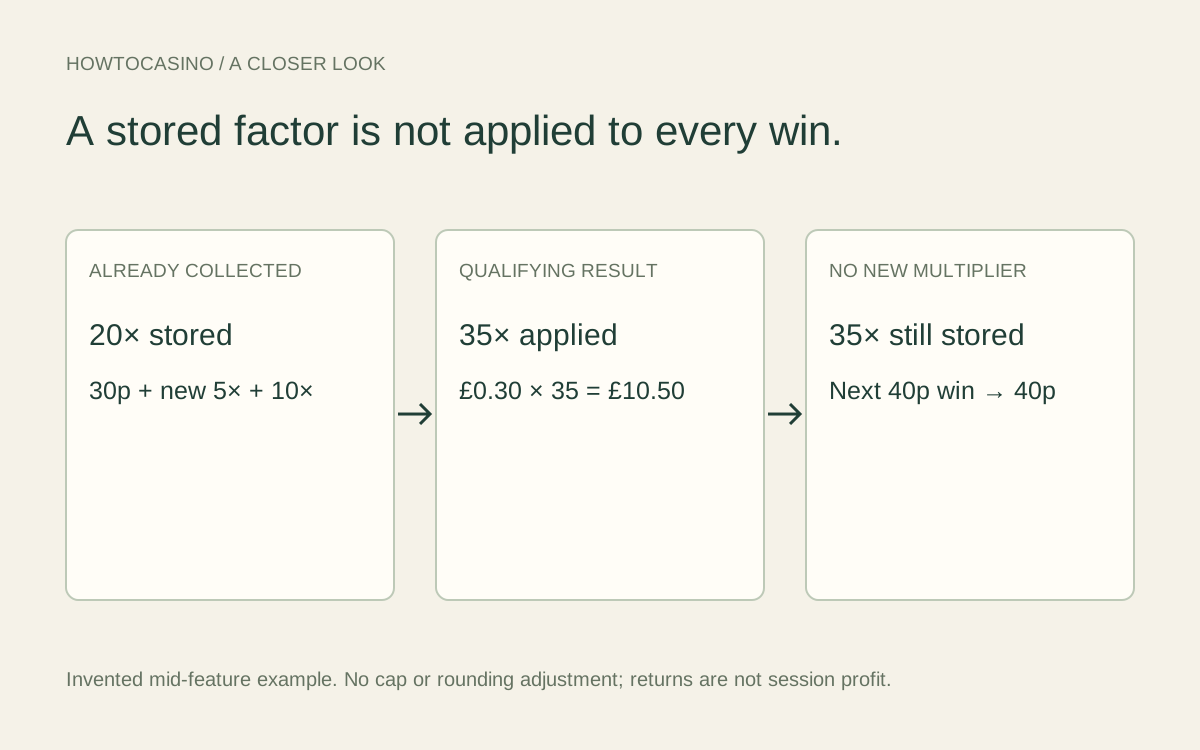
| 30p eligible win; new symbols 5× and 10× | 20 + 5 + 10 = 35× | £0.30 × 35 = £10.50 |
| 40p eligible win; no new multiplier symbol | 35× retained | Ordinary £0.40 |
| No eligible win; a 1,000× symbol lands | 35× retained; the non-winning value is not added | £0 |
| 10p eligible win; a new 2× symbol | 35 + 2 = 37× | £0.10 × 37 = £3.70 |
The first result adds the new values to the old total; it does not calculate 20 × 5 × 10. On the second, the saved 35× is still relevant to a later qualifying result, but it does not turn this 40p win into £14.
The third result is the important boundary case. A large symbol without an eligible win does not create a prize or raise the meter under the supplier’s winning-spin condition. The later 2× therefore increases 35× to 37×, rather than increasing 1,035× to 1,037×.
These four returns total £10.50 + £0.40 + £0 + £3.70 = £14.60. That is a subtotal inside a feature. It excludes earlier and later returns, any trigger award and the accepted cost of the original paid round. It cannot establish the complete feature result or session profit.
As a useful cross-check, the new 5× and 10× alone add to 15×. Applying only those new values to the first 30p would give £4.50 and omit the assumed previously collected 20×. That omission is different from applying the stored total when no new symbol lands.
Why might a saved multiplier not multiply a win?
A stored feature total and permission to use it are separate. Compare the newly landed symbols with the settled sequence, rather than reading the meter alone. The worked example’s 40p result demonstrates a regular win while the meter remains 35×.
Public summaries can shorten this distinction. Virgin Games says a winning free spin adds a multiplier value, then describes the total as applying to winning combinations. Pragmatic Play’s exact-title page additionally states the new-symbol condition. This guide uses that condition together with the supplier’s winning-spin requirement.
If your own game help describes a different result, save that wording and the round reference. A screenshot of the meter without the completed win, new symbols and game version does not settle whether a payment was calculated incorrectly.
The same distinction explains why a large meter is not a forecast. The arithmetic tells you how a qualifying award would be settled; it does not tell you when the next qualifying result will happen or whether the round will recover its cost.
Do extra free spins start a new multiplier total?
The published standard feature begins with 15 free spins after four or more scatters in the base game. Three or more scatters during the feature award five additional free spins. These are an extension of the same feature round; the supplier describes the multiplier as the round’s total.
An extra five spins is a count of further results, not a 5× addition to the meter. The new symbols on those results still have to meet the multiplier rule. A retrigger does not by itself make every remaining win use the saved factor.
Keep a scatter cash award separate from the count of free spins and the ordinary eligible tumble award. If reconciling a round, use the game help to identify how each displayed amount was settled. Our scatter explanation covers why a trigger and a cash prize can be different uses of the same symbol.
Is this different from the original or Sweet Bonanza 1000?
Gates of Olympus 1000 is a separately named game. The supplier describes individual multiplier symbols up to 1,000×, compared with up to 500× in the original Gates of Olympus. The original also has a running free-spin multiplier; accumulation was not introduced solely by the 1000 title.
The original-game explanation covers its own base-game and feature examples. Use this page for the named 1000 round’s stored-versus-applied calculation.
Sweet Bonanza 1000 uses a different boundary: its qualifying bomb sum belongs to the current free-spin tumble sequence. Do not transfer that reset rule to Gates of Olympus 1000 simply because both names contain 1000. Our Sweet Bonanza 1000 explanation works through that sequence calculation.
Neither an individual symbol limit nor a saved factor establishes the RTP, likelihood or complete payout limit of your selected game. Those are separate settings or rules. A 1,000× factor also acts on the eligible award; it does not automatically pay 1,000 times the original stake.
What should you keep if a result does not add up?
- The full title, supplier, selected mode and operator’s game reference.
- The round ID and the exact game-help version available in that account.
- The eligible pre-multiplier award and any separately settled scatter prize.
- The multiplier meter before the result, newly qualifying values and meter afterwards.
- The final credited amount and any recorded cap or interruption.
Then compare one complete sequence at a time. First ask whether a new value qualified, then whether the stored total applied, and finally whether the displayed amount already includes it. Ask the operator to explain any remaining difference against that saved result.
This explanation uses public supplier descriptions and Virgin Games’ GB overview. It is not a test of an individual account, installed RTP, current access or payment. Global supplier demonstrations may contain options absent from GB games; the bonus-buy guide explains that separate market distinction.
Related questions
Does the Gates of Olympus 1000 multiplier carry over between free spins?
Qualifying values contribute to the total for that free-spins round. Carrying the value forward is different from applying it: the supplier’s description requires a new multiplier symbol on the winning result.
Does a 1,000× symbol always add 1,000× to the bonus meter?
The supplier’s winning-spin condition matters. A symbol on a result with no eligible win does not qualify for the addition described here. A multiplier factor is not an independent cash award.
Is the running total multiplied by each new value?
No. Qualifying new values are added to the stored total. In the invented example, 20 + 5 + 10 makes 35×; it is not 20 × 5 × 10.
Does a high stored total make another win more likely?
The stored number describes an award factor. It does not supply a probability for the next result or guarantee a profitable feature. The ledger explains settlement when its assumed results occur, not how often they will occur.