Which Wanted game does this explain?
This is Hacksaw Gaming’s Wanted Dead or a Wild: a five-reel, five-row slot with 15 paylines. The Great Train Robbery, Duel at Dawn and Dead Man’s Hand belong to this exact game. NetEnt’s original Dead or Alive and Dead or Alive 2 use different rules, even though their names and Western themes can look similar.
The comparison uses Hacksaw’s feature description and the detailed explanations on MrQ and Pink Casino. It explains the published mechanics, rather than confirming the version, return setting or features installed in a particular account. Use the information panel of the game you have opened when checking an actual result.
The three bonuses: what starts them, and what persists?
| Bonus | Matching trigger in the base game | What the feature changes |
|---|---|---|
| The Great Train Robbery | Three or more Train Robbery symbols | 10 free spins; landed Wilds stay in their positions for the feature. |
| Duel at Dawn | Three or more Duel symbols | 10 free spins with more VS symbols; qualifying VS reels provide Wilds and multipliers. |
| Dead Man’s Hand | Three or more Dead symbols | A collection phase with resets, followed by three Showdown spins using the collected Wild count and multiplier. |
Read the symbol type as well as the count. One Train Robbery, one Duel and one Dead symbol are not three matching symbols for one of these triggers. The natural trigger determines which feature begins; the table is a rules comparison rather than a menu from which you can choose a bonus.
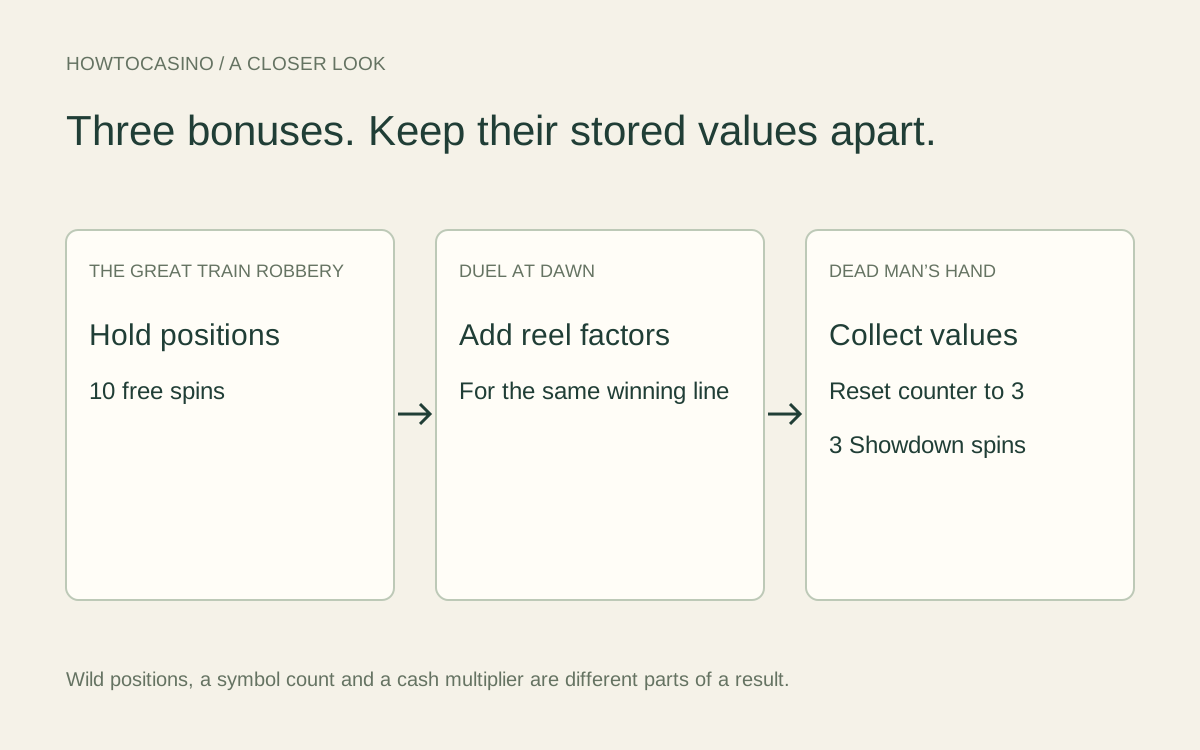
The word “collected” also means different things across the features. Train Robbery retains Wild positions on the grid. Dead Man’s Hand stores a Wild count and a multiplier for a later phase. Neither counter is a cash balance by itself.
The Great Train Robbery: held positions across 10 spins
During The Great Train Robbery, Wilds that land remain sticky for the rest of the bonus. A held Wild can help form a valid winning line again on a later spin. It is the position that persists; the previous line payment is not automatically paid again just because the Wild remains.
For example, a held Wild may participate in a winning combination on one spin, then have no matching payline combination on the next. Holding the symbol does not create a separate fixed cash prize for each remaining spin. Check the settled line result each time.
An individual sticky Wild and a DuelReels expansion are different features. The documented VS symbols belong to the base game and Duel at Dawn; do not assume every Wild in Train Robbery turns an entire reel into a multiplier Wild. The payline guide explains why a useful symbol still needs an eligible combination.
Duel at Dawn: add relevant reel factors before multiplying a line
Duel at Dawn supplies more VS symbols than the base game. A VS symbol expands into a full Wild reel when the expanded reel participates in a winning combination. The duel’s winning outlaw supplies that reel’s multiplier. The animation is part of the game result, not a contest whose winner the player chooses.
Hacksaw’s rule for several multiplied Wild reels is additive: when they share a winning combination, add their values and multiply that payline’s eligible win by the sum. Do not multiply the factors by each other or apply an unrelated reel’s factor to a line.
| Hypothetical settled line | Calculation | Return |
|---|---|---|
| Eligible line award before multipliers: £0.40; relevant Wild reels carry 5× and 10× | £0.40 × (5 + 10) | £6.00 |
| Incorrectly multiplying the factors instead | £0.40 × 5 × 10 | £20.00 — the wrong rule for this example |
The £0.40 is an assumed cash award before multipliers, not a quoted paytable entry or recorded spin. The example assumes the two factors belong to the same valid line and no cap or rounding adjustment applies. Because the initial amount is already money, multiplying by the stake again would count the stake conversion twice.
If the history already displays £6 as the final line return, do not apply the same 15× again. Likewise, the losing outlaw’s number is not another factor to add. Read the surviving reel factors and the specific combination to which they apply. This arithmetic describes settlement of an assumed result, not the chance of landing it.
Dead Man’s Hand: resetting to three is not adding three
Dead Man’s Hand starts with a collection phase. Wilds are stored in the Wild counter; multiplier symbols contribute to the multiplier meter. A new Wild or multiplier resets the remaining collection spins to three. The phase ends after three consecutive spins without one of those collections.
| Assumed collection result | Remaining collection spins afterwards | What to keep separate |
|---|---|---|
| Phase begins | 3 | This is the collection counter, not the later Showdown allocation. |
| Nothing is collected | 2 | One collection spin has been used. |
| A Wild is collected | Reset to 3 | The Wild count increases; this does not turn two remaining spins into five. |
| Nothing is collected | 2 | The counter falls by one. |
| A multiplier is collected | Reset to 3 | The multiplier meter changes; the reset condition also applies without a new Wild. |
| Three consecutive spins collect nothing | 2 → 1 → 0 | The collection phase finishes; the separate three-spin Showdown begins. |
This is an invented sequence to explain the counter, not a prediction of feature length. A productive collection spin can change the stored Wild count or multiplier without paying a conventional line win at that point. Calling it a “winning spin” should not make you ignore what was actually collected.
MrQ’s detailed bonus description and Pink Casino’s feature section both identify a Wild or multiplier as the reset event. Keep that rule separate from the Dead symbols that trigger the feature in the base game. You do not need three new Dead triggering symbols to produce each collection reset.
Showdown: a Wild count and a money multiplier have different jobs
The second phase awards three spins. Hacksaw says the collected Wilds are added in random positions on every Showdown spin, then the accumulated multiplier applies to wins. The stored count is reused for each spin; it is not divided into three smaller allocations.
Suppose the completed collection phase has recorded four Wilds and a 20× multiplier. These are invented meter values. Assume the game has already evaluated each Showdown layout, including the effect of its placed Wilds, and the eligible cash awards before the 20× factor are as follows. No cap or rounding adjustment is assumed.
| Showdown spin | Eligible cash award before the factor | Apply the recorded 20× |
|---|---|---|
| 1 | £0.15 | £0.15 × 20 = £3.00 |
| 2 | £0.00 | £0.00 × 20 = £0.00 |
| 3 | £0.30 | £0.30 × 20 = £6.00 |
The illustrated Showdown subtotal is £3 + £0 + £6 = £9. The four Wilds have already affected which combinations produce the assumed line awards. Multiplying the £9 by four again would incorrectly turn a quantity of symbols into another cash multiplier.
Four Wild placements on each of three layouts make 12 placements across those spins, not 12 permanently held Wilds on the final grid. The positions are selected again for each Showdown result. This is the practical difference from the Train Robbery feature’s held positions.
A multiplier applied to a zero eligible award still gives zero. The £9 subtotal also excludes any other game returns and the paid round’s cost, so it cannot establish net session profit. For an amount that appears wrong, keep the round reference and check whether the history shows the award before or after the multiplier.
Does this tell you which bonus is best?
For a naturally triggered bonus, the matching symbols determine the feature. The mechanics table helps you read the result you receive; it does not give a way to select a more profitable future feature. More VS symbols and retained Wilds describe different rules, not a guaranteed amount or a known probability of recovering previous stakes.
Global supplier pages can also show a Bonus Buy option. That is separate from this explanation of ordinary triggers and does not establish an option available in a GB game. Our bonus-buy guide explains the market distinction; a demonstration or foreign purchase menu should not replace your own game’s rules.
Use the exact game’s information panel to check the return setting, units and applicable payout limits. We have not verified those settings for an individual account here. A public game listing or a supplier software licence also does not establish that every casino offers this specific version; the Hacksaw casino guide explains those operator checks.
What should you save when a bonus result does not add up?
- The full game name, supplier, casino and round reference.
- The type and number of symbols that triggered the feature.
- For a VS result: the winning line, its pre-multiplier award if shown, and the surviving reel factors.
- For Dead Man’s Hand: the Wild count, multiplier meter and remaining collection spins before and after the disputed event.
- The three Showdown layouts and settled amounts, including any cap or interruption message.
Compare one stage at a time: trigger, stored feature state, eligible combination, applied factor and final credit. Ask the operator to explain the specific stage that differs from the saved rule. A single screenshot of a large multiplier cannot show the entire calculation.
Related questions
Can you choose a Wanted Dead or a Wild bonus after it triggers?
The matching base-game symbols trigger their respective features: Train Robbery, Duel or Dead. The table here compares their rules; it does not describe a player choice between all three during ordinary GB play.
Do multiple DuelReels multipliers add or multiply together?
For relevant Wild reels sharing a winning combination, Hacksaw says to add their factors and multiply the payline win by that sum. In the hypothetical example, 5× and 10× give a 15× factor, not 50×.
What resets Dead Man’s Hand back to three spins?
Collecting either a Wild or a multiplier resets the collection counter to three. That differs from adding three to the remaining count and from landing the Dead symbols that originally triggered the feature.
Are collected Wild positions sticky in the Showdown phase?
The supplier describes the collected Wilds being added to random positions on each Showdown spin. The stored Wild count persists; this is different from Train Robbery keeping landed Wilds in their grid positions.
Does a 20× multiplier guarantee a Showdown win?
No. It multiplies the eligible award. If the assumed eligible amount is zero, zero multiplied by 20 is still zero. The stored factor does not by itself supply a cash prize or a probability of the next result.