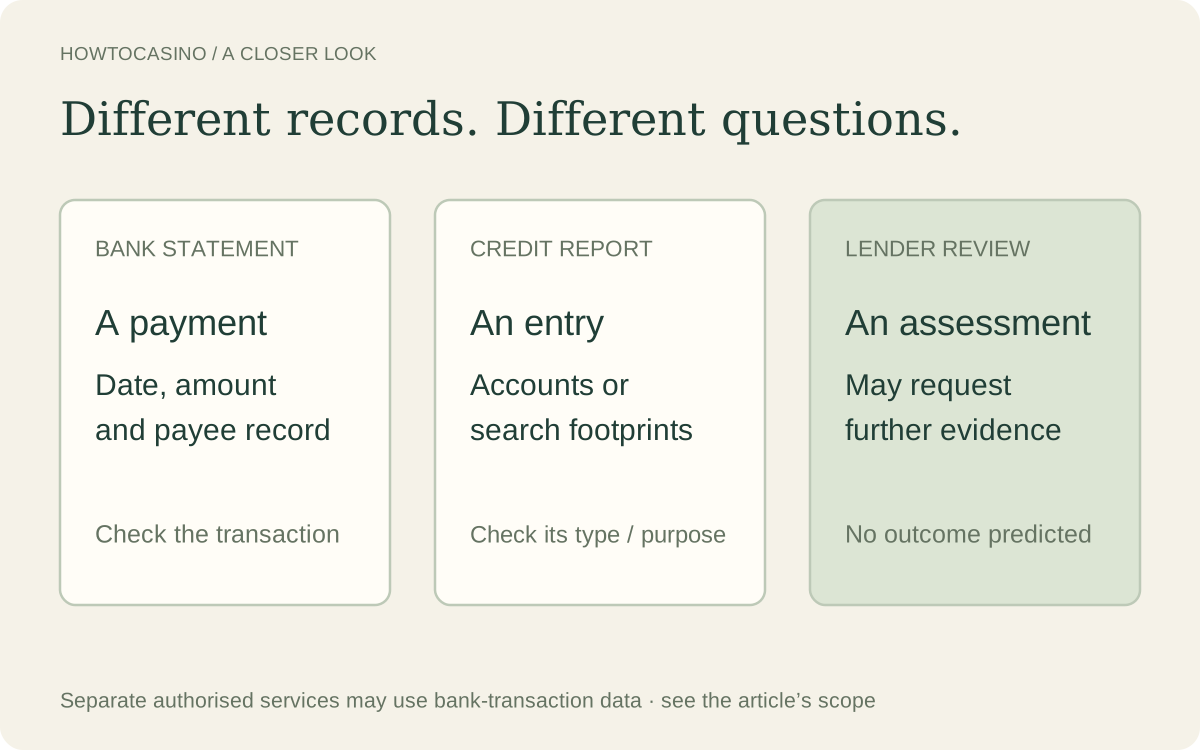
What exactly are you looking at?
| Record or entry | What it can concern | What to check first |
|---|---|---|
| Bank or payment statement | An account transaction, including a payment to a gambling service or payment intermediary. | Date, amount, transaction reference and the actual payee description. |
| Credit-report search footprint | An organisation’s search, with a date and purpose. | The search category and organisation; it is not automatically a credit account. |
| Credit account | An actual credit agreement and its reported account information. | The lender, agreement details, balance and payment status. |
| Debt or public-record information | A different reported event requiring its own explanation. | The source and accuracy of that particular entry; do not assume it is a normal casino deposit. |
| Lender’s request for evidence | A lending assessment that may use more than the credit file. | What information that lender has requested and for what purpose. |
The words credit report and bank statement are sometimes used interchangeably in search questions, but they describe different records. Start with the section heading and type of entry rather than assuming that a gambling-related name means a debt has been added.
A trading name may also differ from a company or parent-company name. TransUnion’s guide explains that an unfamiliar search name can require clarification from the organisation or the agency. That possibility is a reason to investigate, not proof that every unfamiliar name is legitimate.
Why might a gambling business make a credit-reference search?
Credit reference data has uses beyond lending. The Gambling Commission explains that age and identity checks for GB online gambling can use credit-reference or electoral information. The shared Credit Reference Agency Information Notice also describes gambling-related identity and financial-vulnerability services.
A concrete operator example is Sky Bingo’s public Soft Credit Checks help, which names TransUnion and describes a consumer-visible soft-search footprint. That is an attributed description of its process; we have not tested an account or established that every operator uses the same category, information or account decision.
The purpose of the check and any resulting casino account restriction are separate from a new credit agreement. An operator asking for identity information does not, by itself, mean you have applied for a loan. Our casino ID guide explains that different account-check context.
Will the entry affect a credit score or be visible to lenders?
Read the actual entry type. Experian distinguishes soft searches, which the consumer can see but companies assessing credit cannot see and which do not affect its score, from hard searches recorded for other credit assessors. Saying a soft search leaves no trace is therefore imprecise: a footprint can remain visible to you.
TransUnion’s Your credit file explained, version 8.0 dated May 2024, specifically lists Gambling Affordability Assessment as not visible to others and not used in scores in its search-category table. It also lists a non-credit identity-check category with those treatments. That is evidence for those defined categories, not a universal rule for anything with a casino-related name.
If a purported gambling check is displayed as a different kind of search or account, ask the agency and named organisation to identify its purpose and category. Do not assume that a statement transaction, a soft search, a hard search and an actual credit account have identical consequences.
A credit-reference score is also different from a lender’s own assessment. The treatment of one search does not establish how a lender will assess every other piece of information or guarantee a loan or mortgage outcome.
Does a £20 casino payment become a £20 credit account?
Not merely because the payment happened. In this fictional example, £100 of your own money is in a bank account and an accepted £20 debit payment leaves it. With no other transactions or fees, the balance becomes £80. That is an account movement; the subtraction does not itself create a £20 credit agreement.
| Fictional example | Amount or interpretation |
|---|---|
| Starting own-money bank balance | £100 |
| Debit payment | −£20 |
| Balance after that payment | £80 |
| Credit account created solely by this arithmetic | None established by the payment alone |
The merchant label in a real statement must be checked with the payment provider. This illustration does not reproduce a tested casino descriptor, guarantee what a wallet transaction will disclose or show what data a particular credit agency has received.
An existing loan, credit-card account or other borrowing is a separate agreement. The GB casino credit-card restriction is another separate point: covered licensees must not accept gambling payments by credit card, including through money service businesses. That restriction does not prove a casino-related credit entry is impossible in every country or circumstance, and it is not an invitation to route borrowed money around the rule.
Our debit-card and credit-card guides explain the payment routes and GB restriction. The key here is to identify the actual record rather than infer a credit agreement from an ordinary payment label.
Can credit reference agencies ever receive bank-transaction data?
An ordinary credit report is not an itemised bank statement. However, it would be too broad to say credit reference agencies can never process transaction information.
The shared CRAIN notice, version 1.2 adopted on 2 December 2024, describes Open Banking data that can include transaction amounts, dates and payer or payee details where the account access has been specifically authorised. That is different from treating each payment as a new line of credit on the statutory report.
It also does not prove that a particular casino, lender or agency has accessed your bank account. Check the actual service, access arrangements and privacy information. Do not treat the word soft as a promise that no other relevant data exists or can be considered in a separate process.
Could a lender see statements even if a search is soft?
A lending assessment can ask for information beyond the credit report. For example, NatWest’s public mortgage-eligibility guide says bank statements may be requested to review account running, payments and spending. That is one lender’s published process, not a test of an application.
A soft search’s stated visibility therefore does not mean that a lender can never see a gambling transaction through information separately provided to it. Equally, one casino-labelled transaction does not let this website predict an acceptance, rejection or change in score.
If you are applying for credit, use the lender’s current information or an appropriately qualified adviser for your circumstances. This guide does not provide a universal spending threshold, a required gambling-free period or a way to conceal transactions.
How do you check or dispute an unfamiliar entry?
- Identify the agency, report date and exact section: search, account, payment history or another record. Save the relevant details for the agency or information supplier.
- Check the named organisation and any trading-name explanation through verified contact details. Ask what the entry concerns rather than assuming its purpose.
- Use the relevant agency’s statutory access route if you need the underlying file. ICO guidance describes free access; a paid subscription is not required for statutory access.
- If information is inaccurate, raise the specific discrepancy with the agency that supplied the report and the organisation that supplied the data. Explain which detail is wrong.
- If you identify an unrecognised account or transaction, contact the relevant bank, creditor or provider through verified channels. An unexplained name is not, on its own, a diagnosis of fraud.
- For an unresolved data-handling concern, follow the organisation’s complaint process and the ICO’s current guidance. A payment or gambling dispute can require a separate route.
The main UK agencies can hold different information. Experian’s free statutory report shows basic credit history but excludes its score; that does not make a paid score product necessary to query an inaccurate entry.
This is not a promise to remove an accurate, lawfully held record or resolve a dispute within a fixed number of days. A corrected entry also does not guarantee a particular score or lending decision.
Which organisation should answer the concern?
Use the agency and data supplier for a credit-file entry, the payment provider for a statement transaction, and the casino for its account-check or payment explanation. A casino’s statement that its check is soft does not settle whether an unrelated credit account is accurate.
If the actual problem is a casino refund or disputed payment rather than a credit-file record, our refunds and chargebacks guide separates those processes. HowToCasino cannot access or correct your file, handle a lender application or resolve a casino account.
Related questions
Why would a casino show up on my credit report?
It may be a search footprint for identity or financial checks, or a different kind of record requiring investigation. Identify the entry’s category, organisation and purpose. A casino-related name alone does not establish a new debt, fraud or a lending outcome.
Is a casino payment on my bank statement the same as a credit-file entry?
No. A statement transaction, a credit-report search and an actual credit account are different records. Paying £20 of your own money does not, by itself, establish a new £20 credit agreement.
Do soft searches leave no trace?
A soft-search footprint can be visible to you. Experian says its soft searches are not visible to companies assessing credit and do not affect its score. The actual category still needs checking.
Can credit agencies ever process bank transactions?
Yes, in specific contexts described in their privacy information. The shared CRAIN notice includes authorised Open Banking data with transaction details. That is different from saying an ordinary credit report is an itemised bank statement or every casino has accessed your account.
Can I get a credit report without paying a subscription?
ICO guidance describes free statutory access. Experian’s statutory report is one free example and excludes its score. Use the relevant agency’s current statutory route rather than assuming a paid product is required.
Will a casino transaction make my mortgage application fail?
This page cannot predict that. Lenders can assess information beyond a credit report and may request statements. A search’s category, a transaction and an individual lending decision must be considered separately.