What do the reference card, Andar and Bahar mean?
The reference card is sometimes called the Joker or house card. In the selected model it is an ordinary card from a single 52-card deck, not an extra wild joker. Its rank matters: a king is matched by another king, regardless of suit. You are not comparing which pile has the higher card or adding cards to a baccarat total.
Andar and Bahar are the two dealing positions. Evolution’s current public description of Super Andar Bahar says dealing starts at Andar and alternates until a card matches the reference. For the complete educational rules model used for the calculations here, we use Loto-Québec’s publicly accessible English Super Andar Bahar PDF.
LeoVegas’ UK-facing catalogue names Super Andar Bahar separately from Ezugi titles. That public listing illustrates why the provider and full title matter; it is not an account-access test or a recommendation.
How does a round work?
- Identify the exact game and its main and optional bets. The selected rules allow betting before the reference is dealt; do not assume every game reveals it before every betting decision.
- The reference card establishes the rank to match. Betting closes before the alternating deal. In this Super model, any randomly assigned boosts apply to eligible card-count side bets.
- The first counted card goes to Andar, the second to Bahar, and the deal continues in that order.
- The first card matching the reference rank ends the deal. Its side wins the main wager; any separate card-count wager is settled under its own rules.
- The selected rules state that the deck is shuffled after each round. A previous winner does not reveal the next shuffled order.
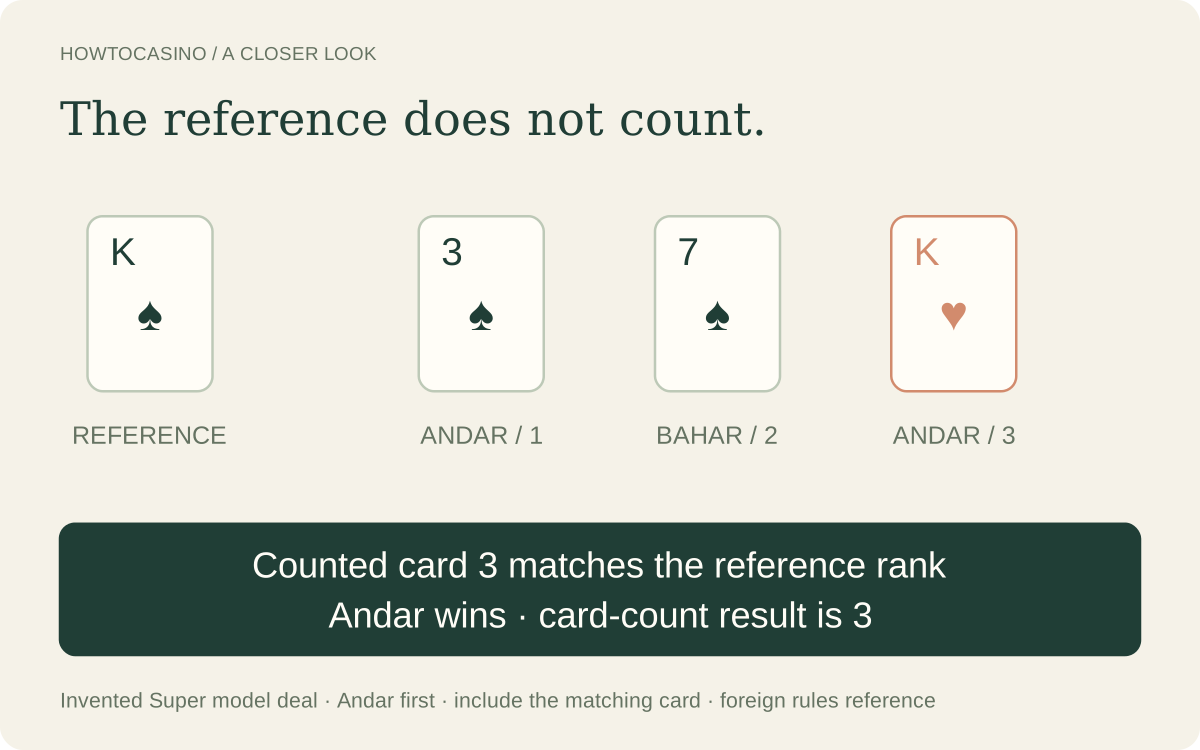
For example, suppose the reference is a king and the next three cards are a three on Andar, a seven on Bahar and a king on Andar. Andar wins. The card-count result is three: exclude the reference and include the terminal matching card. There is no ordinary main-bet tie in this sequence; an interrupted or void round is a separate rules issue.
The distinction from Dragon Tiger is useful: that game compares two card ranks, while Andar Bahar waits for a reference-rank match. Do not transfer Dragon Tiger’s tie treatment or main payouts here.
How much does a winning main bet return?
In the selected Super rules, Andar pays 0.9:1 profit and Bahar pays 1:1 profit. The winning stake is returned in addition to that profit. The following £10 stakes are invented cash illustrations, not the PDF’s local limits or a current GB offer.
| Separate £10 wager | Total return if it wins | Net result if it wins | Total return if it loses |
|---|---|---|---|
| Andar at 0.9:1 profit | £19 | +£9 | £0; net −£10 |
| Bahar at 1:1 profit | £20 | +£10 | £0; net −£10 |
A display using a total-return multiplier can express the same prices as 1.9× and 2×. Read the convention before adding the original stake: a total-return multiplier already includes it. A label such as “payout” without an explanation is not enough to decide whether another £10 should be added.
If more than one wager was accepted, add all their stakes and all returns before working out the round’s net result. One winning wager does not make every other wager on the layout a winner.
What do the card-count bets and boosts measure?
The selected model offers ten ranges, from 1–5 cards through 46–49 cards. The count starts after the reference and ends with the first match. With one reference removed, three cards of its rank remain among 51 cards. The latest possible first match is position 49: 48 non-matching cards could come before it.
An odd count puts the match on Andar and an even count puts it on Bahar in this fixed-first-side model. The main and card-count wagers are separate, but their outcomes are not independent. Knowing the exact count also identifies the winning main side.
The rules give the 1–5 range a profit-price range of 2:1 to 9:1, depending on the assigned boost. Boosts affect eligible side-bet prices; do not apply the advertised headline multiplier to an ordinary main bet or add it a second time to the shown price. Range endpoints alone do not reveal how often a boost is assigned.
| Invented accepted wagers: £10 Andar plus £1 on cards 1–5 at unboosted 2:1 profit | Main return | Side return | Total return on £11 staked | Net result |
|---|---|---|---|---|
| Match at counted card 3, on Andar | £19 | £3 | £22 | +£11 |
| Match at counted card 4, on Bahar | £0 | £3 | £3 | −£8 |
These examples assume both wagers were accepted at the stated prices. They do not test a real betting control or imply all games accept the same combination. A winning £1 side wager can coexist with a losing round after the £10 main wager is included.
Is either side a guaranteed way to win?
No. Under a uniformly shuffled 52-card deck and this fixed Andar-first rule, the three cards matching the reference rank occupy three of the 51 remaining positions. There are 20,825 possible sets of those three positions. Counting which set has its first match at an odd or even position gives the following main-bet probabilities.
| Main side in this model | Win probability | Expected return per £1 at the stated price | House edge |
|---|---|---|---|
| Andar, 0.9:1 profit | 429/833 ≈ 51.50% | 1.9 × 429/833 ≈ £0.9785 | About 2.15% |
| Bahar, 1:1 profit | 404/833 ≈ 48.50% | 2 × 404/833 ≈ £0.9700 | About 3.00% |
Andar’s slightly higher chance of winning is priced with a smaller profit payout. These are mathematical expectations under the stated deck and price model, not a forecast for one session, a measured deck test, or a probability table for another Andar Bahar version. The calculations do not give the complete side-bet RTP because boost-assignment probabilities are not supplied here. The house-edge guide explains expectation and short-session results.
Following a result road or changing the next stake does not reveal the next shuffled order. Increasing stakes after losses changes the amount exposed; it does not remove the model’s house edge or guarantee recovery.
Why do other Andar Bahar guides show different rules?
Similar names cover different products and rule traditions. Pagat’s description of a traditional game uses a colour-dependent first side; the selected Super model uses fixed Andar first. Other named products may offer different dealing or betting windows and optional propositions. A price from one provider does not resolve an incomplete rulebook for another.
| Check in the exact game help | Why it matters |
|---|---|
| Provider, full title and version | Distinguishes Super, classic and other named products |
| Reference timing and first dealing side | Determines what is known when bets close and which side receives odd positions |
| Main profit odds or total-return multipliers | Determines cash settlement, including whether the stake is already included |
| Count definition and accepted side wagers | Prevents including the reference, missing the final match or assuming independent outcomes |
| Shown boost and table limits | Does not follow from a global marketing maximum |
For a settlement query, keep the round identifier, shown reference, counted sequence, accepted wagers, prices and credited returns. Ask the operator to reconcile the exact round against its rules. There is no need to place another wager to establish what an earlier record shows.
Related questions
Is the Joker an extra wild card in Super Andar Bahar?
In the selected published model, no. Joker means the ordinary reference card from the 52-card deck. Three other cards of its rank remain after it is removed.
Which side gets the first card?
Evolution’s Super Andar Bahar description uses Andar first, then Bahar. Do not generalise that rule to every similarly named game or replace it with a traditional colour rule.
Is the reference included in the card count?
In the selected Super model it is excluded. Count the cards dealt after the reference through and including the first matching card.
What does a £10 winning Andar bet pay?
At the selected model’s 0.9:1 profit price, it returns £19 in total: £9 profit plus the £10 winning stake. A different published price needs its own calculation.
Can the main and card-count bets both win?
In a model accepting both wagers, yes. With Andar first, an odd matching-card position wins Andar; a position in the backed count range can also win the side wager. Count every stake and return to establish the whole-round profit.
Can a system guarantee an Andar Bahar win?
No guarantee follows from a results history or stake sequence. In the stated shuffled-deck model, both main wagers have a house edge at their published prices. That expectation is not a personal session prediction.