What are Player, Banker and Tie in baccarat?
Player and Banker are names for the two dealt hands. They do not mean that you must be the Player or act as the casino’s banker. Several people may bet on the same side, and you can select either main outcome before betting closes.
| Wager | What must happen in the conventional game |
|---|---|
| Player | The final Player score is higher |
| Banker | The final Banker score is higher |
| Tie | Both final scores are equal |
The highest score is 9, not 21. You do not choose to hit, stand, double or split in the fixed-draw game explained here. Other formats, including player-banked games or branded variants, should not silently inherit this description.
How do you count baccarat cards?
| Card | Baccarat value |
|---|---|
| Ace | 1 |
| 2–9 | The printed number |
| 10, jack, queen, king | 0 |
Add the card values and keep the units digit. For example, 8 + 7 = 15, so the score is 5. A jack plus 9 scores 9 because the jack is worth zero. A 6, 8 and 5 total 19 and therefore score 9, not a bust.
Suits do not affect this main score comparison. Optional pair or other side wagers can use different properties, so the main-hand scoring rule does not settle every bet on the screen.
An opening two-card total of 8 or 9 is a natural. Under these conventional rules, a natural on either hand ends further drawing for both. A natural 9 beats a natural 8; if both scores are equal, the round is a tie.
What happens in a round of online baccarat?
- Read the exact variant’s main-bet paytable, commission rules, limits and any optional wager conditions.
- Choose Player, Banker or Tie and check the total of all accepted wagers before betting closes.
- Two cards are dealt to each hand. Calculate their baccarat totals.
- Check for a natural 8 or 9. If there is one, neither hand draws further.
- Without a natural, the Player drawing rule applies first, followed by the appropriate Banker branch.
- Compare the final scores and check the settlement of each separate wager.
Live presentation can include a dealer squeezing or slowly revealing a card. The reveal does not give you a drawing decision. A displayed results road records earlier rounds; it is not a set of instructions for what must happen next.
When does a third card appear?
If neither hand has a natural, Player draws on 0–5 and stands on 6 or 7. If Player stands, Banker draws on 0–5 and stands on 6 or 7. If Player draws, Banker instead uses its own total together with the value of Player’s third card.
That last branch is why “both sides draw on 5 or less” is not a complete explanation. For example, Banker on 3 stands if Player’s third card is an 8, but draws against the other third-card values in the conventional matrix.
You do not need to memorise the matrix to place a fixed-draw wager, but it helps explain an unexpected extra card. Our third-card rules guide includes the full matrix, the Player-standing branch and worked examples.
Can you follow one complete baccarat round?
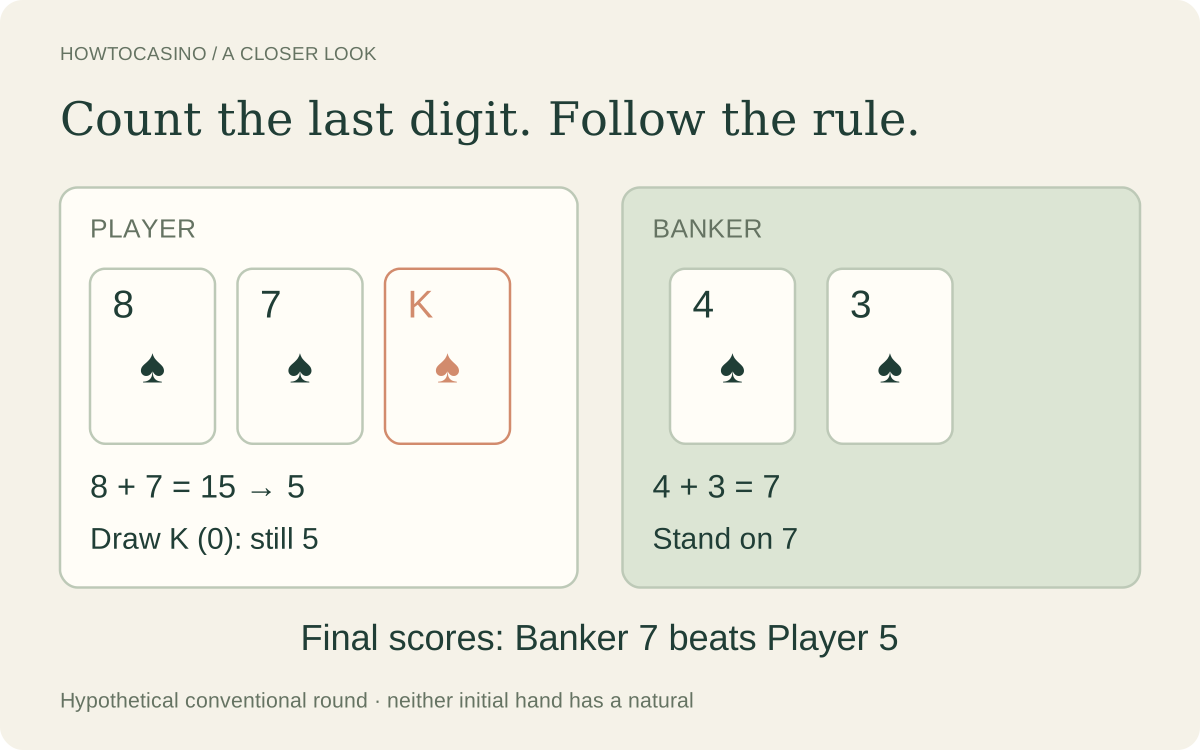
Use this hypothetical round under the conventional drawing rules. Initial Player cards are 8 and 7; initial Banker cards are 4 and 3. No main wager is assumed until the separate payout examples below.
| Stage | Player | Banker |
|---|---|---|
| Opening two-card total | 8 + 7 = 15 → score 5 | 4 + 3 = score 7 |
| Natural check | Not 8 or 9 | Not 8 or 9 |
| Drawing | Player draws a king, worth 0 | Banker stands on 7 |
| Final score | 5 + 0 = 5 | 7 |
| Main result | Lower score | Banker wins |
Banker on 7 stands whether or not Player draws. Change a card and the branch can change: an opening Player 8 would stop all further drawing before the third-card rules are consulted. The sequence matters as much as the arithmetic.
A third card is not a mistake merely because the other hand already has a higher score. The dealer follows the mandatory rule rather than making a tactical choice to beat the exposed total.
What do Player, Banker and Tie bets return?
The following example uses the cited conventional paytable: Player wins at 1:1 profit; Banker wins at 1:1 profit less 5% commission on that profit; Tie wins at 8:1 profit. It is not the paytable of every baccarat game. All amounts below assume one separate £2 wager.
| Winning wager | Profit calculation | Total returned, including £2 stake |
|---|---|---|
| Player | £2 × 1 = £2 | £4 |
| Banker with 5% commission | £2 − (£2 × 5%) = £1.90 | £3.90 |
| Tie at 8:1 | £2 × 8 = £16 | £18 |
If the final scores tie, the ordinary Player and Banker main wagers in this model push: the stake is returned with no main-bet profit. A separate Tie wager wins. Losing wagers return nothing. Side bets can win or lose independently.
Commission is charged on the winning Banker profit in this example, not on the returned stake or on a losing Banker wager. At small denominations, check how commission is accounted for and rounded by the actual game.
Our baccarat commission guide explains the calculation and alternatives such as reduced payment on certain Banker wins. “No commission” does not establish a better payout across every outcome.
What if you place more than one wager?
Count all stakes before interpreting a winning label. Suppose a game accepts £2 on Player and £1 on Tie. Under the example paytable, a Player win returns £4 from Player and nothing from Tie: £4 returned against £3 committed means £1 net profit.
On a Tie, Player returns its £2 stake and the £1 Tie wager returns £9, making £11 in total and £8 net profit. On a Banker win, both wagers lose and the £3 total is lost. This hypothetical ledger illustrates accounting, not a recommended combination or a promise that every interface accepts it.
The size of a possible payout is not its probability. An 8:1 Tie payout is a price for that outcome; it does not mean the outcome occurs once every nine rounds or is due after a run without a tie.
What changes between baccarat games?
- Whether Banker winnings incur commission or particular Banker outcomes pay less or push.
- The Tie payout and the definitions and prices of optional side wagers.
- Bet limits, accepted stake increments, commission accounting and betting deadlines.
- Any different drawing or settlement rule disclosed for a named variant.
The GB rules used as references were read on 29 October 2026; no casino account or game client was tested. They establish the stated mechanics, not that every named version is currently available to you. Check the actual help and paytable before relying on a generic explanation.
Our live-casino guide explains presentation and table differences. Check an operator’s permission to serve Great Britain separately; a live camera does not by itself verify the operator or its terms.
Related questions
Is baccarat the same as blackjack?
No. Conventional baccarat compares scores from 0 to 9 and uses fixed drawing rules. In blackjack, players make permitted hand decisions and normally try to beat the dealer without exceeding 21.
Do you control the Player hand when you bet on Player?
No. Player is a hand label. In fixed-draw baccarat, the dealer follows the mandatory rules regardless of which main outcome you selected.
Can you go bust in baccarat?
Not by exceeding 9 in the scoring model explained here. Only the last digit counts: 8 + 7 becomes 5, while 6 + 8 + 5 becomes 9.
Does Banker always win when it has a third card?
No. The third card is drawn because the rule requires it. The final scores determine the main result; having more cards is not itself a winning condition.
Do Player and Banker wagers lose when the round ties?
In the conventional model here, those main stakes are returned without profit on a Tie. A separate Tie wager wins at its stated price. Check the actual variant and any side wagers.
Is a no-commission baccarat table always better?
No universal conclusion follows from the label. Compare all main-bet settlements in the actual paytable rather than simply removing commission from the ordinary model. Our separate commission guide explains specific alternative rule sets.