What is Casino War, and which model is explained here?
Casino War is a player-versus-dealer card-comparison game. It uses rank rather than a blackjack total or a poker hand. A king beats a queen, an ace beats a king, and two aces tie even when their suits differ.
The broad procedure is described in Grosvenor’s GB venue guide published on 16 November 2023. For explicit individual-stake bookkeeping, the worked examples below use publicly accessible Scientific Games help under a US-PA path. That is a foreign educational rule model, not evidence of a current GB online game or permission to access a foreign casino.
The Scientific Games description specifies six full decks and a shuffle at the start of each round. We do not assume every Casino War table uses that configuration. Its unrelated template wording and incomplete maximum-win field are not used as game limits or current GB features.
How does the opening comparison work?
- A main wager is committed before the opening cards are dealt. Any optional side wager is a separate stake.
- One card goes to the player and one to the dealer. Compare their ranks, with 2 low and Ace high.
- If the player’s rank is higher, the opening wager wins at 1:1. If it is lower, the wager loses.
- If the ranks match, the ordinary opening comparison has not produced a player win. Follow the stated surrender-or-war procedure.
| Fictional £5 opening stake | Total returned | Net result |
|---|---|---|
| Player higher than dealer | £10: £5 profit plus £5 stake | +£5 |
| Player lower than dealer | £0 | −£5 |
| Equal ranks before a choice | Not yet settled as an ordinary win | Read the tie options |
One displayed dealer card is not an extra player stake. When a description includes chips placed by the dealer, separate them from the money actually committed by the customer. A single opening £5 wager does not become three player wagers merely because the display contains three chip amounts.
What happens if you surrender an opening tie?
Under the stated model, surrender returns half the opening stake and forfeits the other half. With £5 originally committed, £2.50 returns and the net loss is £2.50. There is no additional war stake in that branch.
Surrender is therefore a losing settlement with a partial return, not a push or a refund of the entire stake. It also differs from choosing war and subsequently losing both committed wagers.
The word surrender appears in other card games with different conditions. Our blackjack surrender guide explains that separate context; its timing and eligibility rules should not be imported into Casino War.
What happens when you go to war?
In the chosen Scientific Games model, war requires an additional stake equal to the original wager. The described procedure burns three cards and deals a new player card and dealer card. Compare the new ranks under the war settlement rules; this is not another independently funded opening round.
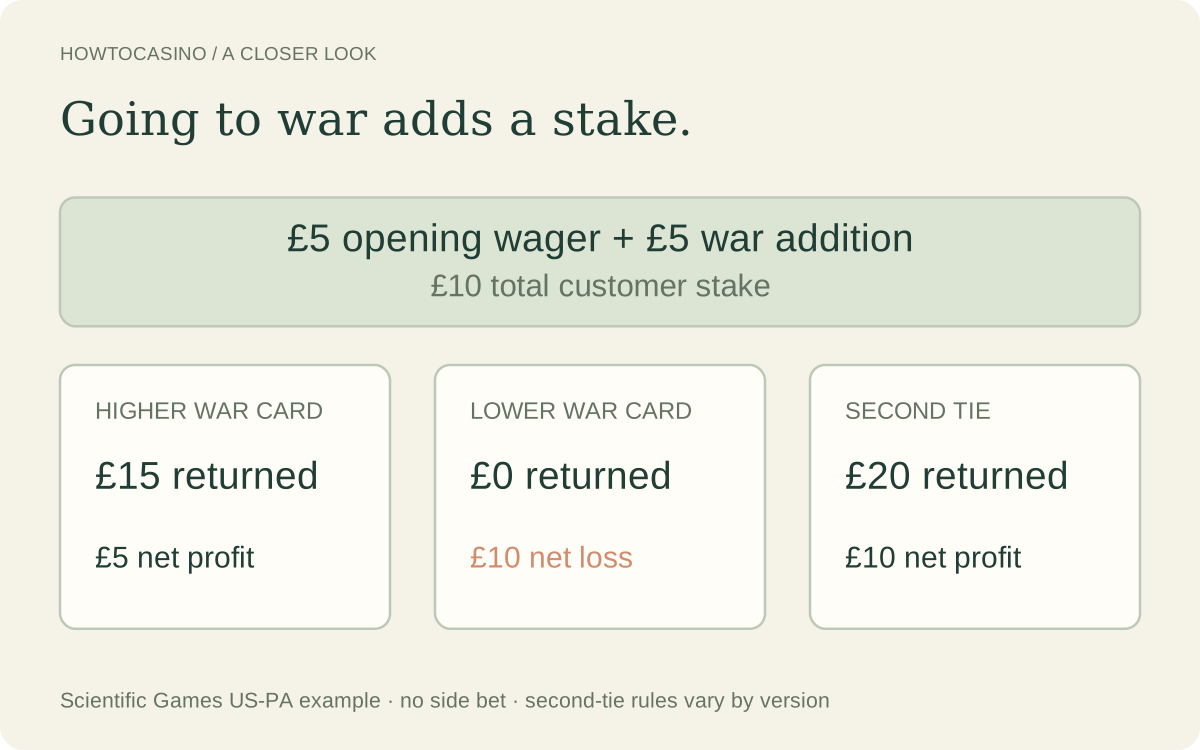
For a fictional £5 opening wager, going to war adds £5 and commits £10 in total. The individual stakes are treated differently in a winning war comparison:
| War outcome | Original £5 wager | Additional £5 wager | Total return / net |
|---|---|---|---|
| Player’s new card is higher | £5 returned as a push | 1:1 win: £10 returned | £15 returned; £5 profit |
| Player’s new card is lower | Lost | Lost | £0 returned; £10 loss |
| New ranks tie again | £5 returned as a push | 2:1 win: £15 returned | £20 returned; £10 profit |
A normal war win does not pay 1:1 profit on the combined £10. It returns £15, which is £5 profit on £10 committed. The second tie is a distinct award in this model, not a rule that a matching card is always an ordinary push.
Does every second tie have the same payout?
No. The Scientific Games example above pays the additional wager at 2:1 on a second tie while returning the original. Grosvenor’s dated venue guide also describes an enhanced second-tie outcome in its overall payout explanation, but it does not supply the same complete individual-stake breakdown.
A different public Danske Spil help page, last modified on 29 March 2018, describes a model where a higher or equal war card wins the original wager at 1:1 and returns the second wager. With £5 plus £5, that second-tie result is £15 returned and £5 net profit, rather than £20 and £10.
The Danish page is a dated foreign variation, not a current GB availability claim. Its value here is to demonstrate why a generic statement such as “a tie pays” is incomplete. Read which tie is involved, the price, the stake it applies to and which other stake returns.
What about a Tie side bet or multiple hands?
A Tie side bet is separate from the main wager and its choice after an opening tie. Grosvenor’s 2023 venue guide quotes 10:1 for the opening Tie bet. At that stated price, a fictional £1 qualifying side wager returns £11 in total: £10 profit and the £1 side stake.
That side award does not, by itself, settle the tied main wager. It also does not establish that an opening side stake remains active for a later war comparison. The exact game may offer different side fields, timing or prices; check them separately.
If a product permits several player hands, add every accepted stake. As a pure arithmetic example, three hands with £5 originally committed to each total £15. If two of those hands then require and receive a £5 war addition each, the total cash committed becomes £25. That example does not establish a product’s available number of hands or betting limits.
Use the game-rules guide to distinguish a wager’s profit price from its total return and to keep optional additions in the cash ledger.
What is the house advantage in Casino War?
It depends on the exact deck, shuffle, tie, payout and decision assumptions. Equal chances of drawing a higher or lower first card do not, on their own, make the whole game fair: the opening-tie branch can require a further stake or create a surrender loss.
In the stated fresh six-deck model there are 312 cards. After the player’s first card, 23 cards of the same rank remain among 311 cards, so the opening-tie probability is 23/311, about 7.40%. This is not 1/13 because the cards are drawn without replacement from that finite shoe.
An independent calculation using this model’s enhanced second-tie rule and a policy of going to war on every opening tie gives an expected loss of about 2.33% of the original opening stake. This is a mathematical policy assumption, not a recommendation to add war stakes, a charge deducted from every wager or a prediction for a session.
Return figures also need a clear denominator. A percentage measured against all stakes, including war additions, is not automatically comparable with a house edge measured against the opening stake alone. The supplier help’s headline return does not explicitly define that denominator, so we do not certify a universal Casino War RTP from it.
The house-edge guide explains how stake bases and long-run expectations differ from a short sequence of wins and losses. A progression system or a larger extra wager cannot guarantee recovery of earlier losses.
What should you check in the actual game?
- The precise rules, deck/shuffle model and ranking convention.
- What an opening tie permits, including the surrender amount and required war addition.
- How each original and additional stake is settled after a higher, lower or equal second card.
- Whether optional Tie wagers refer to the opening comparison, a later comparison or a separate field.
- The actual accepted total stake, limits and round reference, rather than a generic guide’s illustrative £5.
For an online service offered to people in Great Britain, check the exact domain and relevant permissions. This article explains published rules and does not provide a list of currently available GB Casino War games.
If a result or return remains unclear, preserve the game name, time, round reference and stake record and follow the operator’s complaint process. Do not place another wager merely to reproduce a disputed settlement.
Related questions
How do you play Casino War?
Compare one player card with one dealer card, with Ace high and suits irrelevant. A higher player rank wins; a lower rank loses. An opening tie has a separate surrender-or-war procedure, and the war settlement depends on the exact version.
How much do you lose by surrendering a tie?
In the stated model, surrender loses half the opening stake and returns half. A fictional £5 opening wager returns £2.50 and leaves a £2.50 loss, without an additional war wager.
Does going to war double the cash committed?
In the example model it requires an addition equal to the original main wager. £5 originally plus a £5 war addition commits £10; side wagers, if any, are separate.
What happens if you tie again in Casino War?
It varies. The Scientific Games example returns the original stake and pays the war addition at 2:1; £5 plus £5 returns £20. The dated Danish comparison uses a different second-tie settlement returning £15 on the same £10 exposure. Read the actual rules.
Is a normal war win 1:1 on both stakes?
Not in the chosen example. The original £5 returns as a push and the additional £5 wins at 1:1, returning £10. Total return is £15 on £10 committed, for £5 net profit.
Can a Casino War system guarantee a profit?
No. Staking progressions do not remove the loss possibilities or the additional cost of war. Any quoted house edge needs the actual rules, decision assumptions and stake denominator; it is not a forecast for your session.