What do you mean by “rigged”?
| Concern | Evidence needed | What does not establish it alone |
|---|---|---|
| The outcome mechanism was manipulated | Exact product, applicable rules and relevant technical or operational evidence. | A losing run or an impressive test badge. |
| A draw or payout was wrong | Recorded cards, the required drawing decision, accepted wager and paytable. | The fact that a dealer drew on a total you expected to stand. |
| The account or withdrawal is wrong | Round return, account entry and the separate payment status. | A video result without the accepted stake or balance record. |
These concerns need different checks. A mathematical house edge is part of a stated game model; it is not the same allegation as changing accepted outcomes, applying the wrong rules or withholding an unexplained payment.
For GB-regulated games, testing and operating requirements apply, but requirements are not proof that every page, table or round complies. This guide provides a round-audit method rather than a verdict on an unnamed operator.
Why can Banker legitimately draw on six?
In conventional fixed-draw baccarat, the Player and Banker positions follow a drawing table. They are not a customer’s blackjack-style choice to hit or stand. After Player draws, Banker’s decision can depend on the value of that third card rather than Player’s final total.
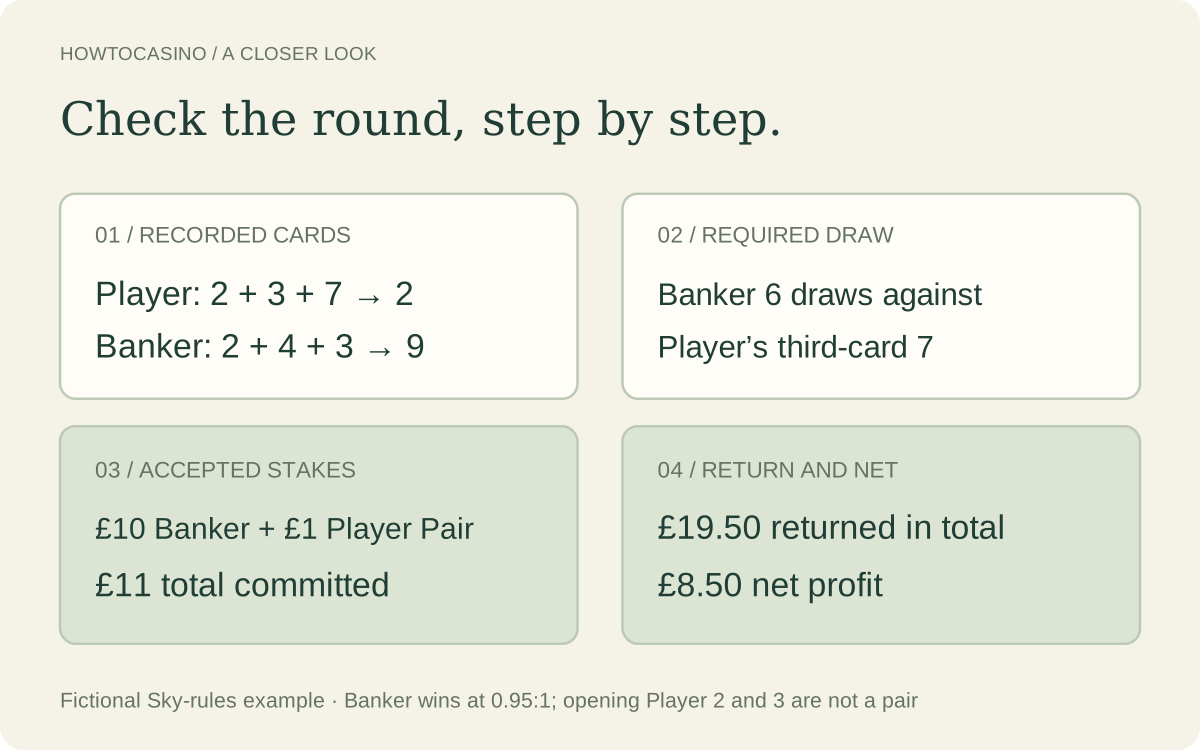
The following fictional sequence uses the conventional rules published on Sky Bet Games’ Baccarat Live page, checked on 30 October 2026. It is not a tested round or a promise that every baccarat variant follows the same conditions.
| Stage | Cards and totals | Rule or result |
|---|---|---|
| Initial Player | 2 + 3 = 5 | No natural; Player draws on 5. |
| Initial Banker | 2 + 4 = 6 | Its later decision depends on Player’s third card. |
| Player draws 7 | 5 + 7 = 12, final digit 2 | The third-card value is 7, even though the final total is 2. |
| Banker draws 3 | 6 + 3 = 9 | Banker on 6 must draw against a Player third-card 7 in this model. |
| Final comparison | Player 2; Banker 9 | Banker is the higher hand. |
The Banker draw can therefore be correct even when a viewer expects every six to stand. It would be wrong to use Player’s final total of 2 in place of the third-card value of 7 when reading the Banker table.
Use the complete third-card guide to check the actual combination. A natural two-card 8 or 9 is a separate stopping condition that must be checked first; an eight or nine reached after drawing is not that initial natural.
Can a correct winning hand produce less than the amount expected?
Yes, if the expectation used the wrong payout, ignored a losing side wager or confused profit with total return. First identify the exact wager. A correct Banker result does not mean a Player Pair wager has won.
For a fictional cash ledger on the cards above, suppose £10 was accepted on Banker and £1 on Player Pair. The stated conventional Banker price is 0.95:1 profit odds, and Player Pair requires a pair in Player’s opening two cards. Player’s 2 and 3 are not a pair.
| Entry | Amount |
|---|---|
| Total accepted stakes | £10 + £1 = £11 |
| Banker profit at 0.95:1 on £10 | £9.50 |
| Winning Banker stake returned | £10 |
| Losing Player Pair return | £0 |
| Total money returned | £19.50 |
| Combined net result | £19.50 − £11 = £8.50 profit |
If the example began with a £20 cash balance and had no other transactions, stakes would reduce it to £9 and the £19.50 return would bring it to £28.50. The final balance is not £28.50 of winnings; it includes the remaining starting money.
These figures exclude fees, bonuses, rounding complications and other wagers. Other baccarat variants can use different commission or special-settlement conditions. The commission guide explains why a rule from one version must not be inserted into another.
Do RNG baccarat and live tables use the same evidence?
Identify the actual mechanism. An RNG-based baccarat product and a streamed physical table do not establish fairness through an identical visual or technical check. A filmed card is not proof that every part of the operation or account settlement is correct.
The Gambling Commission’s RTS 7 requires applicable random outcomes to be acceptably random and prohibits compensated or adaptive behaviour within its scope. Its testing procedure covers matters including raw and scaled RNG output, shuffled-deck output, game mathematics and implementation. The scope and versions identified in a report matter.
RTS 17 addresses fair, independently auditable live-dealer operation through equipment, documented procedures, trained staff, supervision, surveillance, access controls and records. It does not say every live table must use one particular card-recognition method, show its entire shoe to the customer or have a universal camera arrangement.
A laboratory logo or a general supplier statement does not show that this website has obtained a test report for the exact deployed product. No table inspection, game session or private technical report was obtained for this guide. The general casino-fairness guide explains those evidence layers in more detail.
Do losing runs or road patterns prove manipulation?
A short result sequence is not enough to determine why it occurred. Chance, the particular wager, commission and side-bet prices can affect the money returned. A house edge is a long-run expectation under stated assumptions, not a charge deducted from every hand or proof that a win is due after losses.
Do not assume every baccarat hand is an independent trial with the same shoe composition. Cards can be dealt without replacement from a finite shoe, and the shuffle model matters. Conversely, a road display does not provide the full technical evidence needed to establish a manipulation claim.
The scorecard guide explains what roads record and omit. The baccarat odds guide provides a separately stated conventional model. Neither a long losing run nor a visually neat pattern gives a staking system that guarantees recovery.
What should you record if a result still looks wrong?
- Record the exact domain, operating company, game name, supplier if shown, time and round reference.
- Keep the rules and paytable relevant to that version, including natural, draw, commission and side-bet conditions.
- Separate the cards initially dealt from any third cards, and record which wager and stake were accepted.
- Recompute the final totals, mandatory decisions and each wager’s return. Add all stakes before calculating the net result.
- Compare the expected return with the actual round or account entry. Keep the withdrawal request separate from the settled game credit.
- Ask the operator to explain the precise discrepancy through its complaint process. Another wager is not required to reproduce the issue.
A frozen video, delayed display or unexpected draw does not by itself establish deliberate manipulation. Equally, the absence of a dramatic video does not make an unexplained account discrepancy irrelevant. State what differs between the record and the applicable rule.
Who can investigate a complaint or recover money?
Start with the operator’s published complaint process and retain its responses. Independent alternative dispute resolution may be relevant after that process, subject to the dispute and provider’s scope. The payment-dispute guide explains the route and the records to keep.
The Gambling Commission can receive information relevant to regulation, but says it cannot resolve individual gambling transactions or recover a customer’s money. A regulatory report is not the same as a personal refund claim.
Check the exact domain and relevant permissions rather than trusting a copied logo or a similar brand name. The licence-check guide explains that step; permission to operate still does not certify every accepted round.
Related questions
Is online baccarat rigged?
A losing session or the word live cannot settle that question. Identify the exact game and compare the accepted wager, cards, drawing rules, paytable and account return. Regulation and testing matter, but a licence or badge is not proof that an individual round was correct.
Why did Banker draw another card on six?
In the stated conventional model, Banker on six draws when Player’s third card is six or seven. Use that third-card value, not Player’s final total. Other combinations can require Banker to stand.
Does a winning Banker hand always return twice my stake?
Not in a conventional 0.95:1 Banker-profit model. A fictional £10 qualifying winning stake returns £19.50 including the stake. Other wagers, versions and commission rules need their own calculation.
Does a test logo prove the exact game is fair?
A logo alone does not establish the report’s authenticity, scope, software version or correct deployment. The Gambling Commission’s testing procedure makes the tested product and version important; this guide did not obtain a private report for a particular table.
Are all baccarat hands independent?
Do not assume that. A finite shoe and dealing without replacement can change its composition, while different products can have different shuffle models. A road pattern alone does not provide the evidence required to prove manipulation.
Can the Gambling Commission get my baccarat winnings back?
It says it cannot resolve individual gambling transactions or recover money. Use the operator’s complaint process and any applicable dispute route for the individual issue; regulatory information serves a separate purpose.