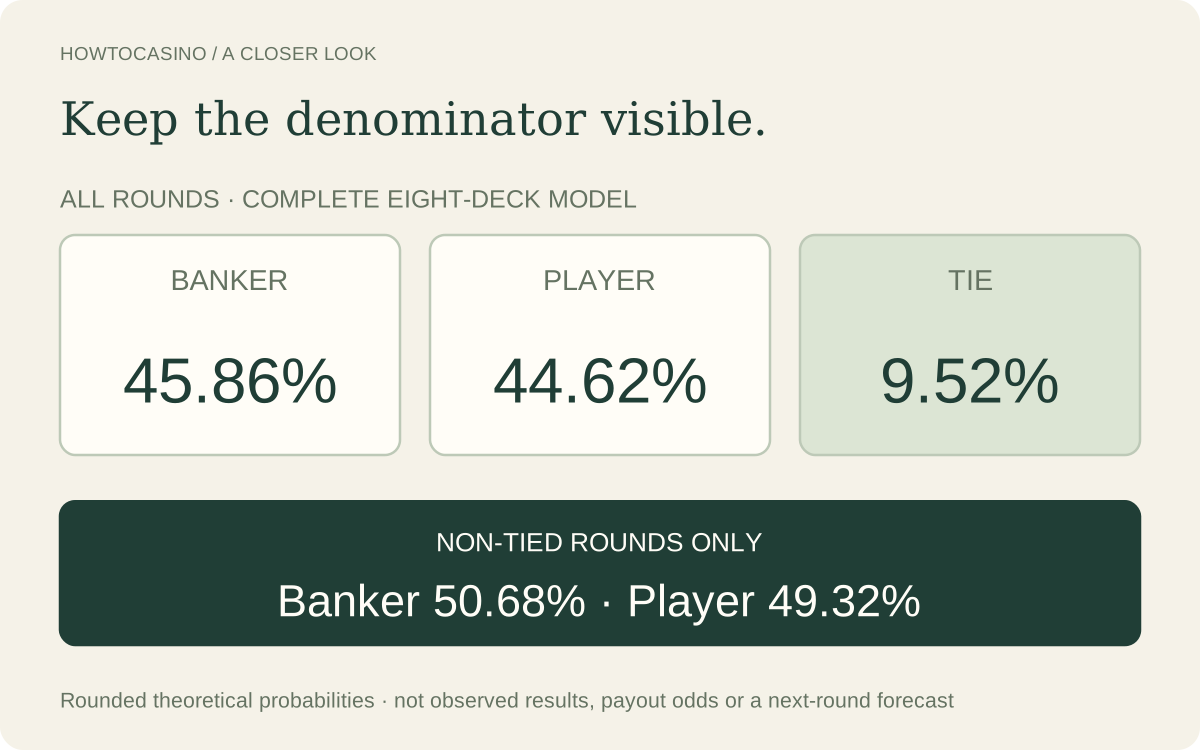
Why are there three outcomes rather than two equal chances?
Player and Banker are the names of two hands, not instructions to deal or choose cards. A conventional punto banco round can finish with Player ahead, Banker ahead or equal final totals. The drawing procedure is fixed, and its rules differ between the two positions.
| Final result | Probability in the complete eight-deck model | Meaning |
|---|---|---|
| Banker wins | 45.859742% | Banker finishes ahead |
| Player wins | 44.624661% | Player finishes ahead |
| Tie | 9.515597% | Final totals are equal |
These values come from the eight-deck event counts in Wizard of Odds’ original analysis, separately reproduced for this guide. The Banker, Player and Tie counts sum to the complete model’s denominator. The figures describe that mathematical model, not a measurement of someone’s account or a promise for the next shoe.
The slight asymmetry follows the drawing procedure, not a dealer choosing a favourable action. The third-card guide gives the full fixed tableau, while the beginner guide covers hand names and scoring.
Where do the 50.68% and 49.32% figures come from?
They remove tied outcomes from the denominator. Banker’s non-tie share is its win probability divided by the combined Banker-plus-Player probability. Player’s share uses the same reduced denominator. This answers which hand wins when the round is not tied.
| Question | Banker | Player | Tie |
|---|---|---|---|
| Share of all rounds in this model | 45.86% | 44.62% | 9.52% |
| Share of non-tied rounds only | 50.68% | 49.32% | Excluded from this denominator |
For Banker, 45.859742 ÷ (45.859742 + 44.624661) is approximately 50.682483%. Player’s complementary share is approximately 49.317517%. Rounding the displayed inputs slightly changes the last decimal places; the calculations here use the full event counts.
Under the stated conventional paytable, a tie pushes a main Player or Banker wager: its stake comes back without winning profit. A returned stake is not a win at the quoted profit odds. It is also not permission to silently call Banker a 50.68% all-round winner or a risk-free bet.
What do separate winning £10 baccarat bets return?
The public GB example used here is Sky’s Evolution Baccarat Live help, consulted on 30 October 2026. It specifies eight decks, Player 1:1, Banker 0.95:1 after 5% commission, Tie 8:1 and returned main Player/Banker stakes on ties. We have not opened a table or verified an individual account’s current game build.
| Separate £10 wager | Profit if it wins | Total cash returned if it wins | What happens on a tied round? |
|---|---|---|---|
| Player at 1:1 | £10 | £20 | £10 main stake returns, with no profit |
| Banker at 0.95:1 | £9.50 | £19.50 | £10 main stake returns, with no profit |
| Tie at 8:1 | £80 | £90 | It is the winning outcome for that wager |
Profit odds describe the gain on a winning stake. Total return adds the returned winning stake: a £10 Tie bet at 8:1 earns £80 and returns £90 in total. It does not earn £90 profit. If that Tie bet loses, it returns £0 and loses the £10 stake.
For Banker, 5% of the £10 winning profit is 50p, leaving £9.50 profit plus the £10 stake. The commission guide covers this calculation and alternative no-commission rules in more detail. The table assumes no extra charges, rounding changes, promotions or side wagers.
Why do nearly even outcomes still have a house edge?
Expected return depends on both the probability of each outcome and the amount paid for it. A main tie push contributes no net gain or loss. The commission changes Banker’s winning profit, while the stated Tie payout is well below the profit odds that would balance its probability.
| Wager under the stated model | Theoretical house edge per original stake | Theoretical net expectation for £100 of total stakes |
|---|---|---|
| Banker, 5% winning-profit commission | About 1.06% | About −£1.06 |
| Player, 1:1 | About 1.24% | About −£1.24 |
| Tie, 8:1 | About 14.36% | About −£14.36 |
For Player, net expectation per £1 is the probability of a Player win minus the probability of a Banker win. For Banker it is 0.95 times the Banker-win probability minus the Player-win probability. For Tie at 8:1 it is eight times the tie probability minus the probability of a non-tie. Each is negative in this model.
The £100 column describes mathematical turnover, not a recommended deposit or a prediction of a £100 session. Actual results can be a gain or a much larger loss. A smaller theoretical edge still does not establish a profitable personal method or a reason to increase spending.
Changing the Tie price, commission rule or model changes the expectation. Do not copy these three edge figures onto a no-commission, multiplier, different-deck or side-bet paytable without recalculating it.
What happens if you place Banker and Tie together?
Count both stakes and settle them separately. In this fictional layout, £10 is accepted on Banker and £2 on Tie, with the conventional paytable above and no other wager, fee or rounding. Total cash committed is £12.
| Final round outcome | Cash returned on Banker | Cash returned on Tie | Combined return | Net result after £12 |
|---|---|---|---|---|
| Banker wins | £19.50 | £0 | £19.50 | +£7.50 |
| Player wins | £0 | £0 | £0 | −£12 |
| Tie | £10 pushed stake | £18: £16 profit + £2 stake | £28 | +£16 |
On a tie, the Banker stake returning is not a second 8:1 payout. On a Banker win, the lost £2 Tie wager reduces the overall gain from £9.50 to £7.50. Adding the Tie wager changes the money committed and the results; it does not guarantee a return or remove the house edge.
The same accounting principle applies when a game offers optional side bets, but their qualifying events and paytables differ. The side-bet guide distinguishes a main-hand winner from a separate qualifying condition.
Which rules should you check before using an odds chart?
- Exact provider/title, deck count and available rule/version information.
- Profit odds versus total-return notation for each wager.
- Main Player/Banker tie treatment and any special exceptions.
- Commission, no-commission conditions, rounding and payout limits.
- Whether the number describes a main wager, side bet or another variant.
- Whether a probability includes all rounds, excludes ties or assumes particular shoe information.
The complete eight-deck calculation is a baseline. A partly used finite shoe has a different remaining composition; a board of past winners does not reveal every card needed to reconstruct it. Our scorecard guide explains why patterns and progression systems do not supply a guaranteed next result.
A headline return percentage can refer to one named wager rather than every betting position on a table. Read its scope instead of applying it to the Tie bet or to additional wagers. If a settlement is disputed, preserve the accepted stake, result, applicable paytable and ledger and ask for the specific calculation.
The useful comparison is the exact model and paytable. A phrase such as almost even, a familiar brand name or a large displayed payout cannot replace those details.
Related questions
Is baccarat exactly a 50/50 game?
No. The conventional complete eight-deck model includes ties, with Banker about 45.86%, Player 44.62% and Tie 9.52%. Excluding ties changes the denominator and gives about 50.68% versus 49.32%, not exact equality.
Why does Banker win slightly more often than Player?
The fixed drawing rules differ between the hands, producing a small asymmetry in the stated model. It is not evidence that the dealer chooses the result or that Banker must win next.
Does a tie mean my Banker bet wins?
Under the conventional model here, the main Banker stake pushes and returns without winning profit. A separate Tie wager wins under its own paytable. Special variants need their own rules.
Does 8:1 mean a £10 Tie win returns £80 in total?
It means £80 winning profit plus the returned £10 stake: £90 total under that rule. Losing the wager returns £0. Profit odds, total return and win probability are different numbers.
Does a 1.06% house edge predict my session loss?
No. It is a theoretical average per original stake under a specified model and paytable, not a personal result or guaranteed loss amount. Actual short-session outcomes vary.
Can I use these percentages for every baccarat variant?
No. Deck count, payout, commission and other rules matter. The main eight-deck calculation cannot be transferred automatically to side bets, altered Banker payouts or multiplier games.