What is a baccarat squeeze?
Squeezing means exposing a card’s face gradually instead of turning it fully over at once. At a physical table that can involve carefully lifting or bending a permitted card to reveal its markings. A streamed version can reproduce the slow reveal through a dealer or a screen control.
The suspense comes from learning which card has already been dealt. The movement does not improve that card’s value or allow the person to select a different one. It is a way of presenting the result, not an extra betting system.
The explanations in this guide use specific supplier, operator and venue descriptions checked on 30 October 2026. They do not establish a single rule for every table carrying a Squeeze or Controlled Squeeze name.
Who squeezes the cards: the player, dealer or screen?
| Example model | Who or what reveals the face | Scope to retain |
|---|---|---|
| Designated player at a physical table | A permitted player handles the allocated cards under the venue’s procedure. | OLG’s Canadian description is one example; it is not permission to handle cards in every GB venue. |
| Dealer Squeeze | The dealer reveals selected cards slowly. | Evolution’s description selects a hand according to total wagers in that version; do not assume a universal allocation rule. |
| Interactive Control Squeeze | A touch or mouse action removes a visual cover from a camera image of the card face. | Evolution describes actual cards on glass with cameras underneath. Screen interaction controls exposure, not which card is dealt. |
Evolution’s public description distinguishes its dealer Squeeze and Control Squeeze products. In the latter, the physical card face is captured beneath the table and concealed on screen by an overlay until it is revealed. A controllable animation is therefore not evidence that the viewer chooses the card.
Grosvenor also has a public GB-facing Controlled Squeeze description. That page establishes a product description, not a tested account feature. It gives inconsistent stake limits in different places, so we do not select either figure as the current limit for every reader.
Does squeezing change when a third card is drawn?
In conventional fixed-draw baccarat, the Player and Banker labels identify two hands. They do not give a customer a blackjack-style hit or stand choice. The drawing rules determine whether either hand receives a third card.
The conventional model used here counts an Ace as 1, cards 2–9 at face value and 10/J/Q/K as 0, keeping only the final digit of the hand total. An initial two-card 8 or 9 on either side is a natural and ends drawing for both. Otherwise the Player rule is applied before the conditional Banker rule.
Squeezing an already dealt card does not change its rank or those conditions. But “the result is fixed” should not be read to mean that every possible third card has already been dealt before the first reveal. Further cards may still have to be drawn according to the game’s procedure.
The third-card guide sets out the full conventional table. It is more useful for deciding whether a draw is required than the way a card appears on screen.
An example: the same cards, shown quickly or slowly
| Stage | Player hand | Banker hand | Required procedure |
|---|---|---|---|
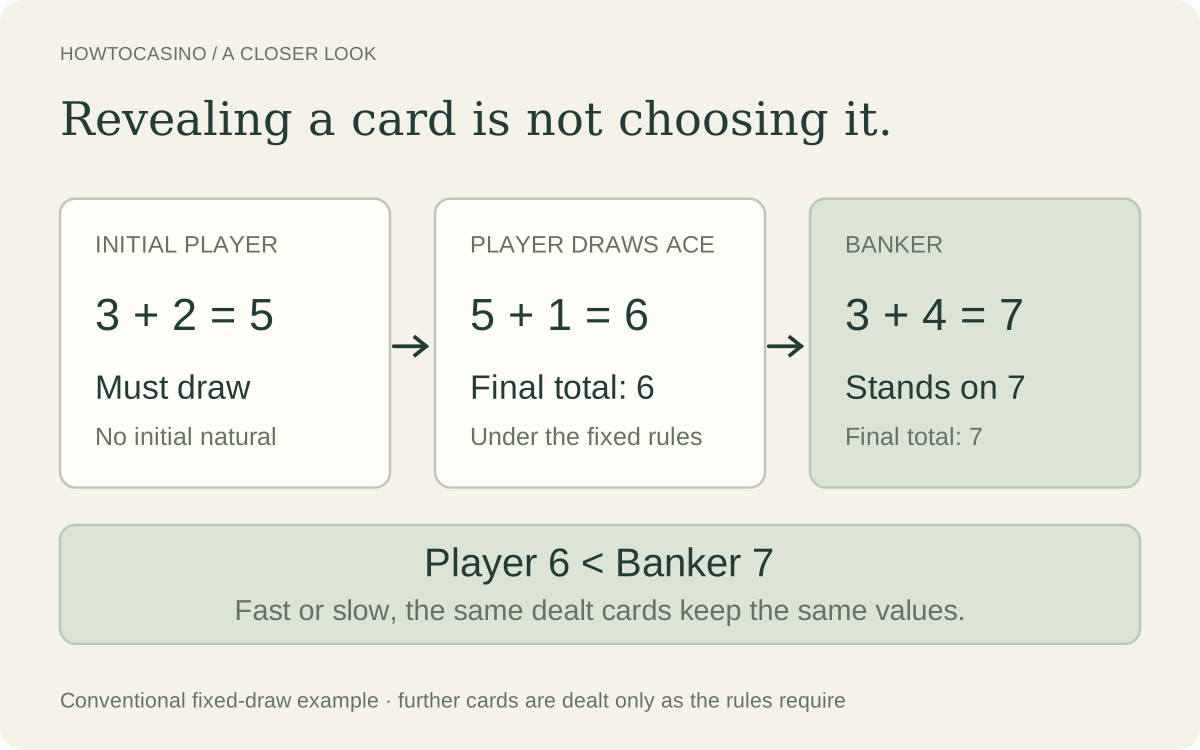
| Initial deal | 3 + 2 = 5 | 3 + 4 = 7 | There is no natural; Player draws on 5. |
| Player third card is an Ace | 5 + 1 = 6 | Still 7 | Banker stands on 7. |
| Final comparison | 6 | 7 | Banker is the higher final hand. |
Suppose those initial cards are turned over immediately. The Player still draws the Ace in this stated example and finishes on 6; Banker still stands on 7. Revealing the same dealt cards more slowly does not produce a different total or a different required decision.
This is a fixed illustrative card sequence, not a prediction of the next round. The winning hand also does not, by itself, establish the money returned to an account: that depends on which wager was made and its actual payout and commission rules.
Our card-values and payout guide explains the conventional comparison. The commission guide explains why a winning Banker bet can have a separate deduction or variant condition.
Why are some players allowed to bend the cards?
Because the particular venue has a procedure allowing designated players to perform the reveal. That permission is table-specific. It is not a general right to touch, bend, tear or keep a casino’s cards.
OLG’s Ontario explanation, for example, describes a physical squeeze arrangement involving designated higher-staking players and a particular process for used cards. It also places limits on damaging cards. These are details of that Canadian model, not a GB-wide rule or a disposal policy to assume at every table.
At a GB venue, follow the dealer’s instructions and ask about the exact handling rules. A customer on an online Control Squeeze interface normally interacts with the displayed control described by that product, not with the physical card. Do not combine the permissions from these different models.
Does the biggest bettor always control the squeeze?
No universal rule is established by the name. A dealer-led game can decide which hand receives the slow reveal according to total wagers. A particular multiplayer interface can instead allocate a reveal control to a selected participant.
The checked Loto-Québec multiplayer rules provide one specific allocation and timer procedure, including automatic revelation when its time expires. That is an explicitly foreign, named game model. It does not establish the same control privilege, tie-breaking rule or number of seconds in a current GB version.
Read the actual game’s help for who can use the control, which cards are included, what happens if nobody acts and any limits on that action. A reveal control should not be treated as an opportunity to change a closed wager.
Does a slower reveal improve the odds or prove fairness?
The reveal action does not alter the face of the dealt card or replace the conventional drawing table. It therefore supplies no method for turning a losing card sequence into a winning one. Squeezing, blowing on cards or following a ritual is not a guarantee of a winning hand.
A camera view is also not, on its own, a complete fairness audit. The exact rules, supplier procedures, result handling and operator responsibilities still matter. A streamed card face and a casino account’s payment process answer different questions.
Do not infer a universal RTP, a safe playing pace or a lower spending total from the word Squeeze. Product variants can change the wagers, commission or side bets, and the amount spent depends on the accepted stakes and play.
The scorecard guide explains the limits of using past Baccarat results, while the odds and payouts guide states the assumptions behind conventional probabilities. A slower reveal does not remove those limits.
What should you check if the reveal or settlement is unclear?
- Identify the exact game, supplier and whether it uses dealer or interactive revelation.
- Separate the revealed card values from the rule requiring any further draw.
- Check the final Player and Banker totals and the particular wager placed.
- Read the actual commission, side-bet and settlement conditions rather than importing another Squeeze version.
- Keep the round reference, time and visible result if the account entry needs explaining; use the operator’s support and complaint route.
Our casino-payment dispute guide explains the information to preserve for an unresolved result or missing credit. A new stake is not needed to ask about an earlier round.
Related questions
Why do baccarat players bend the cards?
They are gradually revealing the card face as part of a squeeze, which builds anticipation. It does not change the rank of a card already dealt. Any physical handling must be allowed by the particular table’s procedure.
What is online baccarat Control Squeeze?
In Evolution’s public description, real card faces are captured by cameras under glass and covered on screen. A mouse or touch action peels away the cover. That controls the reveal, not card selection or the third-card drawing rule.
Can I choose whether Player or Banker takes another card?
Not in the conventional fixed-draw model used here. Its drawing rules determine the required cards. A reveal button is separate from those decisions; other baccarat families need their own rules.
Are all cards already dealt before the squeeze?
Do not assume so. Some cards may already be face down, while a required third card may still need to be drawn under the game’s procedure. Exposing an existing card and dealing a further card are different events.
Are players allowed to bend cards at every baccarat table?
No universal permission follows. Some physical tables allow designated players to handle cards under house procedures; others do not. Ask the dealer or venue, and do not import a foreign table’s permissions into a GB game.
Does squeezing give a better chance of winning?
The reveal does not alter a dealt card or the stated fixed drawing rules. It is not a strategy that guarantees a win. A different product can change other rules, so compare the actual game rather than its reveal name.