What makes a commercial online casino service lawful in GB?
The Gambling Act 2005 sets the framework for providing gambling facilities. Section 33 prohibits provision unless a relevant statutory basis applies. For the ordinary commercial online casino service discussed here, the operator needs a licence authorising the activity and must comply with its terms and conditions.
The Commission’s remote casino operating-licence description includes online slots, roulette, blackjack and poker delivered remotely. Permission to supply software or host games is not, by itself, proof of the separate permission needed by the customer-facing business that contracts with the player.
This article concerns commercial remote casino services. It is not a classification of every private game, prize competition, lottery, social game or activity containing a casino theme. A familiar name for a game does not determine its legal category.
The detailed register procedure is already covered by our licence-check guide. Use this page to understand the legal scope, then use that guide for the company, domain, activity and current status fields.
Does it matter where the operator or player is located?
The Commission regulates remote gambling offered to consumers in Great Britain even when the business and relevant equipment are abroad. A foreign company address is not an exemption from the required GB permission. Conversely, the suffix of the website address does not establish its licence.
Location matters to the service supplied. Being British, holding a GB-registered account or downloading an app while in GB does not answer which rules apply when someone later accesses it elsewhere. Check the actual location, operator terms and applicable local framework rather than trying to bypass a restriction.
| Situation | What the fact does and does not establish |
|---|---|
| An operator is based outside GB | It can still need UKGC permission to serve GB consumers |
| A website ends in .uk | The address alone is not operating permission |
| A familiar brand has several country sites | The exact service and contracting company still need checking |
| The user travels to another territory | GB-account access does not automatically carry the same legal availability abroad |
A copied badge, supplier logo or advertising claim needs an independent check. The fake-advert guide explains how to verify the service address and attribution; the crypto explainer shows why a payment technology is also a separate question.
Is being 18 the only condition?
The minimum age for casino gambling in Great Britain is 18. For the covered remote casino service, age verification must precede deposits, the operator’s free-to-play versions and gambling using cash or a bonus. Identity verification is required before gambling. Those timings should not be collapsed into a claim that every person must upload all documents at sign-up.
The operator may use electronic checks, request documents or need further information to satisfy applicable obligations. Completing an age check does not promise that every subsequent request is unnecessary. Our identity guide explains the process and why legitimate later enquiries need to be distinguished from delayed checks that could have been done earlier.
Self-exclusion, account eligibility and other applicable restrictions can also affect access. Neither this page nor a permission check authorises someone to evade an exclusion or open a replacement account. The GAMSTOP guide explains the difference between scheme coverage and an operating licence.
Does the same answer apply to Northern Ireland?
Great Britain and the United Kingdom are not interchangeable here. Great Britain comprises England, Scotland and Wales; the UK also includes Northern Ireland. The Commission states that it does not regulate the provision of remote gambling in Northern Ireland.
There is a separate advertising point: the Commission says advertising remote gambling to consumers in Northern Ireland without its licence is an offence. That is not the same statement as saying its GB remote-provision framework applies identically in NI.
The Northern Ireland Department for Communities identifies its principal non-National-Lottery framework as the Betting, Gaming, Lotteries and Amusements (Northern Ireland) Order 1985, amended by the 2022 Act. Its page describes a different institutional framework. This guide does not convert that overview into a complete opinion on every online service offered there.
Do not infer either that every GB-licensed website must accept NI customers or that NI consumers are universally prohibited from using one. Exact territorial availability and relevant law need their own check. The same caution applies to the Channel Islands, Isle of Man and other jurisdictions, which are outside this page’s GB guidance.
Does an operator’s licence make everything a player does lawful?
No. Operating permission describes the authorised business and activities. It does not approve every possible customer action, override an account restriction or give permission to deceive an operator or interfere with a game.
For example, section 42 of the Gambling Act creates offences concerning cheating and enabling another to cheat. This is a reason to avoid the blanket claim that being 18 is the only legal consideration. It is not a classification of every form of mental calculation, card counting or external assistance.
Questions about a disputed action require the actual facts, applicable law and service terms. We do not claim that players have universal immunity, guaranteed recourse or no possible remedies merely because a website’s permission is disputed. The online card-counting guide separates mathematical feasibility, operator restrictions and legal scope.
A licence is also not a promise of profit or an automatic guarantee about every payment or complaint. Identify those questions separately. Our comparison guide covers the operational details that an authorisation record cannot settle on its own.
What should you establish before relying on a legal claim?
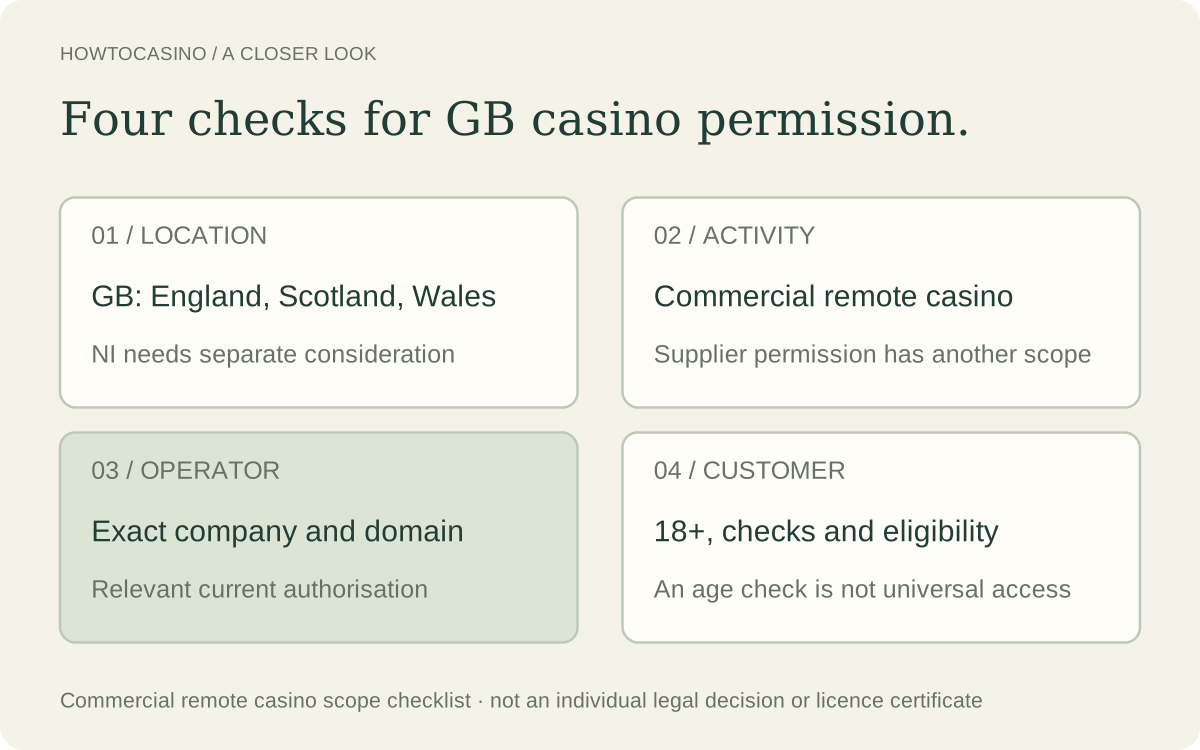
- Identify your actual territory and the exact service being offered.
- Identify the gambling activity, such as remote casino rather than a software supplier’s service.
- Match the customer-facing operator and exact domain to the relevant current permission.
- Check customer eligibility, age and identity requirements, and any applicable account restriction.
- Resolve a mismatch using official information rather than an advert, copied badge or assumptions about another market.
These steps are an orientation, not a substitute for the full register procedure or advice on an individual dispute. If an operator’s identity or permission cannot be established, do not treat uncertainty as permission to send money or documents.
Related questions
Is online roulette legal in Great Britain?
It can be supplied lawfully as part of an appropriately authorised remote casino service. The exact operator, activity, current permission and customer restrictions still matter; the word roulette alone is not enough.
Does a licence from another country replace UKGC permission?
It does not replace the relevant permission for a commercial remote casino service offered to GB consumers. An overseas address or foreign badge is not the GB operating check.
Can someone under 18 use a casino demo?
Covered GB casino operators must verify age before providing their free-to-play versions as well as before deposits and gambling. Calling a mode a demo does not remove that requirement.
Is a UKGC software licence enough for a casino website?
A software or hosting permission has its own scope. Establish the relevant permission of the customer-facing operator providing the gambling service, rather than substituting a supplier’s licence.
Are Northern Ireland and GB covered by identical remote rules?
No. The Commission distinguishes GB remote provision from NI, while also identifying a UKGC licensing requirement for advertising remote gambling to NI consumers. Exact access and local law need their own check.
Does a licence guarantee a win or approve every account action?
No. It concerns the authorised business and activities under applicable conditions. It does not remove losses, replace eligibility checks or authorise cheating or deception.