What does card counting actually use?
Card counting uses information about cards observed leaving a finite shoe to estimate something about the cards remaining. A running count is a compressed summary, not a prediction of the next card or a record of which side won the previous hand. Different methods retain different information.
Knowing that the player won three hands is not the same as knowing the ranks of all cards removed. A session result can conceal many possible inventories. Conversely, even a detailed inventory gives probabilities, not certainty about the next random card.
This guide explains the mechanism and the evidence needed to assess an online format. It does not provide a count-to-stake schedule, evasion technique or income promise. Our basic strategy article deals with a separate question: comparing actions under a specified rule and information model.
How does removing known cards change a probability?
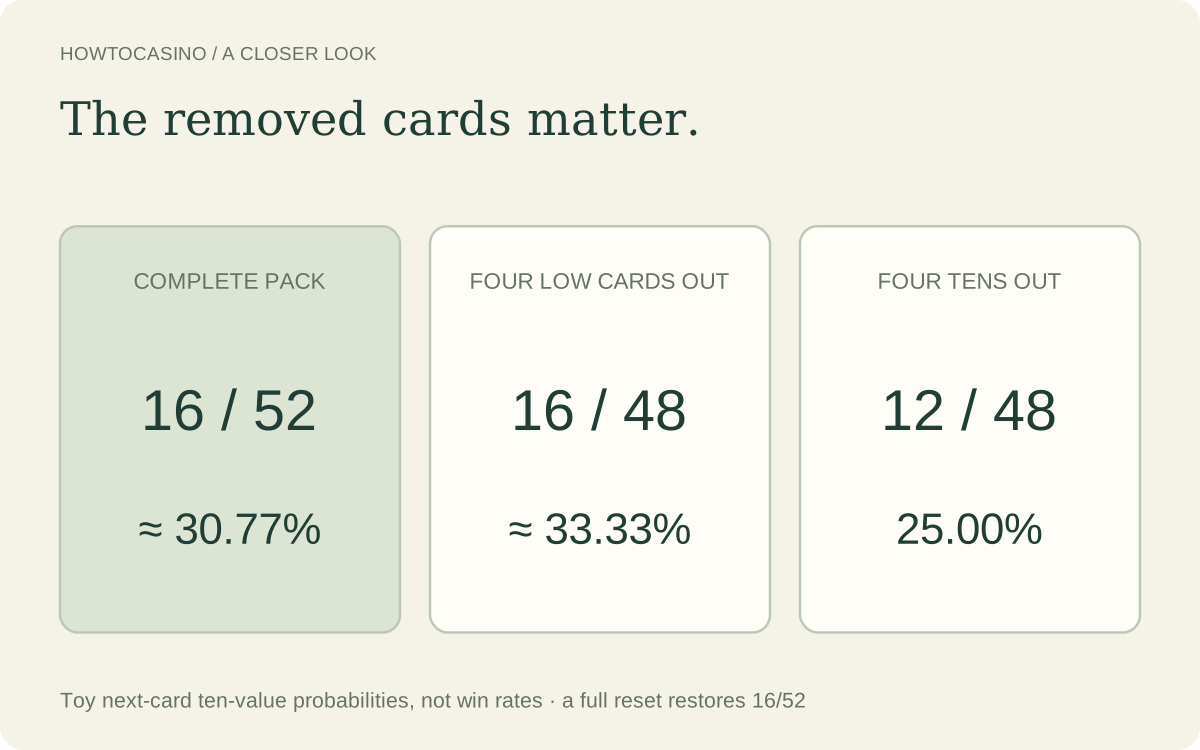
Use an ordinary complete 52-card pack, not an actual online table. It contains 16 ten-value cards: four each of 10, J, Q and K. Assume the next card is uniformly selected from the remaining cards. Compare these three possible inventories.
| Toy pack state | Ten-value cards remaining | Cards remaining | Probability next card has value10 |
|---|---|---|---|
| Complete pack | 16 | 52 | 16/52 ≈30.77% |
| Four known low non-ten cards removed | 16 | 48 | 16/48 ≈33.33% |
| Four known ten-value cards removed | 12 | 48 | 12/48 =25.00% |
The same number of removed cards can leave different probabilities because their identities differ. Shuffling the remaining 48 cards changes their order but does not restore the four missing cards. Reconstituting all 52 and randomising the complete pack restores 16/52 in this toy model.
None of these percentages is the player’s probability of winning blackjack, receiving a natural or making a profit. Those require the relevant cards, decisions, rules and settlement. Actual games use their stated number of decks, not necessarily one pack.
What changes between RNG, live shoes and continuous shuffling?
| Published dealing model | What can carry between hands? | Important qualification |
|---|---|---|
| Complete decks reshuffled before each hand | Previous-hand removals are reset | Current-hand cards still provide information; within-hand dealing need not use replacement |
| Finite shoe continues until a cut card | Observed removals can persist until the reset | Visibility, entry point, unavailable cards and the exact reset procedure matter |
| Batch shuffler prepares the next shoe | The current shoe can still continue until replacement | An automatic shuffler is not necessarily continuous |
| Cards returned through a continuous shuffler | Simple depletion assumptions may no longer match the process | The actual recycling process must be known; a generic live label is insufficient |
RNG describes how randomness is produced; it does not, on its own, tell you whether a finite virtual shoe continues or resets. Likewise, seeing a dealer on camera does not establish how much of the shoe is dealt, when cards are returned or whether every relevant card is visible.
The Commission’s rules standard includes relevant information about deck counts and shuffles in virtual card games. Its live-studio standard concerns fairness and auditability; neither is an endorsement of a counting method or a guarantee that a public video supplies all the necessary information.
What do specific published GB rules say?
PokerStars UK Classic and Premium both state that their decks are shuffled before each hand. Classic describes eight decks and Premium four. That supports a per-hand reset for those published models; it does not establish that every RNG blackjack product uses the same arrangement.
BetMGM UK’s standard Live Blackjack help instead describes a continuing shoe, a cut card and a two-shoe procedure in which another shoe is prepared. That is evidence about the described format, not proof that every table in the lobby matches it or that a particular viewer has a usable advantage.
These primary documents were consulted on 29 October 2026. We have not played the products, measured their shuffle depth, tested a counting system or verified an account’s access. Check the exact in-game rules and any special-table conditions rather than inferring them from an article or product category.
Why does a live continuing shoe not establish a profitable method?
Several questions remain even when a finite shoe continues. Did observation start at a known reset? Were all relevant ranks visible? How many cards can be dealt before the next reset? What are the main-hand payouts, dealer rules and extra-stake conditions? These change the available information or the mathematical result.
A change in one card probability is not automatically a favourable expected return. A complete analysis needs the actual game and the decision method, including the uncertainty created by unseen cards. You cannot substitute a result-history panel for that calculation.
A useful illustration is the natural calculation in our odds guide: it explicitly assumes a complete fresh shoe. Once known cards are removed, that unconditional formula no longer describes every situation. This does not mean an arbitrary betting progression becomes profitable.
A small modelled advantage, if one were established, would still not guarantee session profit or eliminate the chance of losing the available funds. This page does not establish one for a currently accessible GB table.
Is mathematical possibility the same as permission to use a method?
No. Applicable operator terms can restrict conduct, software and assistance independently of whether an analysis is mathematically meaningful. PokerStars’ published terms, for example, contain a restriction on the activity they define as card counting outside peer-to-peer poker. Read the current wording and its service scope rather than assuming the definition is identical everywhere.
We do not give a universal legal classification for mental counting, external aids or every jurisdiction. Nor does a mathematics page authorise an overlay, automated capture tool or account practice. The consequences of a particular disputed action depend on the applicable terms, facts and law.
For a useful format check, identify the exact game, reset procedure, information actually visible, permitted assistance and rule set. If a claim merely says “live means countable” or “RNG means a new deck on every draw”, it has skipped the evidence. The dealer-rules guide explains another variable that a label alone does not settle.
Related questions
Does a reshuffle after each hand make every draw independent?
No. A fresh finite shoe can still deal without replacement within a hand. The previous hand’s depletion is reset; the current hand’s exposed cards can still be relevant.
Can you count a live blackjack shoe?
A continuing shoe can retain composition changes, but usable information, rules and permissions must still be established. Live video alone does not prove a profitable or permitted method.
Is an automatic shuffling machine always a continuous shuffler?
No. A machine can shuffle a separate batch while the current shoe continues. The actual procedure matters, not the word automatic.
Is a list of previous winners enough to count cards?
No. Different card inventories can produce the same sequence of hand results. Winner history is not a complete record of card ranks removed.
Do more ten-value cards guarantee a player win?
No. Their proportion describes a component of the card distribution, not the final player win probability or expected return. The complete game model is needed.
Does this guide establish that counting is allowed on my account?
No. It explains dealing models and information limits. Check the current operator terms and permitted tools; a general mathematical explanation is not account permission.