What does a strategy chart optimise?
Expected value, or EV, weights each possible net result by its probability. A higher EV can mean a larger expected profit or a less negative expected loss. It is not necessarily the action with the highest probability of winning the current hand: the amount paid, pushes and extra stakes also matter.
For an explicitly invented comparison, one action could return a net gain of £1 with probability 60% and lose £1 otherwise. Its EV is £0.20. Another could gain £2 with probability 45% and lose £1 otherwise, giving EV £0.35. The second has fewer winning outcomes but a higher expectation in that hypothetical model. These are not blackjack probabilities.
A basic strategy chart compresses a rule-specific calculation into rows and columns. It does not read the future order of cards. Nor does it turn every conditional hand into a favourable position. A correctly selected action may still leave a negative expectation.
The distinction between an action value and a whole-game return is important. Our blackjack odds guide separates natural frequency, payout prices, RTP and house edge; none is a universal instruction for the hand in front of you.
Which rules must match before a chart is useful?
| Rule or model assumption | Why to check it |
|---|---|
| Number of decks and shuffle method | A fresh shoe, a depleted shoe and an infinite repeated-draw model are different |
| Dealer stands or hits soft 17 | Changes dealer completion and some player decisions |
| Hole-card checking and dealer-blackjack settlement | Can affect whether extra split/double money is lost or returned |
| Permitted doubles and double after split | An unavailable action needs the correct fallback |
| Split limits and split-ace treatment | Pair-hand decisions cannot be assumed from a hard-total row |
| Surrender timing and availability | A surrender instruction only applies when that option and timing exist |
| Natural payout and special dealer totals | A familiar name does not establish conventional settlement |
For example, PokerStars UK Classic describes eight decks, H17 and a no-hole-card procedure; Premium describes four decks and S17. Those named rule sets are not interchangeable. Classic also describes returning unbusted optional split or doubled stakes when a dealer blackjack ends the round. No hole card therefore does not automatically mean all extra stakes are lost.
The Commission’s rules standard includes relevant deck and shuffle information and the strategy assumptions used for skill-influenced theoretical returns. An article that merely says “use the UK chart” has not identified an exact game. These source pages were consulted on 29 October 2026; we have not tested a table or account.
How do you read a blackjack strategy chart?
- Identify the chart’s full rule profile and confirm that the actions are available at the actual table.
- Count the hand correctly. A usable ace makes a soft total; a pair may have its own row instead of the equivalent hard total.
- Find the dealer’s exposed card column. Do not replace it with a guess that the hidden card is always worth ten.
- Read any priority instructions, such as how surrender or pair decisions are handled before the remaining hard/soft rows.
- Read the legend and the fallback. Two charts can use the same letter differently.
- Reclassify the hand after an action. A double may no longer be available after taking a card, and a soft total can become hard.
| Common notation | Typical meaning | Important limit |
|---|---|---|
| H | Hit | Future decisions still follow the applicable model |
| S | Stand | Ends decisions on this hand |
| Dh or equivalent | Double if allowed; otherwise hit | Do not substitute stand for the printed fallback |
| Ds or equivalent | Double if allowed; otherwise stand | Different from a double/hit cell |
| P or equivalent | Split | Check the chart’s pair rules and available extra stake |
| R with a fallback | Surrender if allowed; otherwise the stated action | Timing and legend must match |
These are common conventions, not a universal legend. The chart-reading method is more reliable than memorising a letter without its conditions. Our card-values and splitting guides explain the hand classifications that a compact chart assumes.
How can double/hit and double/stand mean different things?
Use a deliberately limited mathematical example, not a named GB game: an infinite deck model in which each draw independently gives an ace or each rank 2–9 with probability 1/13, and a ten-value card with probability 4/13. The dealer shows 6 and stands on soft 17. Ordinary wins pay 1:1; there is no split or surrender in this comparison.
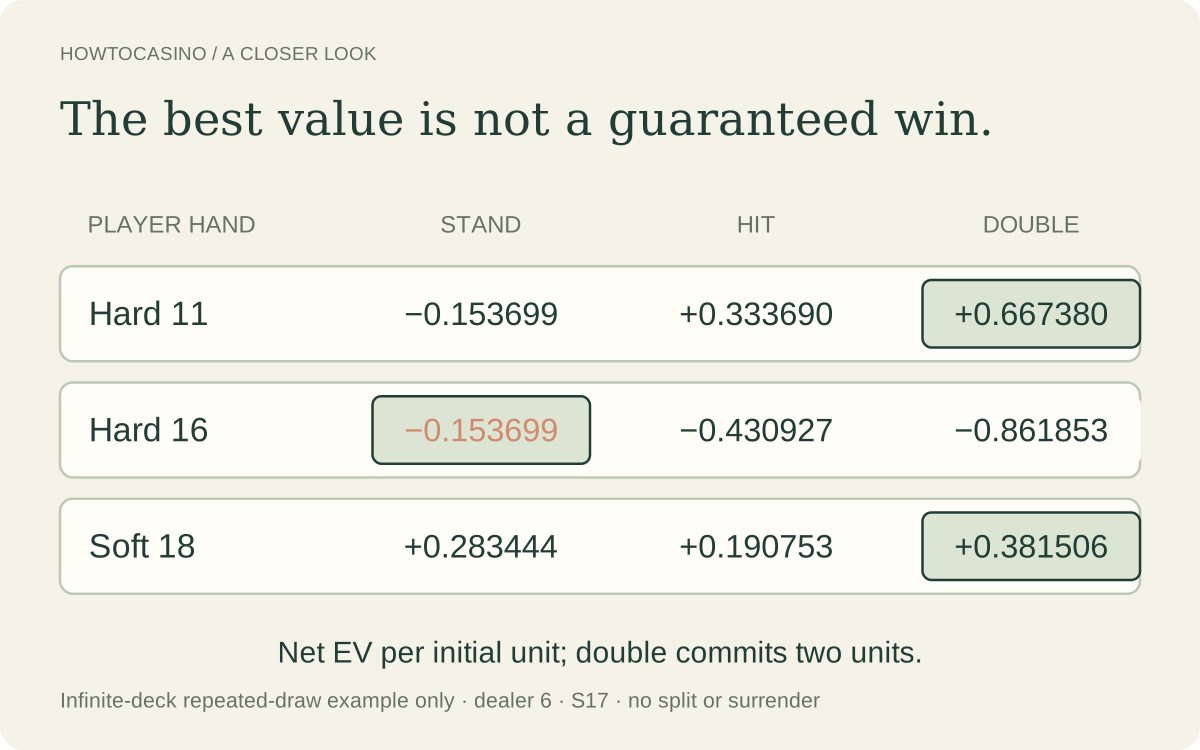
Hit means draw now and then choose the better of hit and stand. Double means add an equal stake, draw exactly one card and stop. Values below are net units per initial unit, so a double puts two units at risk. We independently recalculated the values and checked them against the published mathematical reference.
| Player hand against dealer 6 | Stand EV | Hit EV | Double EV | Highest of these values |
|---|---|---|---|---|
| Hard 11 | −0.153699 | +0.333690 | +0.667380 | Double; if unavailable, hit |
| Hard 16 | −0.153699 | −0.430927 | −0.861853 | Stand; expectation still negative |
| Soft 18 | +0.283444 | +0.190753 | +0.381506 | Double; if unavailable, stand |
The soft 18 row shows why a double instruction cannot always fall back to hit. The hard 16 row shows why “best” can mean losing less in expectation. These three examples are not a complete finite-deck strategy chart, a prediction of your next cards or a reason to add funds to make an unavailable action possible.
A per-hand reshuffle in a real eight-deck game is not the same thing as this infinite-deck model: cards can still be removed within the hand. Keep the model label when quoting the numbers. Changing the dealer rule, payout or permitted actions requires a new comparison.
Is basic strategy the same as card counting or a staking system?
No. A usual total-dependent basic strategy uses the hand category, dealer upcard and specified rules. Composition-dependent analysis can use more detailed card information. Card counting concerns what observed removals imply about the remaining shoe. A betting progression instead changes the stake after results; those are different operations.
A losing sequence is not a new dealer upcard or a rule change. Increasing a wager after a loss does not repair a decision model or reveal the next card. The online card-counting explanation examines when a continuing shoe exists, and why the word online alone does not answer that question.
Do not assume that an external chart, calculator, overlay or automated aid is permitted during play. Operator terms can restrict assistance and conduct independently of the mathematics. The article explains a method; it is not permission to use a particular tool on an account.
Can basic strategy guarantee that you beat blackjack?
No. A rule-specific expected-value comparison does not remove the spread of possible outcomes. A favourable conditional hand can lose; a less favourable hand can win. Neither event by itself proves that the ranking of actions was wrong.
A quoted whole-game house edge also depends on the model and its stake denominator. It should not be inferred from one row above. Our worked double values are per opening unit, not per all money committed. The house-edge comparison explains why those denominators matter across different games.
For a useful reference, retain the chart’s source, rule profile, version, legend and fallbacks together. If those details cannot be reconciled with the game, do not treat the chart as verified for that table. Learn the underlying actions before interpreting a compact grid; the beginner guide covers the order of a round.
Related questions
Does basic strategy mean always copying the dealer?
No. The dealer follows a mandatory drawing procedure; the player can have different actions and payouts. Basic strategy compares permitted player actions under stated rules.
Is the best action always the one most likely to win?
Not necessarily. Expected value accounts for the sizes of wins and losses, pushes and additional stakes. A higher win frequency can have a lower expected result.
Should every double instruction fall back to hit?
No. In the stated analytical example, hard 11 against 6 falls back to hit, but soft 18 against 6 falls back to stand. Read the actual chart’s legend and rule assumptions.
Does H17 tell the player to hit their own soft 17?
No. H17 is the dealer’s drawing rule. A player decision still needs the appropriate hand, upcard and model.
Does this page contain a complete chart for every GB table?
No. It explains chart reading and gives a fully stated three-hand EV example. It does not certify a complete strategy for an unspecified table or variant.
Does a positive action EV guarantee that hand wins?
No. It is a probability-weighted average under the stated model. An individual result can be a loss; it is not a session forecast.