Is the blackjack game RNG or live dealer?
| Format | How cards are presented | Relevant distinction |
|---|---|---|
| RNG blackjack | Software produces virtual cards under the stated game model | The deck, shuffle and outcome-generation rules matter |
| Live dealer blackjack | A studio deal is streamed to the player | Dealing procedures, studio controls and round logs matter |
| A named hybrid or special variant | The game can combine presentation and other features | Read its own description rather than infer the model from its appearance |
RNG means random number generator. Its use does not, by itself, show manipulation. Great Britain's standards require the generation of random outcomes to meet defined fairness and unpredictability conditions, and simulated game behaviour must match its described model.
Do not assume every card draw is independent of the remaining cards. A finite shoe and a virtual deck reshuffled between hands represent different models. The appropriate probabilities depend on what the published rules say is being simulated or dealt, rather than a blanket statement that every game behaves like repeated independent coin tosses.
What testing is required for licensed GB games?
The Gambling Commission says online gambling software and gameplay must be tested in line with its testing strategy before products are made available in Great Britain. Operators must also monitor live performance. Its game-report requirements cover game and RNG test results for the relevant remote licence holders.
Live dealer operations have a separate technical standard requiring fair, independently auditable operation. Its controls include documented dealing procedures, supervision, surveillance and game logs. A camera is therefore one part of the operational picture, rather than a substitute for the rest of the controls.
These are requirements, not a finding about the particular website you visited. This guide has not independently audited an operator's code, certified a table or reviewed your individual round. A generic testing badge or the word licensed is not enough to establish which legal entity, domain or game it refers to.
Why can a game feel unfair without proving manipulation?
A fair game can still have a house advantage and produce a losing session. Fairness concerns whether the game operates according to the relevant rules and requirements; it does not mean that the player and house must make equal money in each session or that a loss must soon be repaid.
A short sequence is incomplete evidence. A clip showing five dealer wins leaves out the complete round history, all stakes, pushes and any side bets. Even a complete history needs the actual rules and a sound statistical method before an unusual pattern can be interpreted. Neither a dramatic clip nor the reply that losses are normal settles an individual technical complaint.
A return figure also needs its assumptions. Blackjack RTP can depend on decisions and the exact rule set. Our RTP explanation separates a theoretical long-run model from a personal refund rate; it should not be read as a promise that your next hand will offset the previous one.
What should you record if a result seems wrong?
| Useful evidence | What it helps establish | What it cannot establish alone |
|---|---|---|
| Game title, variant and rule version | Which settlement conditions apply | Whether the software is correctly implemented |
| Round ID, date, time and complete cards | Which specific event needs investigation | That an unusual result is deliberate manipulation |
| Each stake and returned amount | Whether the reported balance matches the settlement | The fairness of all other rounds |
| Screenshots plus operator game history | A documented discrepancy or sequence | That a display delay changed the underlying outcome |
Before alleging a rigged result, check whether the dispute is about a natural blackjack versus a drawn 21, a push, or a separately settled side bet. An original stake, added split stake and insurance wager can have different outcomes in the same round.
How do you check the operator and raise a dispute?
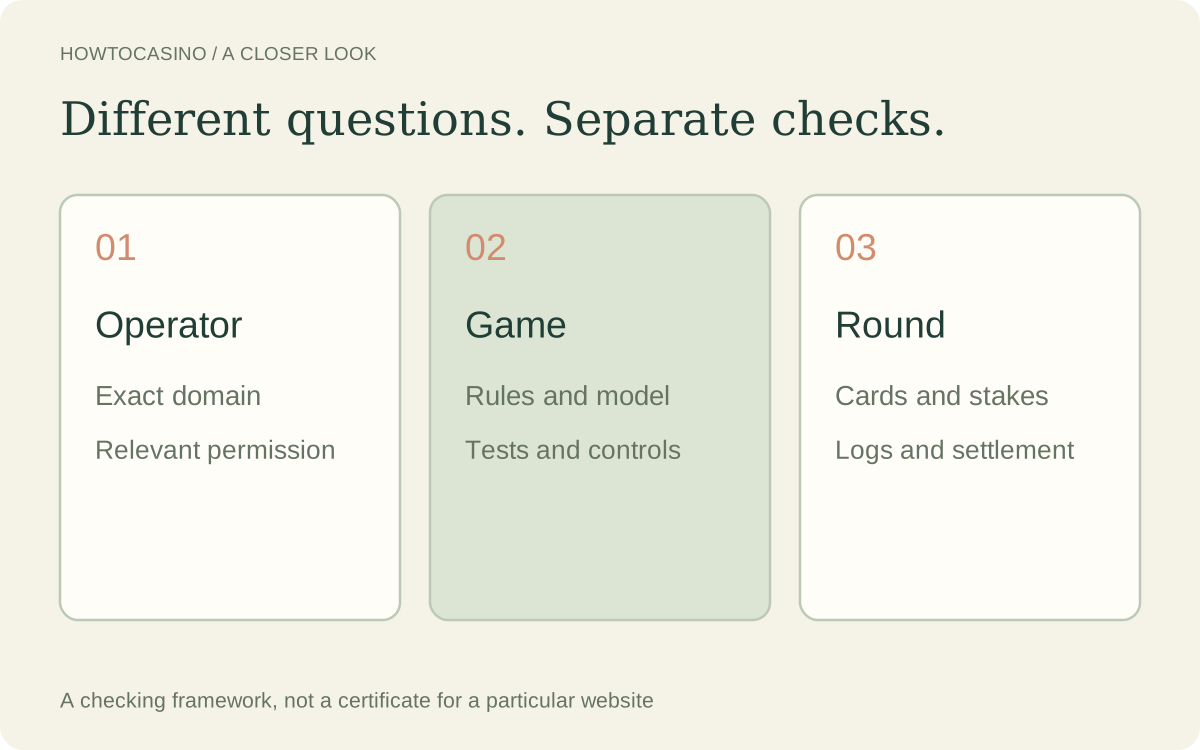
- Check the exact domain, legal operator and relevant permission on the Gambling Commission's register. Do not rely on a similarly named company.
- Save the round evidence and the terms or rules that relate to it.
- Use the gambling business's published complaints process and retain its replies.
- If unresolved, follow the applicable escalation route, including the operator's alternative dispute resolution information where relevant.
Our casino licence-checking guide explains the domain and operator match. The Commission's complaint guidance directs customers to complain to the gambling business first. A generic explainer or a third party's claim of provable fairness cannot replace investigating the particular product and transaction.
Related questions
Does an RNG mean the casino chooses a losing card for me?
No such conclusion follows from the use of an RNG. The relevant questions are the stated game model, the fairness requirements and whether the implementation follows them. The term alone is neither evidence of cheating nor a certification of a particular site.
Is live blackjack automatically safer because I can see the dealer?
A live feed changes the evidence and controls to consider. It does not establish the operator's permissions or eliminate the need for documented dealing and settlement rules, supervision and logs.
Can a losing streak prove a blackjack game is rigged?
A streak by itself cannot establish that conclusion. Keep the complete records and distinguish a settlement error, a rule misunderstanding and a statistical concern. A specific documented discrepancy deserves investigation rather than a promise that all outcomes are fine.